Ballot shortage crisis widens
NEC's systemic mismanagement exposed
Minimum print threshold cut from 60% to 50% by two officials
Inconsistent standards across regions; no guidelines in place
University student councils demand full investigation
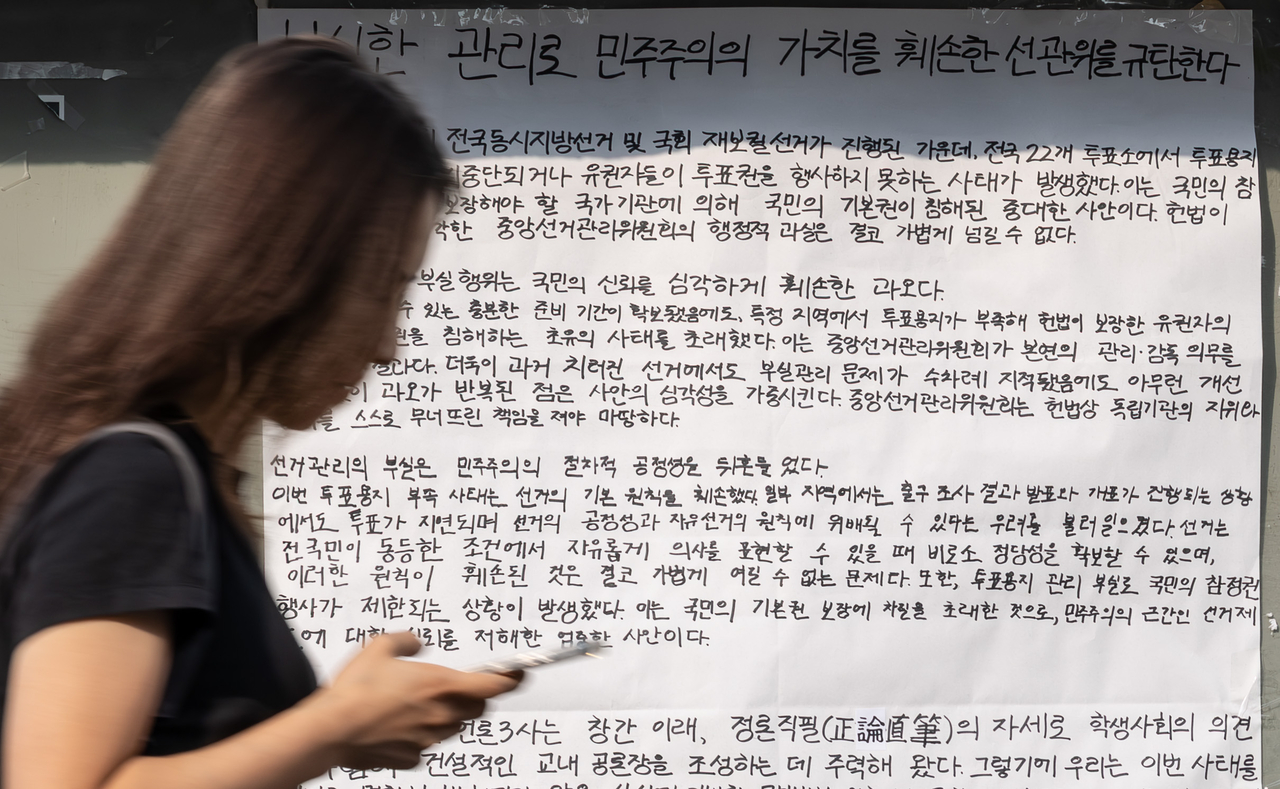
The fallout from the ballot shortage that struck on the day of the June 3 local elections continues to intensify.
Amid mounting evidence of systemic mismanagement by the National Election Commission, university students have begun mobilizing in force. Political circles are calling for a full investigation and institutional reform of the NEC, but the ruling and opposition parties are divided over how to proceed, raising the prospect of the issue devolving into partisan conflict.
According to documents submitted to People Power Party lawmakers Kim Seung-su and Kim Min-jeon by the NEC, the commission lowered the minimum ballot printing threshold — from 60 percent to 50 percent — in its comprehensive management guidelines for the 9th nationwide simultaneous local elections. The change was made on Dec. 10 last year without a formal meeting, approved solely by the secretary-general's executive sign-off. A second revision followed on Dec. 24, when the director of the election policy division used the same sign-off procedure to amend the official election procedures manual to reflect the same change — again without a formal meeting.
Under the revised guidelines, the Songpa-gu election commission printed ballots at the 50 percent rate for 25 of its 27 precincts, excluding Jamsil 3 and 4 dongs. Songpa-gu's actual turnout on election day reached 65.8 percent — above Seoul's average of 63.6 percent — triggering the shortage.
The inconsistency across regions has drawn sharp criticism. While Songpa-gu prepared ballots for only half of eligible voters, the Ongjin-gun election commission in Incheon printed enough for 100 percent, and Gangwon Province prepared ballots covering 66 percent of its electorate.
The NEC defended the decision to lower the threshold to 50 percent, citing a rise in early voting participation, difficulty securing printing facilities within tight timeframes, challenges in inspecting and storing millions of ballots, and concerns about the loss of unused ballots.
But the problems ran deeper than the print ratio. Local election commissions not only failed to prepare sufficient ballots — they also had no guidelines for handling a shortage if one occurred, including no defined procedures or division of responsibilities. The NEC said that with only six to 13 staff members managing voting, mail-in ballot processing and vote counting simultaneously under tight time pressure, reporting of the shortages was delayed and information was slow to reach the relevant authorities.
The NEC says the shortage has now been confirmed at 91 polling stations nationwide. The number of missing ballots has also grown: the initial figure reported was 4,726, but documents the NEC submitted to PPP lawmaker Jung Hee-yong on Tuesday put the total at 7,194.
Against this backdrop, student councils at major universities have jointly issued political declarations condemning the ballot shortage and are coordinating collective action. Student councils from 16 universities across the country have signed on to the declaration.
Hwang In-seo, emergency committee chair of the Yonsei University student council, said the students hoped their voices would contribute to the development of representative democracy in Korea, just as university students had championed voting rights more than 30 years ago.
The Kyung Hee University student council said the students who took to the streets in June 1987 had shown that democracy must be defended through action, not silence, and vowed not to stay silent over a crisis caused by the NEC's incompetence. The Sungkyunkwan University student council said it was joining the nationwide declaration in solidarity with university students across the country, with the goal of advancing a democratic society built on trust.
The National University Student Council Association, an umbrella body representing student councils at more than 100 universities, said in a statement issued June 5 that a constitutional body responsible for administering elections had failed to fully guarantee every citizen's vote — an act it called a grave abdication of duty and a challenge to popular sovereignty. "This amounts to the theft of the suffrage that the people have fought so hard to protect," the group said.
As anger among young people mounted, Prime Minister Kim Min-seok held a meeting with university students on June 7, sitting down with current and former student council representatives to discuss the ballot shortage. The student representatives urged the government to pursue a full investigation in the name of defending democracy, setting aside partisan considerations, given that citizens' right to vote had been undermined.
Meanwhile, protests led primarily by people in their 20s and 30s have continued for six consecutive days at Olympic Park in Songpa-gu, which served as a vote-counting venue, since June 4.
By Yang Dae-geun, Kim A-rin, Jeon Sae-nal and Jung Joo-won
bigroot@heraldcorp.com
arin@heraldcorp.com
newday@heraldcorp.com
jookapooka@heraldcorp.com