APCC and KAIST analyze 47 years of East Asian summer fronts; front axis in late September has shifted 213 kilometers northward compared to the past

The northward shift of summer weather fronts driven by climate change has been identified as one of the key reasons behind the lingering late-summer heat and heavy rainfall that have become increasingly common on the Korean Peninsula.
A joint research team from the APEC Climate Center (APCC) and KAIST published the findings in the international journal npj Climate and Atmospheric Science.
A weather front is the boundary where air masses with different properties meet. When warm, humid air flows in, intense rain clouds develop. The high humidity around a front also impedes the evaporation of sweat, making the heat feel more oppressive.
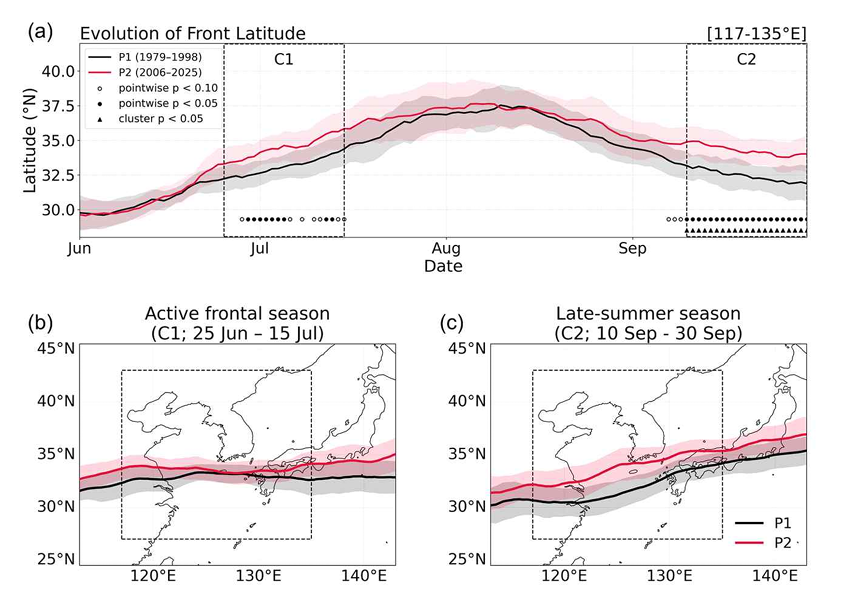
Normally, the summer front that advances toward the Korean Peninsula retreats southward by September. In recent years, however, it has shown a clear tendency to linger farther north well into late summer. Analyzing 47 years of climate data from 1979 to 2025, the researchers found that the monsoon rain-cloud front over the past 20 years (2006–2025) had shifted approximately 1.32 degrees of latitude — about 146 kilometers — northward compared with the earlier period (1979–1998).
The shift was even more pronounced in late September: the front's central axis has moved about 1.92 degrees of latitude — roughly 213 kilometers — northward compared with the past, a far larger change than during the monsoon season itself. That distance is roughly equivalent to the straight-line distance between Seoul and Daegu, meaning the main corridor of rain clouds has migrated significantly northward.
The late-summer heat persisted this year as well. According to the Korea Meteorological Administration's "September 2026 Climate Characteristics" report, the national average temperature in September was 21.7 degrees Celsius, 1.2 degrees above the historical norm. September temperatures have now exceeded the historical average for six consecutive years since the start of the 2020s.
Changes in atmospheric and oceanic conditions driving late-summer front northward
The researchers found that climate-change-driven shifts in atmospheric and oceanic conditions are linked to the northward movement of the late-summer front. Sea surface temperatures have risen across waters stretching from around the Korean Peninsula to east of Japan, water vapor transport has increased, anticyclonic circulation has strengthened, and the upper-level jet stream has weakened — all pointing to broader changes in atmospheric flow patterns.
As a result, the heat burden people actually experience has grown more severe. The team analyzed the wet-bulb globe temperature (WBGT), an index that reflects not only air temperature but also humidity and radiant heat to measure the real-world heat stress on the human body.
The study found that in years when the late-summer front sits farther north, the proportion of days on which both precipitation and WBGT simultaneously exceeded threshold values was up to 19 times higher than in years when it did not.
WBGT quantifies the heat burden on the human body by factoring in temperature, humidity, solar radiation and wind. A high number of days on which both precipitation and WBGT exceed their thresholds signals a greater risk of extreme rainfall and intense heat occurring at the same time. Even at the same air temperature, high humidity prevents sweat from evaporating, causing heat stress to rise sharply.
"This study is significant in that it identifies the cause of the increasingly frequent late-summer heat waves and heavy rainfall in September through the lens of shifting front positions in the atmosphere," said Moon Su-yeon, a researcher at the APCC. "As climate change continues to extend summer-related disasters later into the year, we need an integrated disaster-preparedness strategy that addresses both heat waves and heavy rainfall together."
newday@heraldcorp.com