The challenges left behind by Jensen Huang's high-profile Korea visit
Nvidia's trip risks being a roadshow for its AI infrastructure ambitions
Rhetoric must yield tangible benefits for Korea to matter
AI cloud deals with Naver and SK Telecom cited as key outcomes
AI infrastructure investment projected to reach $3–4 trillion annually by 2030
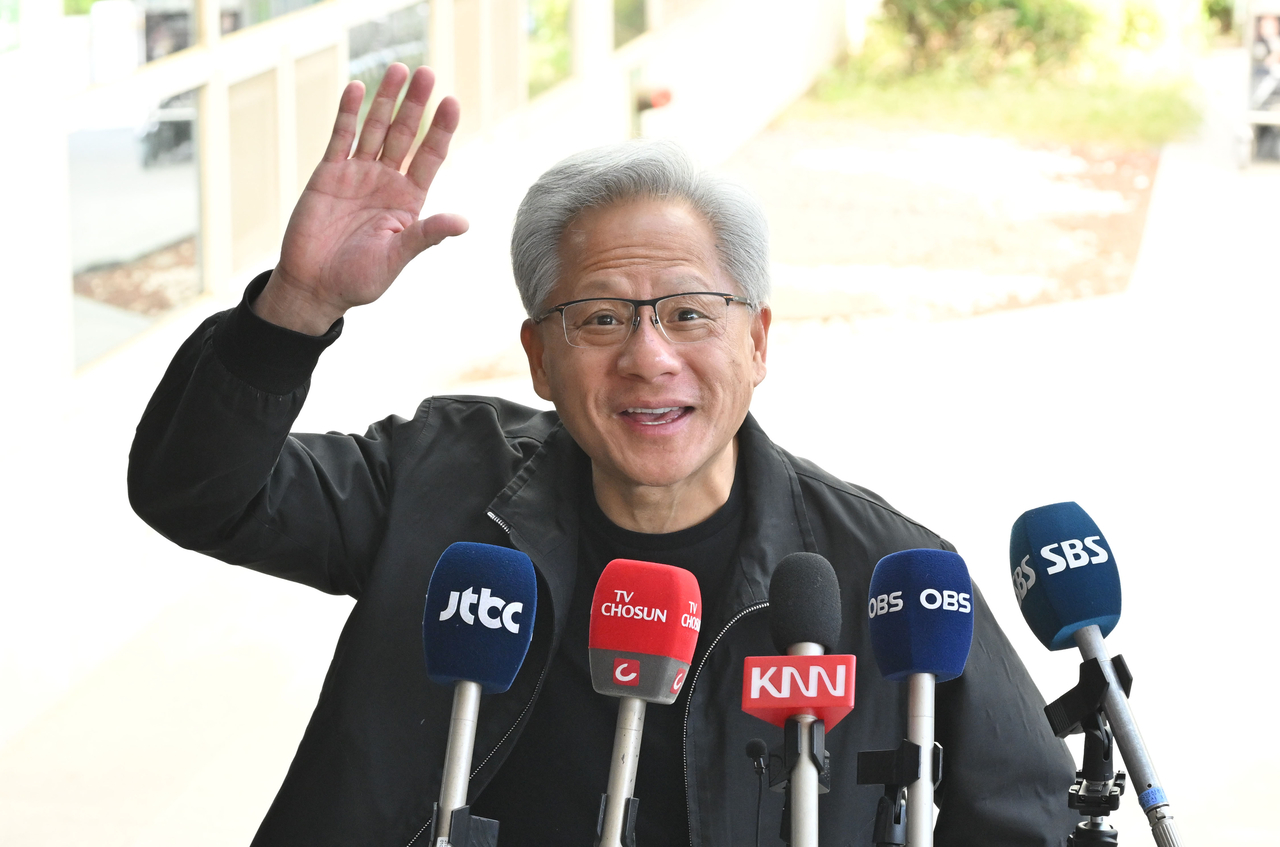
Nvidia CEO Jensen Huang packed his five-day South Korea visit with a string of partnership announcements — signing a long-term memory chip supply deal with SK Hynix, agreeing to build AI factories with Naver and SK Telecom, and holding talks on robotics cooperation with Hyundai Motor Group and LG Group.
From his first day in the country, Huang said he had arrived with work to offer. Right up until his departure, he continued to pitch South Korea as an ideal destination for future AI investment, arguing that the country's "ppalli-ppalli," or fast-paced, culture combined with its receptiveness to AI infrastructure would generate strong business opportunities.
Whether the visit will yield tangible results, however, remains to be seen, analysts say. Huang spoke of bringing a surprise gift to Korea, but the trip also aligned closely with Nvidia's own push to reinvent itself as an AI infrastructure company — raising questions about who stands to benefit more. The AI factory concept, which Huang invoked repeatedly when presenting each partnership, is emblematic of that ambition.
'A deal the world has never seen before'
After the Korea AI Ecosystem Reception held Monday evening at the Shilla Hotel in Jung-gu, Seoul, Huang said Nvidia had secured "the largest business deal in Korean history." He added that he could not elaborate because contracts were in place, but described it as "not an ordinary deal — a deal at a level the world has never seen before."
He went on to say that he expected "hundreds of billions of dollars in revenue to flow into Korea over the next five years," calling it "our gift and our partnership."
Before the reception Monday, Huang kept a relentless schedule of visits to South Korea's largest conglomerates. At 9 a.m. he arrived at SK's Seorin Building in Jung-gu, Seoul, where he announced a technology partnership with SK Hynix for joint memory chip development and agreed with SK Telecom to build a gigawatt-scale AI factory.
He then visited LG Twin Towers in Yeouido, Seoul, where he unveiled a physical AI cooperation plan to jointly develop a reference robot based on Isaac GR00T.
From there, Huang traveled to Hyundai Motor Group's headquarters in Yangjae-dong, Seoul, where he met with Hyundai Motor Group Chairman Euisun Chung to discuss AI investment in North Jeolla Province's Saemangeum development zone, before heading to Naver's 1784 campus in Seongnam, Gyeonggi Province, to reaffirm the AI factory investment Nvidia had announced earlier that morning at a media briefing.
As he left South Korea on Tuesday, Huang singled out two highlights from the visit: the multi-year memory chip partnership with SK Hynix, and the AI cloud partnerships concluded with Naver and SK Telecom.
AI infrastructure build-out expands from big tech to all industries
The long-term supply agreement — covering more than two years — with SK Hynix matters for Nvidia's supply chain management, while the AI factory announcements with Naver and SK Telecom are significant for Nvidia's future growth.
Some observers view Huang's visit as a roadshow to promote that new growth strategy. Just before arriving in Korea, Huang delivered a keynote at GTC Taipei 2026 in Taiwan, laying out a blueprint for building an integrated ecosystem with partners in AI factories and open-source AI models. The Korea visit effectively secured Naver and SK Telecom as key partners in that vision.
Nvidia's AI factory — its data center solution — is a new operating model designed to meet surging computing demand. Built on the Nvidia DSX platform, it delivers a full stack covering design, simulation, infrastructure software, chips and operations.
Nvidia is looking beyond GPU supply to establish itself as an AI infrastructure company, and it sees substantial growth potential in that market. Where only hyperscalers such as big tech firms once invested in AI infrastructure, every company will now need to build it.
At an earnings conference call last month for the first quarter of fiscal year 2027, Nvidia Chief Financial Officer Colette Kress predicted that "as agentic AI spreads across all businesses, AI infrastructure investment will reach $3 trillion to $4 trillion annually by 2030."
The AI factory plans announced by Naver and SK Telecom fit squarely within that outlook. Both companies expect to commercialize their AI factory operations as early as next year. Naver plans to initially secure 200 megawatts of capacity in the Asia region through a lease arrangement, scaling up to 1 gigawatt of infrastructure by 2030.
Given that Huang estimated building a 1-gigawatt data center would require $60 billion (about 90 trillion won), the question of future financing has already come up. Naver plans to contribute more than $1 billion upfront, with a strategic investor committing an equal amount.
SK Telecom is also targeting the launch of its first AI factory next year, with plans to build a 5-gigawatt AI factory in partnership with Nvidia.
Deputy PM Bae to Huang: 'Don't just put on a show — invest'
The software cooperation deals are also designed to further entrench Nvidia's platform dominance.
LG Group's adoption of Isaac GR00T — the world's first open humanoid robot foundation model, which Nvidia unveiled last year — will be paired with the autonomous driving platform Drive Hyperion to advance LG's mobility AI systems.
During his visit to Hyundai Motor, Huang examined Boston Dynamics' robot dog Spot and the autonomous mobility platform MoBeD, expressing interest in collaboration on autonomous driving and robotics. Nvidia supports autonomous driving technology through its open model AlphaMAYO.
Beyond these announced projects, however, no more concrete investment plans have emerged. Huang responded warmly to Chairman Euisun Chung's proposal for Saemangeum investment, even calling the zone an "AI Valley," but nothing tangible has materialized yet.
The government also pressed Huang directly to ensure the visit's outcomes take concrete shape. Deputy Prime Minister and Minister of Science and ICT Bae Kyung-hoon said at the Korea AI Ecosystem Reception on Monday that he had told Huang: "Don't just put on a show in Korea — invest too."
Bae said the government had agreed to support AI ecosystem investment and added that, because South Korea could become the largest buyer of GPUs, "Nvidia has agreed to invest alongside the Korean government in our AI ecosystem."
jeongwan@heraldcorp.com