Agency chief says talks with Incheon city government on public office space have been ongoing since late last year; overseas voting expansion to be taken up once National Assembly committee is formed; dedicated consuls already deployed to Los Angeles and Beijing, with Tokyo next
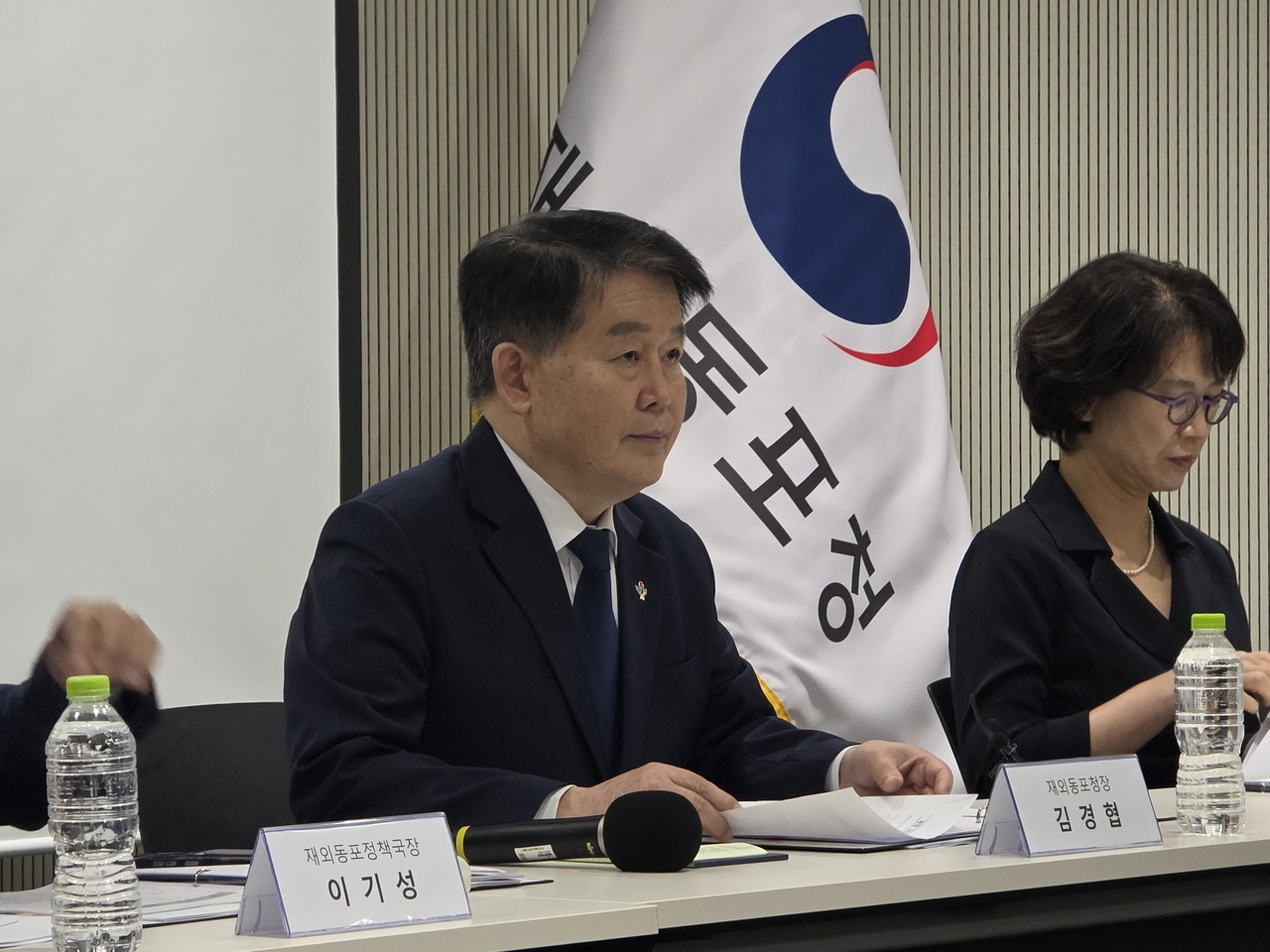
Overseas Koreans Agency Commissioner Kim Gyeong-hyeop said Friday he intends to discuss the agency's long-sought headquarters relocation with Park Chan-dae, the newly elected mayor of Incheon.
Kim made the remarks at a press conference held Friday at the Diplomacy Town complex in Seocho-gu, Seoul, to mark the agency's third anniversary. He said the agency has been in talks with the Incheon city government since late last year to have a public office building designated for its use.
The Overseas Koreans Agency is currently housed in a leased space inside a private building in Yeonsu-gu, Incheon. Given the agency's security requirements, officials say securing a dedicated government facility has become urgent. Although media reports had suggested a possible move to Gwanghwamun in Seoul, the agency plans to remain in Incheon once a new headquarters is secured.
"We met with then-Incheon Mayor Yoo Jeong-bok in April and formally requested a building, and he told us he would cooperate fully," Kim said. "The Democratic Party's Incheon chapter also told us it would resolve the headquarters issue as quickly as possible after the local elections."
With a new mayor now elected following the local elections, Kim said the agency plans to raise the issue as soon as a mayoral transition committee is formed. "We need to actively push the matter at the transition committee stage to secure a public building," he said.
On the question of overseas voting rights — one of the agency's top priorities — Kim said discussions would move in earnest to the National Assembly's Public Administration and Security Committee once the second-half leadership of the 22nd National Assembly is organized.
"In South Korea, one polling station is set up for every 6,000 people, but for overseas Koreans it is one for every 30,000," Kim said. "We clearly need to expand polling stations, introduce mail-in voting where postal infrastructure is reliable, and allow electronic voting where it is not — so that overseas Koreans have a genuine opportunity to participate."
He acknowledged that progress has been slow. "The National Assembly's Special Committee on Political Reform took it up as its first agenda item, but the discussions went nowhere," he said. "Some lawmakers support mail-in voting but oppose electronic voting; others take the opposite view. Opinions are all over the place and it has been hard to reach any consensus."
Kim said the issue would likely move to the Public Administration and Security Committee — the standing committee with jurisdiction — once the second-half Assembly leadership is in place. "Once that committee is formed, we can have a full-scale discussion building on what the special committee debated," he said. He added that overseas voting generates the most constituent complaints and is the project the agency is most committed to advancing.
The agency also plans to expand the number of consuls dedicated to overseas Korean communities. Kim said dedicated consuls have been deployed to Los Angeles and Beijing since March, and that a deployment to Tokyo has been decided. "We are working to expand the posting of dedicated consuls, focusing on areas with large concentrations of overseas Koreans," he said.
Kim said he accompanies President Lee Jae Myung on overseas trips whenever the president holds roundtables with Korean diaspora communities. "There are sessions the president chairs, and not all overseas Koreans can attend those," Kim said. "For those who cannot, I hold separate meetings with them." He added that the agency has instructed overseas diplomatic missions to collect constituent complaints in bulk, and that those complaints are being processed centrally.
moone@heraldcorp.com