During his tenure, the court struck down bans on private tutoring and same-surname marriages
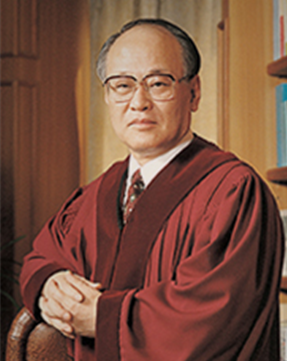
Former Constitutional Court Chief Justice Kim Yong-jun died Friday at 7:05 p.m. He was 87.
Kim served as the court's second chief justice beginning in 1994, leading the institution for six years and earning recognition for his role in dismantling a range of restrictions on citizens' fundamental rights.
During his tenure, the court struck down bans on private tutoring and marriages between people sharing the same surname and clan origin, as well as provisions that gave military veterans bonus points in civil service exams, capped residential land ownership and barred local government heads from running for office.
On the special law related to the May 18 pro-democracy uprising, Kim issued a limited unconstitutionality opinion, arguing that retroactively applying the law to crimes for which the statute of limitations had already expired was unconstitutional.
Born in Seoul in 1938, Kim contracted polio as a child, leaving him with a physical disability in his legs. He passed the high school equivalency exam while in his second year at Seoul High School and went on to study law at Seoul National University. In 1957, during his third year of university, he placed first in the ninth judicial examination of the higher civil service exam. He was commissioned as a judge in 1960 — the youngest at the time — and went on to serve as a senior judge at Seoul High Court and as chief judge of the Seoul Family Court before being appointed to the Supreme Court in 1988.
During his time on the Supreme Court, Kim took part in a landmark ruling that opened the door to the domestic sale of bottled water. In 1994, the court found that a Health and Social Affairs Ministry measure prohibiting the domestic sale of bottled water infringed on citizens' right to pursue happiness — including the freedom to choose their drinking water — as well as manufacturers' freedom to conduct business.
That same year, Kim was appointed the second chief justice of the Constitutional Court, a post he held until 2000. During that period, the court struck down a system granting bonus points to military veterans in civil service hiring exams, as well as a legal provision that broadly prohibited private tutoring.
After leaving the court, Kim practiced law. He later chaired the presidential transition committee for President-elect Park Geun-hye and was nominated in 2013 as the first prime minister candidate of the incoming administration. He withdrew five days after his nomination amid allegations surrounding his two sons' military service and real estate speculation.
Kim is survived by his wife Seo Chae-won, sons Hyeon-jung and Beom-jung, daughter Ji-hee, and son-in-law Choi Yeong-ik. A private family funeral was held, and he was interred at Seoul National Cemetery.
yg@heraldcorp.com