After six rejections, district becomes first in nation to grant conditional remodeling association approval for mixed housing complex
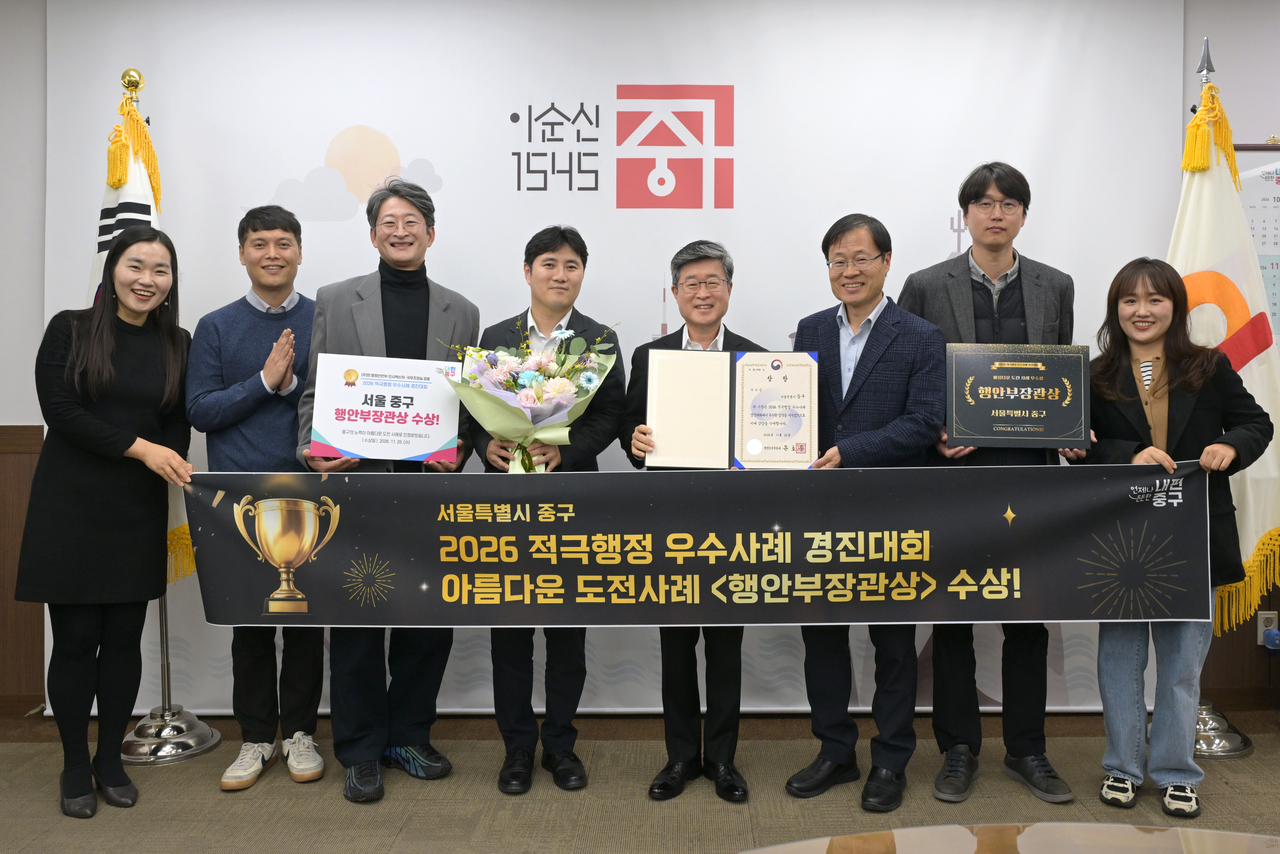
Seoul's Jung-gu has been recognized as a model of proactive governance after becoming the first district in the country to resolve a legal impasse blocking the remodeling of Namsan Town apartments through a conditional approval mechanism.
Jung-gu said its Namsan Town remodeling project won an excellence award in the "Beautiful Challenge" category at the 2026 Proactive Governance Best Practices Competition, jointly organized by the Ministry of Interior and Safety, the Ministry of Personnel Management and the Office for Government Policy Coordination.
Designated as a Seoul-type remodeling pilot complex in 2018, Namsan Town ran into legal obstacles during the association formation process because of its status as a mixed complex containing both pre-sale and rental housing units. After rejecting the association formation application six times, Jung-gu worked with the Seoul Metropolitan Government to devise what became the nation's first conditional association formation approval.
Namsan Town is a large complex of 5,150 units built in 2002 in the Sindang-dong 844 area. It comprises 3,116 pre-sale units, 2,034 rental units and ancillary commercial and welfare facilities.
Reconstruction has long been considered difficult given the complex's floor-area ratio of 231 percent, its sloped hillside terrain and restrictions under the priority landscape management zone designation. Remodeling has in effect been the only viable option for improving the aging residential environment.
The project began as a publicly led initiative. In 2018, the Seoul Metropolitan Government designated Namsan Town as a Seoul-type remodeling pilot complex, and Jung-gu, at the city's request, drew up a basic remodeling design for the pre-sale blocks — excluding the rental blocks — and presented it to residents.
Trusting the public plan, residents spent more than five years and hundreds of millions of won gathering consent forms and holding general meetings to advance the project. In November 2023, they secured the agreement of 67 percent of pre-sale unit owners and filed for approval to establish a remodeling housing association.
Under the current Housing Act, however, all land covered by a single project plan approval is defined as a single housing complex, leaving no legal basis for forming an association limited to the pre-sale blocks alone. Without the consent of the Seoul Metropolitan Government — the owner of the rental units — meeting the requirements for association formation was effectively impossible.
Jung-gu moved proactively to find an alternative that would uphold legal principles while honoring residents' determination to proceed and their trust in the public project. The district twice requested official legal interpretations from the Ministry of Land, Infrastructure and Transport and the Seoul Metropolitan Government, consulted its own legal adviser and outside legal experts, and underwent the city's proactive governance pre-consultation process to examine available options.
The district also invested heavily in communicating with residents. It produced and distributed easy-to-read information cards explaining the legal reasons the applications had to be rejected, and held meetings with District Mayor Kim Gil-sung to work through potential solutions together with residents.
After a year of consultations, Jung-gu and the Seoul Metropolitan Government arrived at a conditional association formation approval scheme under which the relevant parcels would be subdivided before project implementation approval. The arrangement opened a path to remodeling the pre-sale blocks while protecting the property rights of the Seoul Metropolitan Government as owner of the rental units.
In April, Jung-gu became the first district in the country to grant conditional approval for the formation of a remodeling association in a mixed housing complex. The case was recognized as an example of proactive governance — one that went beyond citing legal constraints to block a project and instead produced a workable solution through inter-agency consultation, legal review and resident communication.
Going forward, Jung-gu plans to actively support the remaining licensing and permitting steps, and intends to recommend to the Ministry of Land, Infrastructure and Transport, the Seoul Metropolitan Government and other relevant agencies that a special provision on parcel subdivision be added to the Housing Act to prevent similar problems from recurring in other mixed housing complexes.
"It was deeply frustrating to see the Namsan Town remodeling — which residents had pursued for so long in good faith — blocked by legal limitations," Jung-gu District Mayor Kim Gil-sung said. "Now that we have found a solution together with the Seoul Metropolitan Government, we will actively support the follow-up procedures so that residents' long efforts can bear fruit, and we will carefully attend to the fundamental institutional improvements needed."
seouldream01@heraldcorp.com