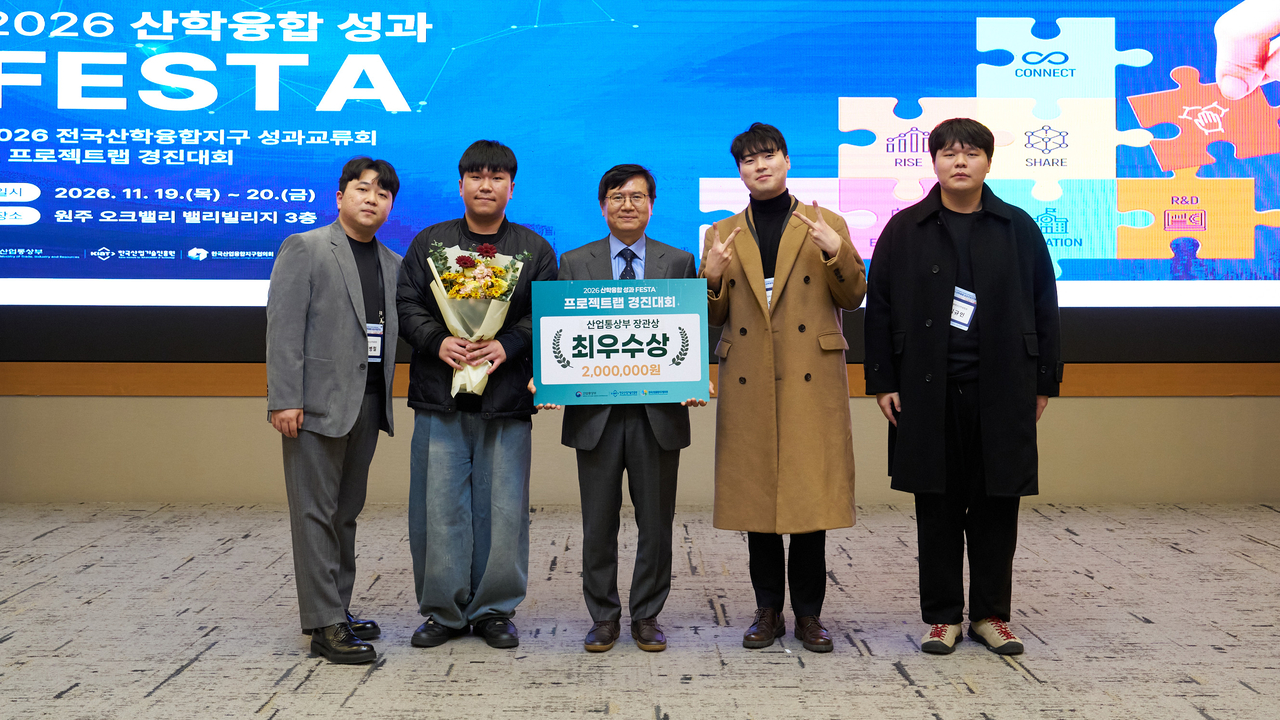
A student team from the Department of Semiconductor and Electronic Engineering at Daegu Catholic University has won the Ministry of Trade, Industry and Resources minister's award for a used-battery energy recovery technology co-developed with a local company.
According to Daegu Catholic University on Saturday, the team took the top prize at the 2026 National Industry-Academia Convergence District Performance Exchange and Project Lab Competition, held Nov. 19 at Oak Valley in Wonju, Gangwon Province.
Students Choi Jun-hyeok, Kim Gyu-in, Hwang Byeong-cheol and Lee Jong-hun, representing the North Gyeongsang Province Gyeongsan Industry-Academia Convergence District, presented a "four-phase bidirectional DC-DC converter system for high-efficiency inter-battery energy transfer" co-developed with Solaraite Co. under the supervision of Professor Kim Bong-hwan.
The research team developed a power conversion system that recovers residual energy otherwise wasted when used batteries are discharged and stores it in other batteries.
The system recovered approximately 2.7 kWh of energy per battery pack and incorporated a safe-discharge water tank, an air-cooling unit and a real-time monitoring system.
The achievement was particularly notable because the students took part in every stage of development — from circuit design and prototype fabrication to performance verification — and pursued a technology transfer to the partner company, demonstrating tangible results from industry-academia collaboration.
"We resolved a real-world problem faced by a company using the university's research capabilities, strengthening students' practical skills and driving corporate technological innovation at the same time," Professor Kim said. "We will expand this industry-academia collaboration model into technology transfer, commercialization and follow-on research and development."
kbj7653@heraldcorp.com