
Official youth unemployment rate stands at 5.2% — extended rate nearly three times higher
Extended youth jobless rate rises for third straight month on-year even as overall figure falls
Employment falls by 110,000 when health and social welfare sector is excluded
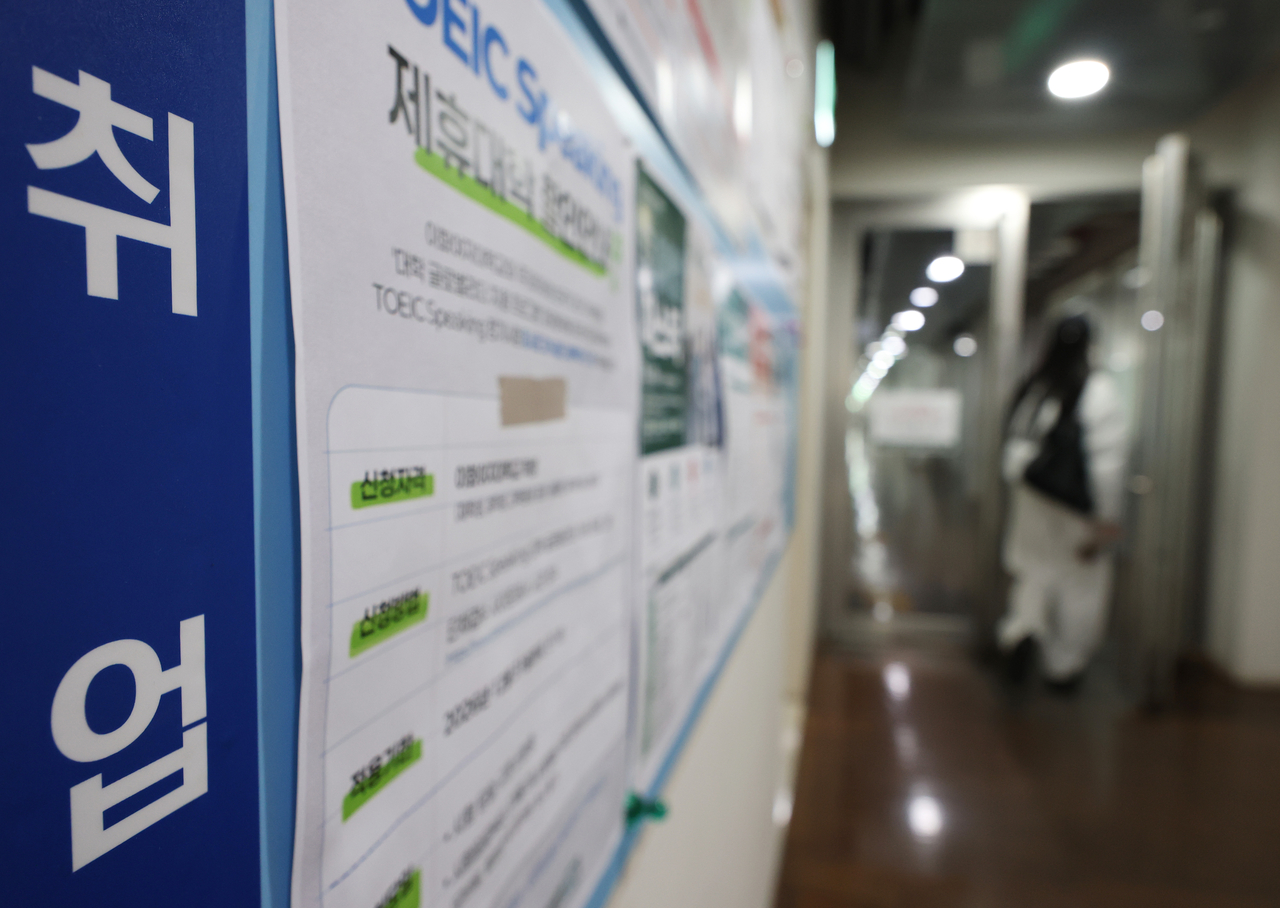
Employment rose and unemployment fell — that was South Korea's jobs scorecard for last month. Yet if you asked young people preparing to enter the workforce whether the job market had actually improved, few would say yes. Is there a gap between the statistics and reality?
A look at the extended unemployment rate — which captures workers not counted in the official figure — offers a clue. Last month, the extended unemployment rate for young people was nearly three times the official youth unemployment rate. Even the total number of employed workers shrank once the gains in one particular sector are stripped out. Understanding the true state of the labor market requires looking not just at the numbers, but at how those numbers are constructed.
Official youth unemployment at 5.2% — so why does the felt rate reach 15.1%?
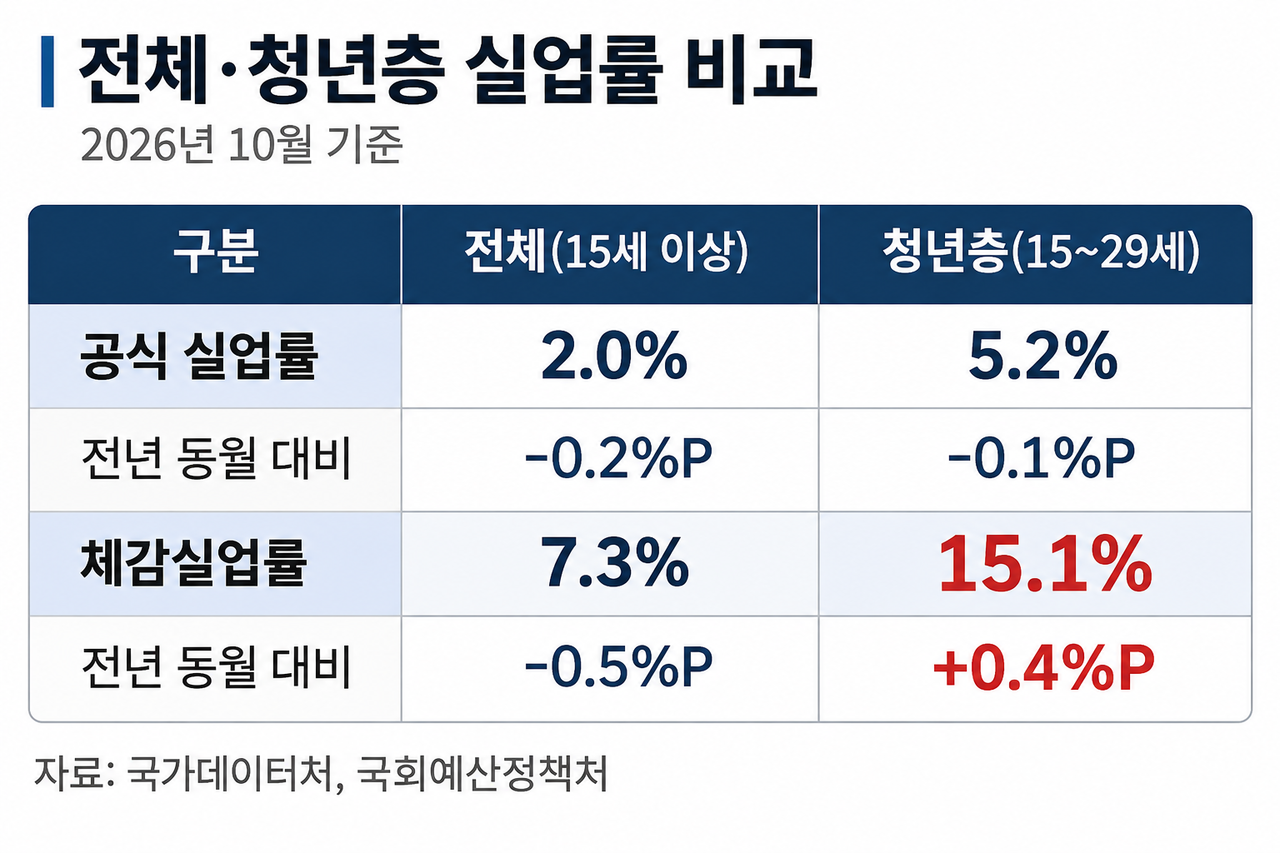
South Korea's overall unemployment rate stood at 2.0 percent in October, down 0.2 percentage points from a year earlier, according to the National Assembly Budget Office's November issue of its NABO Population and Employment Trends report, released Saturday. The unemployment rate for young people aged 15 to 29 also edged down 0.1 percentage points year-on-year to 5.2 percent.
Judged by the official unemployment rate alone, the youth job market appeared to improve from last year. The picture changes, however, when looking at the extended unemployment rate — commonly called the "felt unemployment rate" and officially designated as supplementary labor indicator No. 3.
The overall extended unemployment rate fell 0.5 percentage points year-on-year to 7.3 percent last month. The youth extended unemployment rate rose 0.4 percentage points to 15.1 percent and has now climbed for three consecutive months compared with the same period a year earlier, since August.
Why the divergence? The official unemployment rate does not classify everyone without a job as unemployed.
A young person who has actively sought work over the past four weeks — submitting job applications, for instance — and is immediately available to start work is counted as unemployed. Someone who wants a job and is able to work, yet has not actively searched, is excluded from the official count.
Part-time workers putting in fewer than 36 hours a week who want more hours are also included in the extended unemployment rate calculation if they meet certain conditions — but they are classified as employed under the official measure.
The extended unemployment rate incorporates not only officially unemployed people but also those available for additional hours and the latent economically active population. It is a broader gauge of unmet labor demand than the official rate.
The total number of unemployed people last month was 602,000, down 56,000 from a year earlier. The economically inactive population, however, grew by 179,000 to about 16.3 million. Both the labor force participation rate and the employment rate slipped, by 0.2 percentage points and 0.1 percentage points respectively.
A falling unemployment rate does not necessarily mean it has become easier to find work.
Total employment up 140,000 — but down 110,000 when health and welfare are excluded
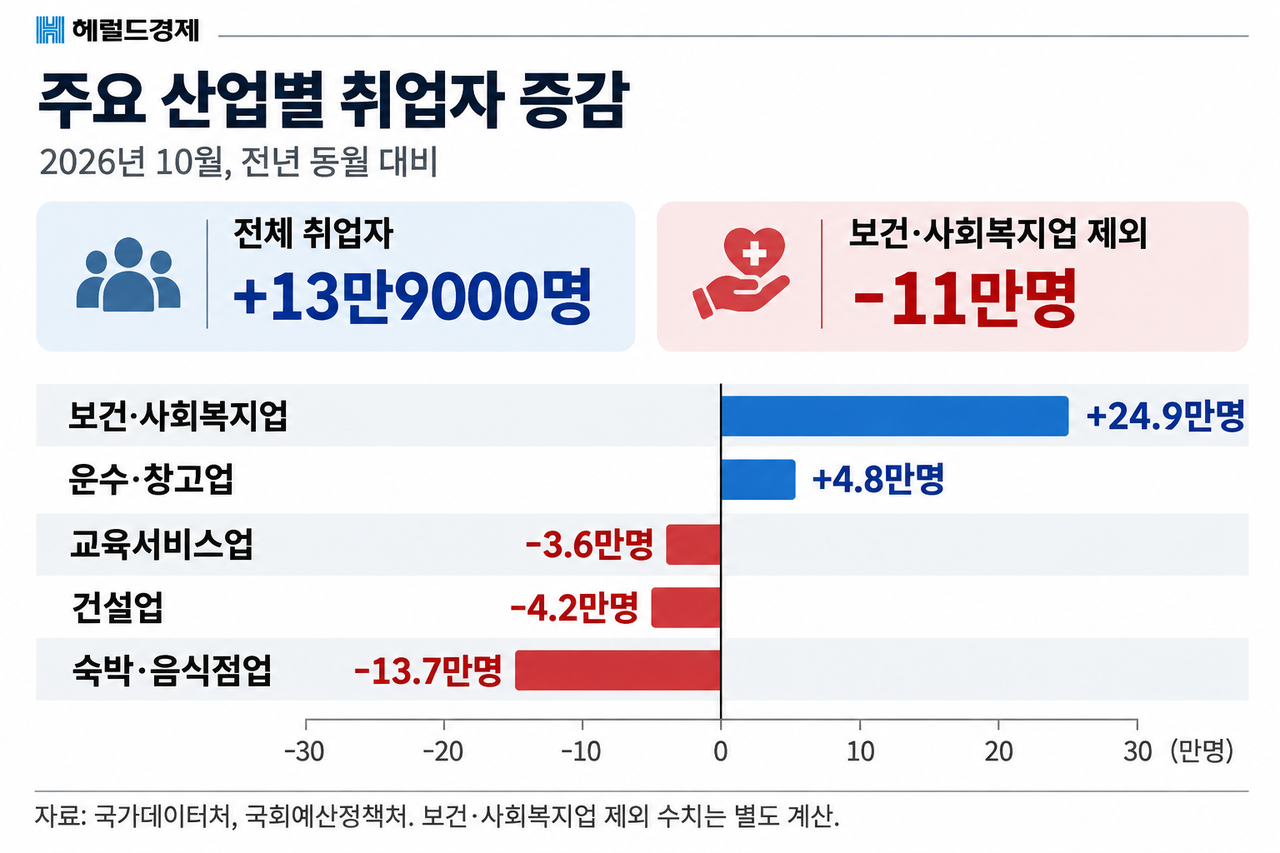
The headline employment gain also warrants a closer look. Total employment last month reached about 29.18 million, up 139,000 from a year earlier — sustaining the 100,000-plus monthly gains seen in August (184,000) and September (113,000).
Broken down by industry, the health and social welfare services sector alone added 249,000 jobs — 110,000 more than the overall net gain. Strip out that sector and employment across the rest of the economy actually fell by 110,000.
Transportation and warehousing added 48,000 jobs, but accommodation and food services shed 137,000 and construction lost 42,000. Employment in education services also fell by 36,000.
There is no reason to view job growth in health and social welfare negatively in itself. As South Korea ages rapidly, demand for medical and care services will only grow.
When gains in one sector mask weakness across the rest of the economy, however, it is difficult to conclude from the overall employment figure alone that the job market has broadly improved.
The gap is also stark by age group. The overall employment rate last month was 63.3 percent, down just 0.1 percentage points from a year earlier — but the employment rate for men and women in their 20s fell by 1.7 percentage points and 1.6 percentage points, respectively.
The employment difficulties facing young people risk being obscured by the aggregate figures.
46 job openings per 100 job seekers — which statistics should we be watching?
Another indicator of labor market supply and demand is the job-offer ratio — the number of new job openings divided by the number of new job seekers, showing how many positions are available per applicant.
The WorkNet job-offer ratio last month was 0.46, meaning there were 46 openings for every 100 job seekers.
There are some encouraging signs. The WorkNet ratio had fallen year-on-year for 35 consecutive months from February 2023 through December last year, but has risen for eight consecutive months since March this year. The figure covers only users of the WorkNet platform, however, and should not be read as a direct reflection of overall labor market conditions.
None of the indicators — unemployment rate, employment rate, extended unemployment rate or job-offer ratio — is wrong. Each simply measures a different thing in a different way.
The problem arises when only the most favorable number is used to assess the entire job market. Evaluating the effectiveness of youth employment policy requires looking beyond how many total jobs were added — it means asking whether young people are actually finding work, whether they are getting the hours they want, and whether some have simply given up looking.
A 2.0 percent unemployment rate and a 15.1 percent youth felt unemployment rate. Both figures describe the same country's labor market in the same month. Neither number alone tells the full story of where South Korea's job market stands today.
"Na Yu-jeong" is a regular column that explains useful policy information in plain language. It examines the background behind policy proposals, the significance of changes, and guidance on who can use them, when and how.
fact0514@heraldcorp.com




