
City holds public forum and rally to share Mahan historical and cultural value and the direction of the initiative
Three community support group representatives appointed to strengthen civic participation and public-private cooperation
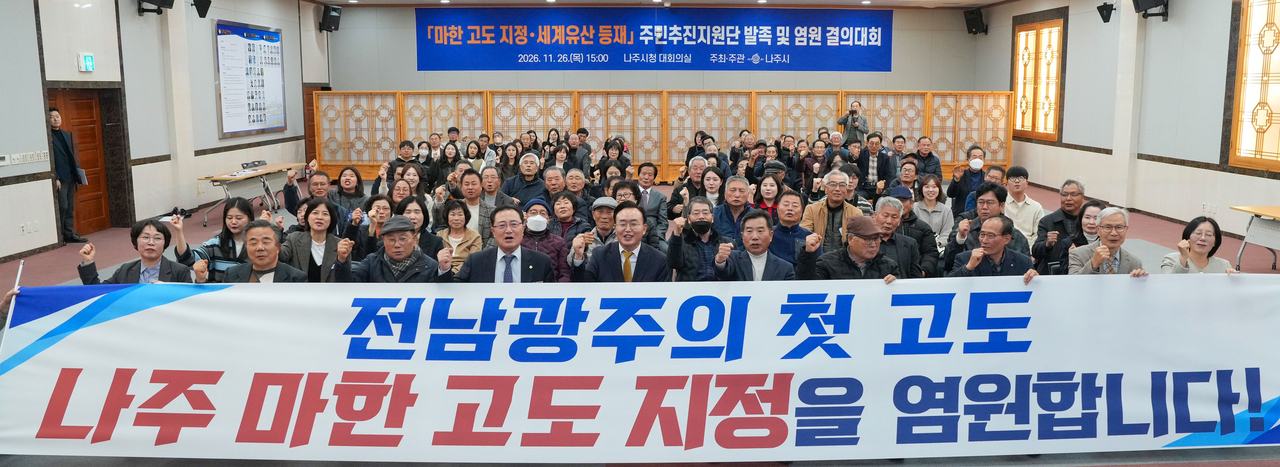
Naju, a city in South Jeolla Province, has launched a drive to spotlight the value of Mahan historical and cultural heritage along the Yeongsan River basin and to strengthen civic participation and public-private cooperation for its systematic preservation and use.
Naju held a public forum and rally titled "Mahan Ancient Capital Designation and World Heritage Inscription" on Thursday at the city hall's main conference room, with residents and members of a newly formed community support group in attendance.
The event was organized to share the progress of the application for Mahan ancient capital designation and the significance of a potential UNESCO World Heritage listing, while broadening public understanding of the need to preserve and utilize Naju's Mahan heritage.
At the forum, Lee Jeong-ho, a professor at Dongshin University, opened with a presentation on the historical and cultural value of Naju's Mahan ancient capital, explaining the significance and importance of the Mahan historical heritage.
Gwak Myeong-suk, director of the National Heritage Research Institute at the Jeonnam Cultural Foundation, then introduced the value and significance of UNESCO World Heritage inscription, deepening attendees' understanding of how the Mahan heritage could be preserved and utilized.
On Gonggan Research Institute, which is conducting a feasibility study for the Mahan ancient capital designation application, also presented the details of the application and the direction of the initiative, sharing with attendees the case for designation and the tasks ahead.
Participants reviewed the value of Naju's Mahan historical and cultural heritage through expert presentations and progress reports, exchanging a range of views on systematic preservation, utilization, ancient capital designation and the pursuit of UNESCO listing.
A highlight of the event was the presentation of appointment certificates to three representatives of the community support group, who will serve as the civic backbone of the designation and inscription drive, reinforcing the spirit of public-private cooperation.
All attendees then joined in a collective pledge, affirming their commitment to protecting the value of Mahan historical and cultural heritage and uniting efforts toward ancient capital designation and UNESCO inscription.
Naju said it plans to use the forum and rally as a springboard to deepen public interest in and understanding of the Mahan heritage along the Yeongsan River basin, further cementing the city's identity as an ancient historical and cultural hub.
The city also said it will continue to advance follow-up procedures for the ancient capital designation application, lay the groundwork for UNESCO inscription, expand civic participation, and strengthen cooperation with relevant agencies and the broader community.
"Mahan is a precious cultural heritage that reflects the history and identity of Naju, the heart of Yeongsan River culture, and an asset that must be passed on intact to future generations," Naju Mayor Yun Byeong-tae said. "I ask the city's 120,000 residents for their continued interest and participation so that the Mahan ancient capital designation and UNESCO World Heritage inscription can be successfully pursued."
kkm9971@heraldcorp.com




