
Korea Institute of Civil Engineering and Building Technology diagnoses ground weakening around aging sewer pipes
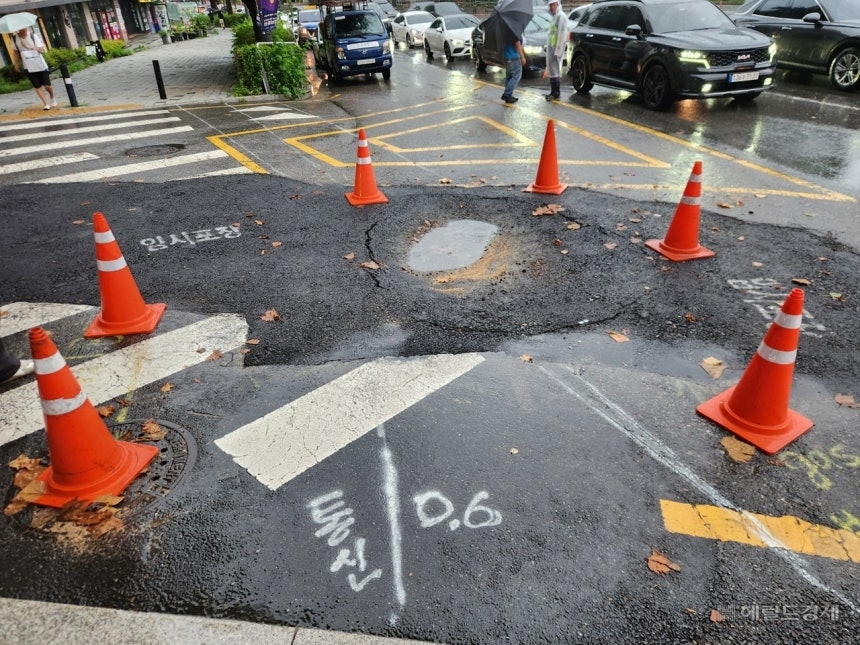
South Korean researchers have developed technology to prevent sinkholes — the sudden collapses of urban roads that have caused widespread concern in recent years.
The Korea Institute of Civil Engineering and Building Technology announced Friday that it has developed a technology capable of diagnosing ground weakening and underground voids around aging sewer pipes.
Aging sewer pipes allow surrounding soil to seep in through cracked joints and gaps in connecting pipes, gradually weakening the ground. Heavy rainfall is particularly dangerous: when water levels and pressure inside sewer pipes fluctuate during downpours, soil loss accelerates and the risk of sinkholes rises sharply. Soil that accumulates inside the pipes can also obstruct water flow, contributing to urban flooding.
Existing ground-penetrating radar technology detects underground voids using reflected radio waves, but it has significant limitations. It struggles in moisture-rich soil and cannot identify ground weakening or reduced load-bearing capacity before a void actually forms.
To address these shortcomings, a research team led by Han Sang-jong, a senior researcher at the institute, developed a new diagnostic method using a falling weight deflectometer.
A falling weight deflectometer applies a controlled load to a road surface and measures the resulting deflection to assess the condition of road pavement.
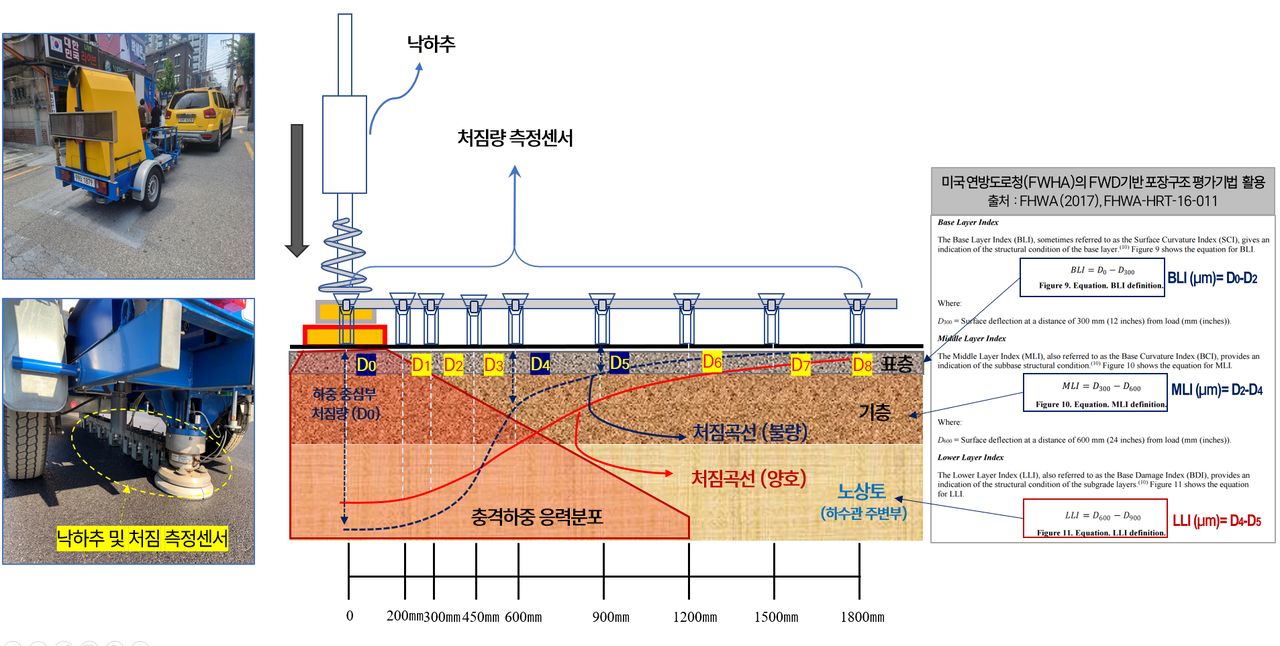
The research team overlaid deflection measurements from road surfaces with closed-circuit television footage from inside sewer pipes, analyzing the data by location within a geographic information system. Drawing on road pavement assessment methods from the US Federal Highway Administration, the team also established diagnostic criteria for evaluating ground conditions around sewer pipes.
Working with the Seoul Metropolitan Government, the team conducted two field tests in Eunpyeong-gu and Mapo-gu in July last year and June this year. At points where road deflection readings were abnormal, analysis of sewer pipe footage revealed voids at poorly joined pipe connections and confirmed that aggregate had flowed in and settled inside the pipes.
The technology's key advantage is its ability to detect warning signs of ground instability around sewer pipes without excavating the road. It is expected to supplement the limitations of both conventional ground-penetrating radar surveys and sewer pipe CCTV inspections in managing the safety of urban underground infrastructure.
Park Seon-gyu, president of the institute, said the achievement "will make a significant contribution to preventing road collapse accidents in urban areas and to building self-reliant smart underground infrastructure management technology, at a time when localized heavy rainfall is becoming more frequent due to climate change."
nbgkoo@heraldcorp.com




