
Broad framework agreed, but union resistance, key department transfers and ownership questions remain
Local community demands substance, not just a nameplate
Jeon Jae-soo's 'maritime capital' vision gains an air link — but Korea Development Bank relocation deal denied
With launch months away, getting the 'brain,' not just the banner, to Busan is the real test
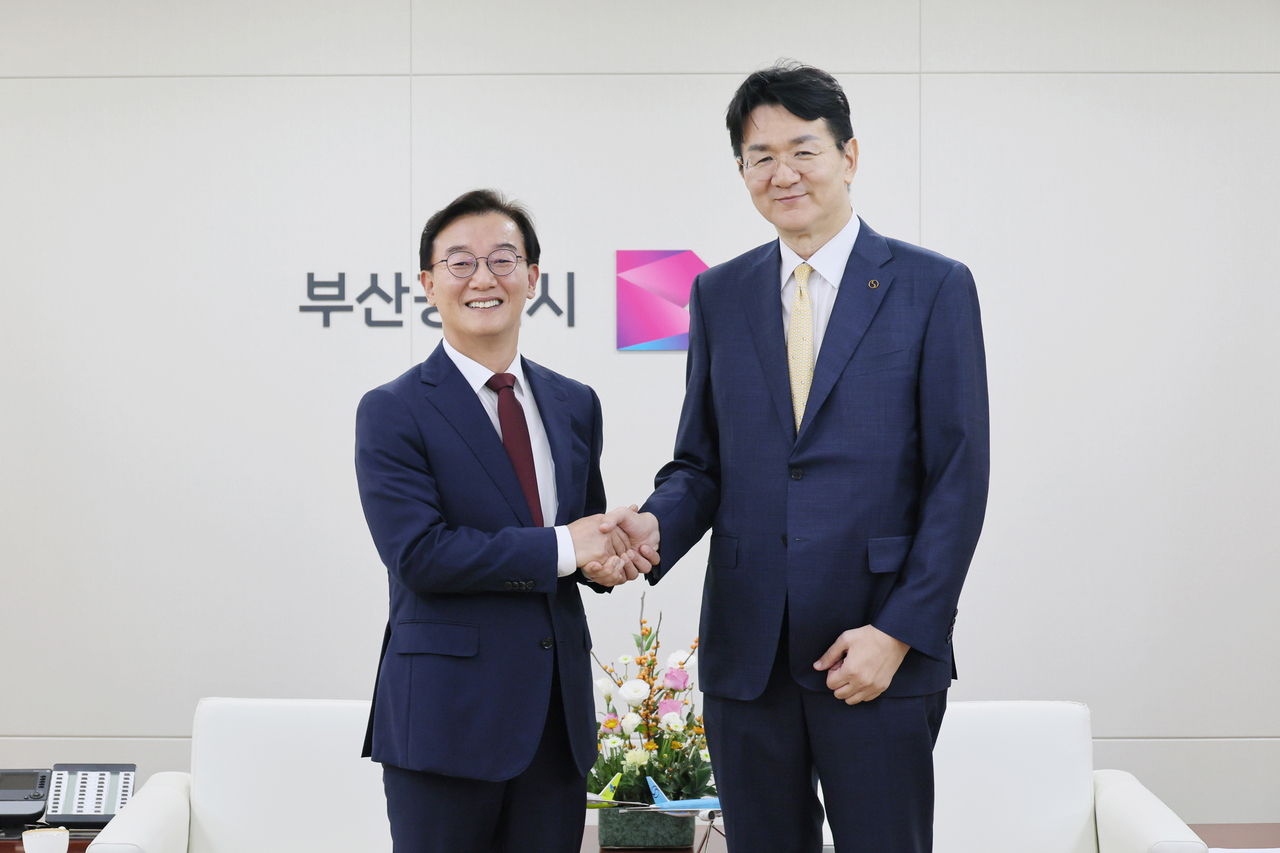
The headquarters of a new integrated low-cost carrier combining Air Busan, Jin Air and Air Seoul will be established in Busan. Mayor Jeon Jae-soo met with Hanjin Group Chairman Cho Won-tae on Thursday and agreed to base the merged carrier in the city. While Busan's civic and business communities have welcomed the deal — reached after eight formal rounds of negotiations with Korean Air — the mayor faces no shortage of hurdles ahead.
The integrated LCC will operate a fleet of 60 aircraft, post annual sales of about 3 trillion won ($2.23 billion) in its first year and carried about 15 million passengers in the first nine months of this year, making it one of the largest low-cost carriers in the country. The agreement, however, covers only the broad framework. The placement of core departments — finance, planning and human resources — in Busan remains subject to further negotiation, as do the carrier's name, its chief executive and employment continuity. The ownership battle between Hanjin Kal and Hoban Group over Hanjin Kal shares also remains an unresolved variable.
Labor unions present another challenge. The pilots' union at Jin Air expressed "deep regret and concern," calling for the retention of Incheon and Gimpo as operational bases and a ban on forced transfers. Park Jae-hong, the city's new airport bureau chief, acknowledged that bringing all staff down at once would be difficult given union concerns, and said the city would gradually increase the number of employees performing headquarters functions in Busan.
Political circles, the business community and civic groups all welcomed the agreement while pressing for substance. The local community, which had been disappointed when the headquarters location was left out of the original merger approval request, now sees the deal as a potential turning point for the region's aviation industry.
The Busan chapter of the Democratic Party of Korea said the relocation "will serve as a catalyst for Busan's leap to a Northeast Asian logistics hub with a triport system linking sea, air and rail." The Busan chapter of the People Power Party warned against the headquarters becoming a "nameplate-only" operation where key decisions are still made in the greater Seoul area, and called for the transfer of core management departments, expansion of international and long-haul routes, and development of specialized talent.
The Busan Chamber of Commerce and Industry said it would "actively support the integrated LCC in establishing itself as the anchor carrier for Gadeok New Airport." The Busan Citizens' Movement for a New Airport and Hub Carrier urged a phased deployment of core functions — including management strategy, finance, human resources and route planning — along with specialized personnel, job security for existing Air Busan employees, and an expansion of medium- and long-haul routes connecting Gimhae and Gadeok airports.
The agreement adds an air link to Mayor Jeon's broader vision of completing Busan's identity as a "maritime capital." In an interview with The Herald Business last month, Jeon described his four-year goal as "building solid infrastructure to make Busan a maritime capital at a level that cannot be reversed." The vision encompasses relocating the Ministry of Oceans and Fisheries, establishing a specialized maritime court, and bringing in the headquarters of HMM and a Southeast Investment Corporation — assembling administrative, judicial, corporate and financial functions to position Busan for the era of Arctic shipping routes.
The integrated LCC headquarters adds an air dimension to that infrastructure. The city has outlined a blueprint to create a "Sea & Air" hub connecting Gadeok Island New Airport, set to open in 2035, with Busan Port and the rail network.
Asked whether the deal was linked to a potential relocation of Korea Development Bank's headquarters, Jeon drew a line against that political reading, saying he lacked "that kind of strategic thinking." He said the outcome was the result of months of discussions with Korean Air and had nothing to do with the presidential office, the ruling party or Korea Development Bank's shareholding. "Korean Air's own business judgment was decisive — international passenger traffic at Gimhae Airport has surpassed 10 million for two consecutive years, reflecting explosive growth in aviation demand," he said.
With less than four months remaining before the carrier's planned launch next March, industry observers say the real measure of success will be whether core functions — including route planning and flight operations control — are actually transferred, and whether cabin crew bases and maintenance personnel genuinely relocate to Busan.
Jeon's remaining tasks include fleshing out support measures such as relocation allowances for transferred employees, expanded subsidies for new routes and a talent-development pipeline in partnership with local colleges — all while maintaining a working relationship with Korean Air to ensure the agreement holds amid the ongoing Hanjin Kal ownership uncertainty. The air links that Busan residents will actually feel in their daily lives will be opened not by the agreement itself, but by its implementation. That is why the mayor's next moves will be closely watched.
kaf2002@heraldcorp.com




