
Cargo drones haul 2,030 solar panels to rooftop
New paint factory fitted with 2.8 MW solar array
Environmental and energy management certifications renewed
Bentley Motors said Friday it has verified carbon neutrality at its Crewe factory operations for 2025 under the new international standard ISO 14068-1. The verification was conducted by independent body LRQA and covered the Crewe headquarters and nearby sites in Cheshire.
Bentley first obtained certification under the previous carbon neutrality standard, PAS 2060, in 2018. The company has now transitioned to the new international standard for its latest verification.
ISO 14068-1 requires that actual greenhouse gas reductions take priority over offsetting through carbon credits, permitting offsets only for residual emissions that remain after reductions have been made.
Scope 1 and 2 emissions — those generated directly at the factory or through energy use — fell roughly 89 percent, from 17,482 metric tons in 2018 to 1,907 metric tons in 2025. Including some indirect emissions tied to site operations, the remaining total stands at 9,326 metric tons of CO2 equivalent, which the company offset using verified carbon credits.
Bentley also renewed its certifications under ISO 14001, the international standard for environmental management systems, and ISO 50001, the standard for energy management systems. Both certifications apply to the Crewe headquarters and nearby sites and remain valid through October 2029.
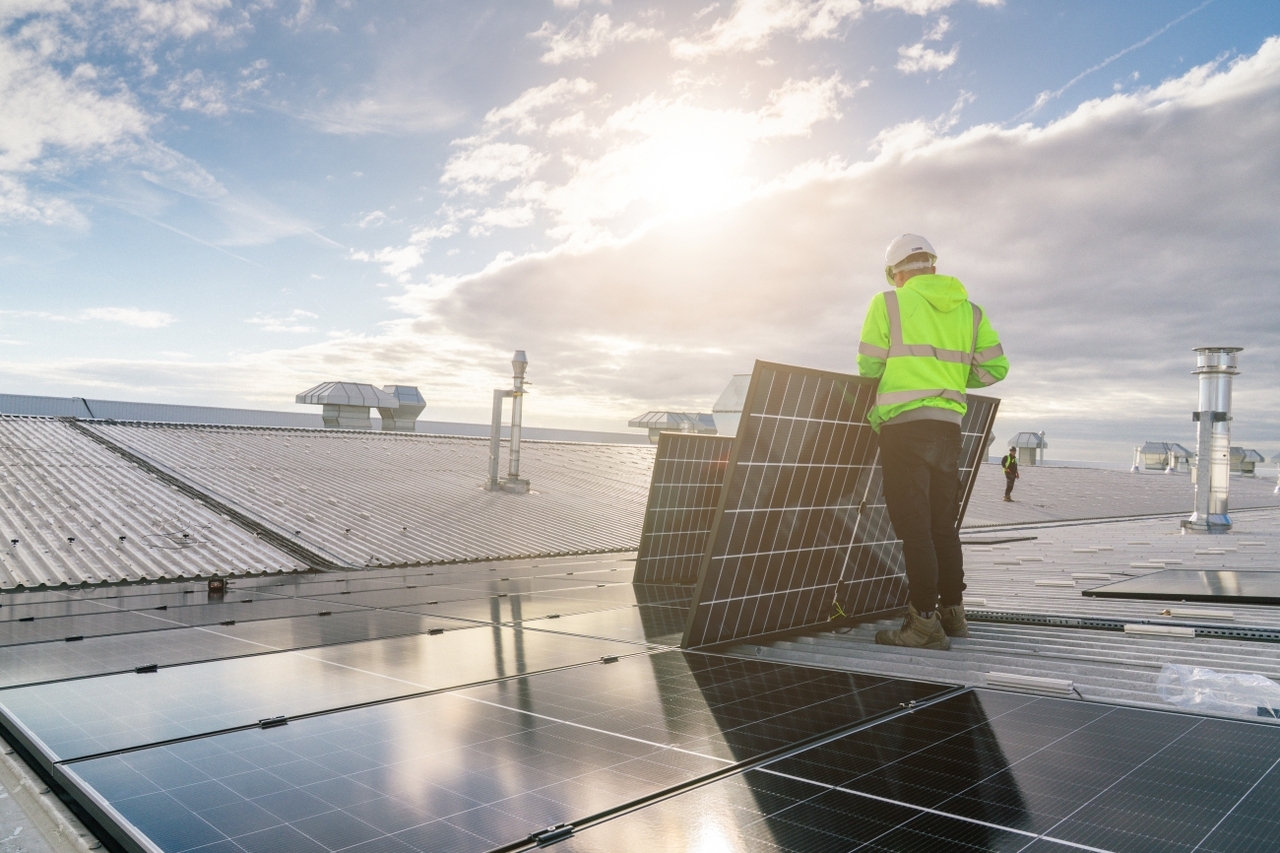
The company has also expanded its renewable energy infrastructure. Four rooftop sections of the new paint factory at Crewe — which began operation in June — have been fitted with a combined 2.8 megawatts of solar generation capacity.
Cargo drones were used to lift the 2,030 panels, each weighing about 30 kilograms, to the rooftops. The drones transported roughly one panel per minute, completing the installation in just over a week.
Bentley said the drones allowed panels to be delivered directly to their installation positions, improving efficiency. Transporting panels one at a time also reduced the risk of concentrated roof loading and relieved workers of the burden of carrying heavy panels manually, while cutting the use of heavy machinery during construction.
The installation was carried out in partnership with renewable energy specialist Pushi Power and Finlite. The expansion brings the total number of solar panels installed at the Crewe headquarters to more than 35,000.
Bentley Motors is transforming its Crewe factory into a "Dream Factory" — a future production hub — as part of its long-term brand strategy "Beyond100+." The launch of the new paint factory and the expansion of renewable energy infrastructure are both part of that broader investment in production infrastructure.
Andreas Lehe, Bentley Motors' board member for manufacturing, said the company's efforts to reduce the environmental impact of its operations had been recognized through independent verification, and that innovative technologies such as cargo drones were enabling a safer and more efficient expansion of its renewable energy infrastructure. "We will continue to actively adopt new technologies and ideas to drive innovation at our production facilities and advance Bentley's long-term decarbonization goals," he said.
Meanwhile, Bentley recently named Hiroshi Fujiwara as its new global brand ambassador and unveiled the "Batur FRGMT Commission," a collaboration with his design brand FRGMT. The model is based on the Batur First Edition, with Bentley's bespoke coachbuilding division Mulliner working alongside Fujiwara to design both the exterior and interior.
eyre@heraldcorp.com




