
Korea Ocean Business Corporation wraps up 2026 KOBC BADA Conference
Event covers supply chain early warning systems, Arctic routes and shipping market outlook
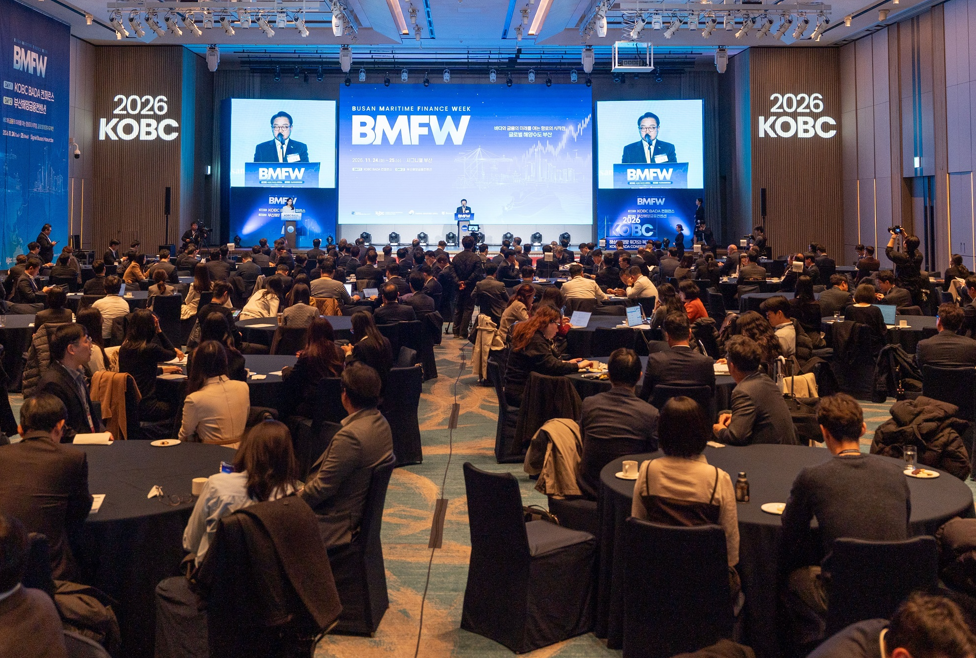
Investing in human capital and strengthening international cooperation are essential to overcoming the maritime supply chain crisis, experts said at a major industry conference. The need to build proactive response systems and public-private cooperation frameworks was also underscored.
The Korea Ocean Business Corporation (KOBC) held the 2026 KOBC BADA Conference on Tuesday, focusing on "Maritime Supply Chain Crisis and Resilience" as its central theme. The event brought together about 500 participants from government, academia, research institutions, the shipping, logistics and financial sectors, and the media to discuss South Korea's crisis-response capabilities and sustainable growth strategies for its shipping industry.
Lim Ki-tack, honorary secretary-general of the International Maritime Organization (IMO), delivered the keynote address, identifying geopolitical supply chain disruptions, decarbonization and digital transformation as the three defining challenges facing the global shipping industry. Lim said investing in human capital and deepening international cooperation are indispensable to building resilience in an era when crises have become routine. He also urged South Korea's shipping sector to move beyond simply adopting international norms and instead become a "rule-maker" that actively shapes the global maritime order.
HMM CEO Choi Won-hyuk and Bloomberg researcher Kwon Hyo-sung analyzed the shifting dynamics and risk factors in the global maritime supply chain. They said that because 99.7 percent of South Korea's import and export cargo moves by sea, proactive response systems must be put in place to prevent geopolitical risks along key shipping lanes — including the Strait of Hormuz — from cascading into disruptions across the country's industrial and trade supply chains.
Proposed measures included upgrading KOBC's AI-based maritime supply chain early warning system (EWS) and linking it to financial support, strengthening the national essential fleet regime, and expanding real-time information sharing between shipping companies and cargo owners. Participants particularly said building a public-private cooperation framework — in which the government, public institutions and private companies share crisis intelligence and respond jointly — is critical, going beyond what individual firms can do on their own.
Kwon Young-tae, a professor at the Korea Institute of Maritime and Fisheries Technology who took part directly in the Arctic route trial voyage, presented measured results showing the Busan-to-Rotterdam leg was completed in 22 days — roughly 10 days faster than the conventional Suez Canal route — demonstrating the Arctic route's operational efficiency and potential. For full commercial use of the Arctic route, Kwon identified key prerequisites: precisely calculating navigable windows by season and sea area, and securing specialists trained in polar operations.
KOBC President Ahn Byung-gil said the corporation would continue pursuing stronger public-private cooperation, closer coordination between financial and policy support, and active adaptation to the emerging maritime order, in order to secure new growth engines for South Korea's shipping industry.
ook967@heraldcorp.com




