
Solo exhibition 'Yomojomo Seulgi Lee' opens at Seoul Museum of Art
First solo show at a Korean public art museum
Over 70 works on view, including 9 new pieces
A traditional Korean nubi quilt carries proverbs stitched into its fabric. Wooden lattice panels that once divided the inside and outside of a building ripple overhead like the surface of the sea. Baskets woven by women in Mexico hold within them a language on the verge of extinction.
These are the worlds conjured by Lee Seulgi, a 54-year-old contemporary artist who has spent her career connecting everyday objects to language, culture and human memory. Her solo exhibition "Yomojomo Seulgi Lee" is on view at the Seoul Museum of Art's Seosomun Main Building through Feb. 28 next year. It is her first solo show at a Korean public art museum. The exhibition brings together more than 70 works — sculptures, installations, video and sound pieces — spanning from her late-1990s practice to nine new works created for this occasion.
The exhibition title "Yomojomo" is a Korean expression meaning to look at something from every angle and in every way. It comes from the artist's own words: "Let's think carefully. If you listen and look from every angle, the answer is already there." The show invites viewers to step outside a human-centered perspective and see the world through the eyes of objects — examining the relationships and histories accumulated within them.
"Quilt Project: U," an ongoing series begun in 2014, was created in collaboration with Cho Seong-yeon, a master of Tongyeong nubi quilting. The works translate Korean proverbs and idiomatic expressions — among them "My own nose is three feet long" (meaning one has enough troubles of one's own), "Fanning the flames of a burning house," and "If a small bird tries to follow a stork, it will tear its legs apart" — into abstract geometric patterns and color through the direction of stitching and the arrangement of lines.
In "U: Still as a Dead Mouse" (2020), for instance, horizontal rows of quilting lines evoke the image of a mouse lying flat on the ground. The artist has embedded stories long shared by a community into the quilt — an intimate object belonging to the private space of sleep and dreams.
"Basket Project W" (2018), which combines traditional Mexican craft with an endangered language, is another work that exemplifies the artist's distinctive sensibility. It was created in collaboration with Xula, a community of women basket weavers in Oaxaca, Mexico.
In that region, the technique of weaving baskets from palm leaves has been passed down through generations, but the Ixcatec language spoken by its residents is now endangered as Spanish has taken hold as the dominant tongue. Lee gave the baskets woven by the women names drawn from Ixcatec words meaning "white," "rain" and "sunset."
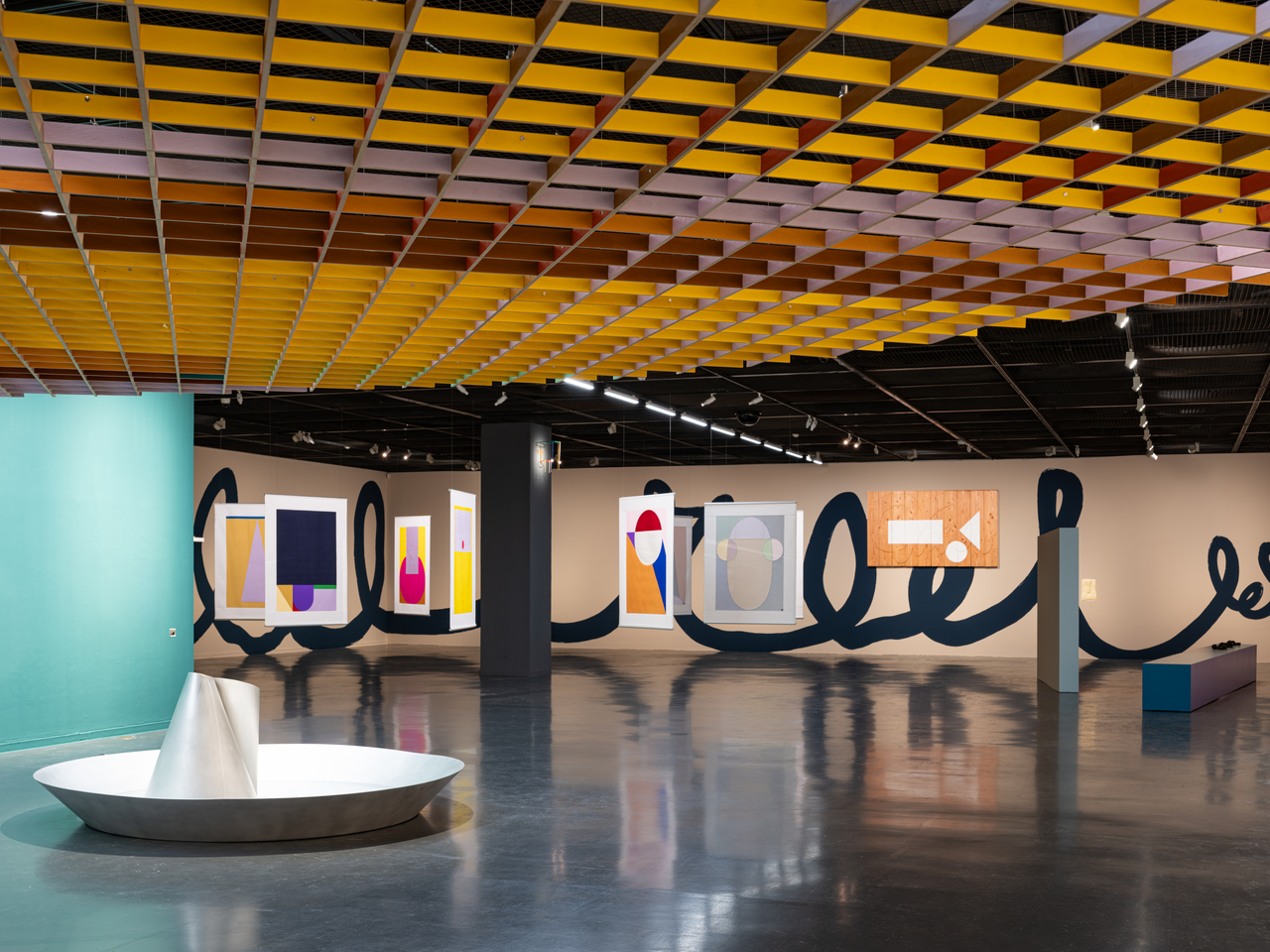
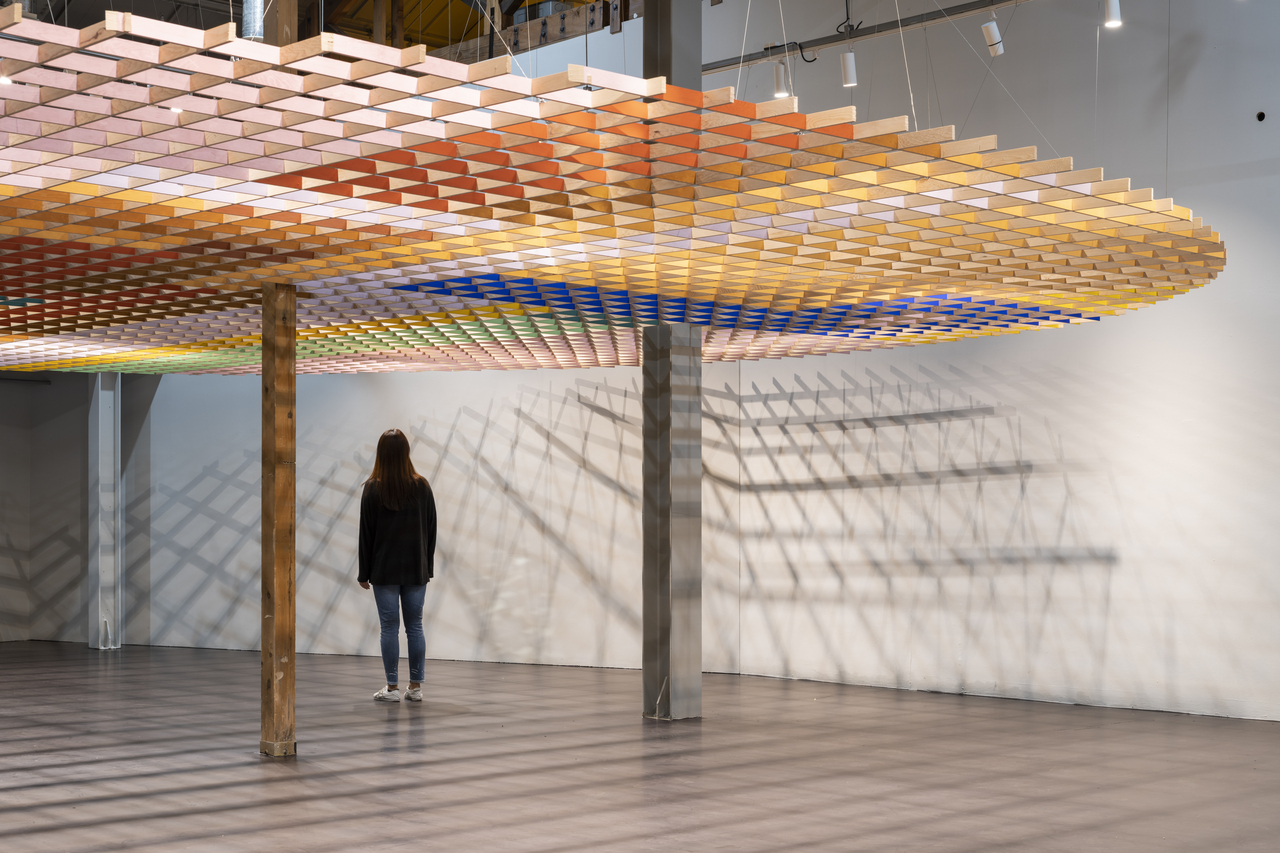
At the center of the exhibition stands "Slow Water" (2021), a large-scale installation measuring 11 meters in diameter. Created in collaboration with craftspeople specializing in traditional Korean wooden lattice and dancheong (decorative paintwork), the work expands the well-shaped lattice pattern of traditional Korean architecture into a vast circular grid, painted in dancheong colors and suspended from the ceiling.
As visitors walk beneath it, overlapping colored lines appear and disappear depending on their angle and position, evoking the sensation of looking up at light filtering through the surface of water from below.
A new mural, "Lrlrlr" (2026), stretches across 157 meters of the exhibition's walls, wrapping the entire space in thick, winding lines. The work calls to mind the strokes a young child makes while practicing handwriting, or the coiled cord of an old telephone.
The exhibition also features works that playfully transform the function of everyday objects. "Book" (2009, remade 2026) fans strands of spaghetti between every page of Jean Baudrillard's "The System of Objects" so that they bloom like flowers. "Ido" (2009) shows a city bus fitted with long fur, filmed driving through the streets of Bordeaux, France.
"À la Claire Fontaine" (2026), whose title is borrowed from an old French nursery rhyme meaning "by the clear fountain," is a large-scale fountain created in collaboration with architects Han Seung-jae and Jang Seo-gyeong. The work is conceived as a place where anyone, amid the wars and turmoil unfolding around the world, can pause for a moment and make a wish.
The exhibition also connects to Lee's concurrent solo shows in Europe. "Garonne" (2026) and "Lake Léman" (2026) each seal water drawn from the Garonne River in Bordeaux and Lake Geneva in Switzerland inside small glass spheres, bringing different times and places together into a single exhibition space.
The new work "U: In the Blink of an Eye" (2026) is displayed as an open eye at the Frac Méca museum in Bordeaux and as a closed eye at the Seoul Museum of Art — a witty conceit by the artist connecting two distant venues in the blink of an eye.
"When objects disappear, so do the people, the skills and the memories," Lee said.
Treating objects as equal presences capable of communicating with humans, Lee proposes what she calls an "I.o.T (Inner Net of Things)" — a different kind of connectivity — as a counterpoint to the Internet of Things era, which measures connection solely by speed and efficiency. It is about linking the people, time, memories and cultures that reside within objects.
Choi Eun-ju, director of the Seoul Museum of Art, said the exhibition "will illuminate the creative possibilities of contemporary art as it embraces and expands upon the craftsmanship and diverse cultures of different communities," adding that she hoped it would offer "an opportunity to rediscover the value of our existence and of objects through Lee Seulgi's singular vision."
Lee received the National Museum of Modern and Contemporary Art's Artist of the Year award in 2020 and has held solo exhibitions at venues including Icon Gallery in the United Kingdom and Frac Méca in France. Her works are held in the collections of the Centre national des arts plastiques in France and the National Gallery of Victoria in Australia, among others.
pink@heraldcorp.com




