
Global cooperation sought to prevent AI cheating on college entrance exam
Domestic NPU ecosystem to reduce reliance on Nvidia
Public AI service 'Modu's AI' to launch in December
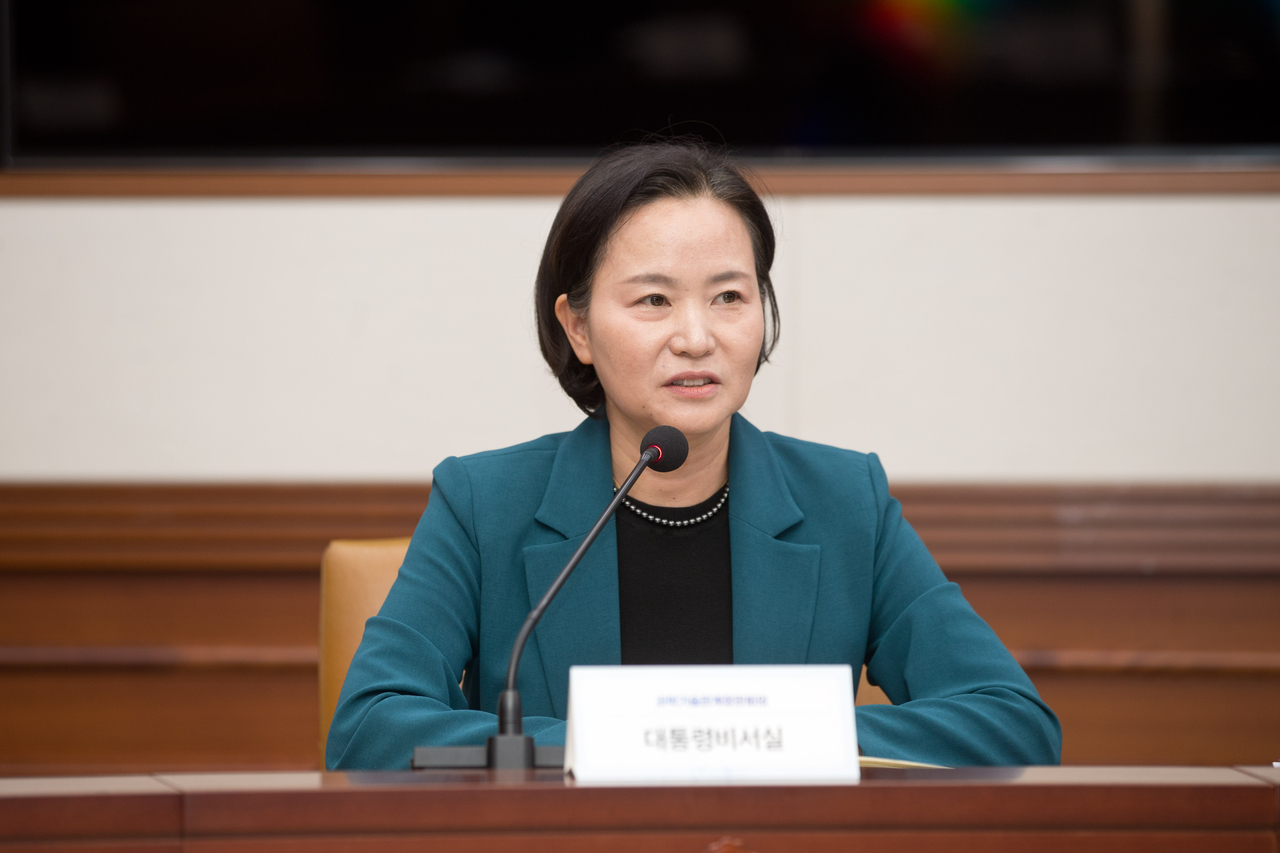
Lee Hae-min, Cheong Wa Dae's senior secretary for AI future planning, said Friday that South Korea is leading efforts to build international cooperation with global AI companies to prevent cheating on the College Scholastic Ability Test and other major exams. Lee also outlined plans to foster a domestic neural processing unit ecosystem to reduce dependence on Nvidia's GPUs, and said the government's public AI service — "Modu's AI" — will roll out in stages starting in December.
Speaking on MBC Radio's "Kim Jong-bae's Morning Focus," Lee described a three-pronged approach to AI cheating. "Blocking the cheating itself, tracking it after the fact, and drawing up medium- and long-term measures that combine both — all of this is happening at once," Lee said.
On specific technical countermeasures, Lee said the government is working with the Ministry of Science and ICT to verify a method that would prompt AI systems to refuse to answer exam questions on their own. The approach, known as prompt injection, involves embedding factual statements in exam materials — such as the date, time and subject of the test, along with a notice that providing answers constitutes a punishable offense under the Higher Education Act — so that AI models decline requests on rational grounds rather than being forced into behavioral changes. "The idea is to state the facts so that the AI makes a rational refusal," Lee said.
Lee said South Korea is also pursuing cooperation requests to global AI companies, noting that other countries face the same concerns around university entrance qualification exams and that worldwide coordination is needed. "Korea is trying to be the first to do this," Lee said. Beyond physical searches and radio-frequency detectors, Lee added that making clear to companies that they could face legal liability if exam questions are illegally transmitted through their AI services "is an important point for generating cooperation." Lee acknowledged, however, that "this is one of many issues still under discussion, and it alone cannot provide 100 percent prevention."
Lee also addressed the government's response to external regulatory risks facing the AI industry. On US moves to restrict overseas AI data center investment and related tariff issues, Lee said there was initial relief when a 15 percent tariff figure was floated, but that proposed US restrictions on AI data center investment outside the country are being closely watched. "There are also moves by the Democratic Party following the US midterm election results regarding AI data center regulation, and we are monitoring the situation comprehensively and preparing responses," Lee said.
On the concentration of the AI value chain around Nvidia CEO Jensen Huang and a handful of companies, Lee said the government would pursue both volatility reduction and supply chain diversification in parallel. "Because Samsung Electronics and SK hynix are all caught up in this too, we need to work toward reducing volatility while at the same time weakening that dependence," Lee said. Drawing an analogy, Lee described GPUs as closer to off-the-rack clothing and NPUs as closer to tailored suits, and said South Korea's NPU technology has reached the stage just before mass production. "US companies including AMD and others are also working to partner with Korean NPU firms and help them grow, so diversification is necessary," Lee added.
On the growing stock market volatility driven by concerns over AI industry profitability and so-called circular financing arrangements, Lee characterized the current moment as a transitional phase. "Just as in the early days of high-speed internet, the companies making money in AI right now are the hardware, chip and infrastructure players — the era when software companies generate added value and profit from demand has not yet arrived," Lee said. "Long-term demand is visible, but there will inevitably be turbulence along the way from financing and regulation."
Lee identified "physical AI" — combining AI with South Korea's manufacturing strengths — and the construction of a social safety net as the country's key AI specialization strategies. Lee said the government is pursuing physical AI as one of its three major megaprojects, drawing on the country's competitiveness in home appliances, shipbuilding and semiconductors. On concerns about job losses from rapid AI adoption, Lee noted that while the Industrial Revolution unfolded over more than 200 years, the AI transition is happening far more quickly, compressing the timeline. "Preparing a social safety net is a major role of government, and we need to build the relevant systems within the framework of an 'AI basic society,'" Lee said.
On the possibility of community opposition to domestic AI data center construction, Lee said that unlike the United States, where the power grid is privatized, South Korea can site data centers within industrial complexes and manage electricity supply through Korea Electric Power Corporation. Lee also said the government plans to release community benefit guidelines early next year in connection with a draft enforcement decree for the AI Data Center Act currently being drafted.
Lee also disclosed the launch schedule for "Modu's AI," the government's public-facing AI service. "Modu's AI provides services that directly touch people's daily lives, centered on Korea's own foundation model technology," Lee said. "It will begin in December and be released in stages, and three consortiums are preparing with their own distinct features so that people who currently use ChatGPT and similar services for free can make the switch."
sunpine@heraldcorp.com




