Consumer spending rises for 23rd consecutive quarter, but real spending flat
Non-consumption outlays jump 11%, largest increase in 5 years
Bottom 20% households spend 132.3% of disposable income
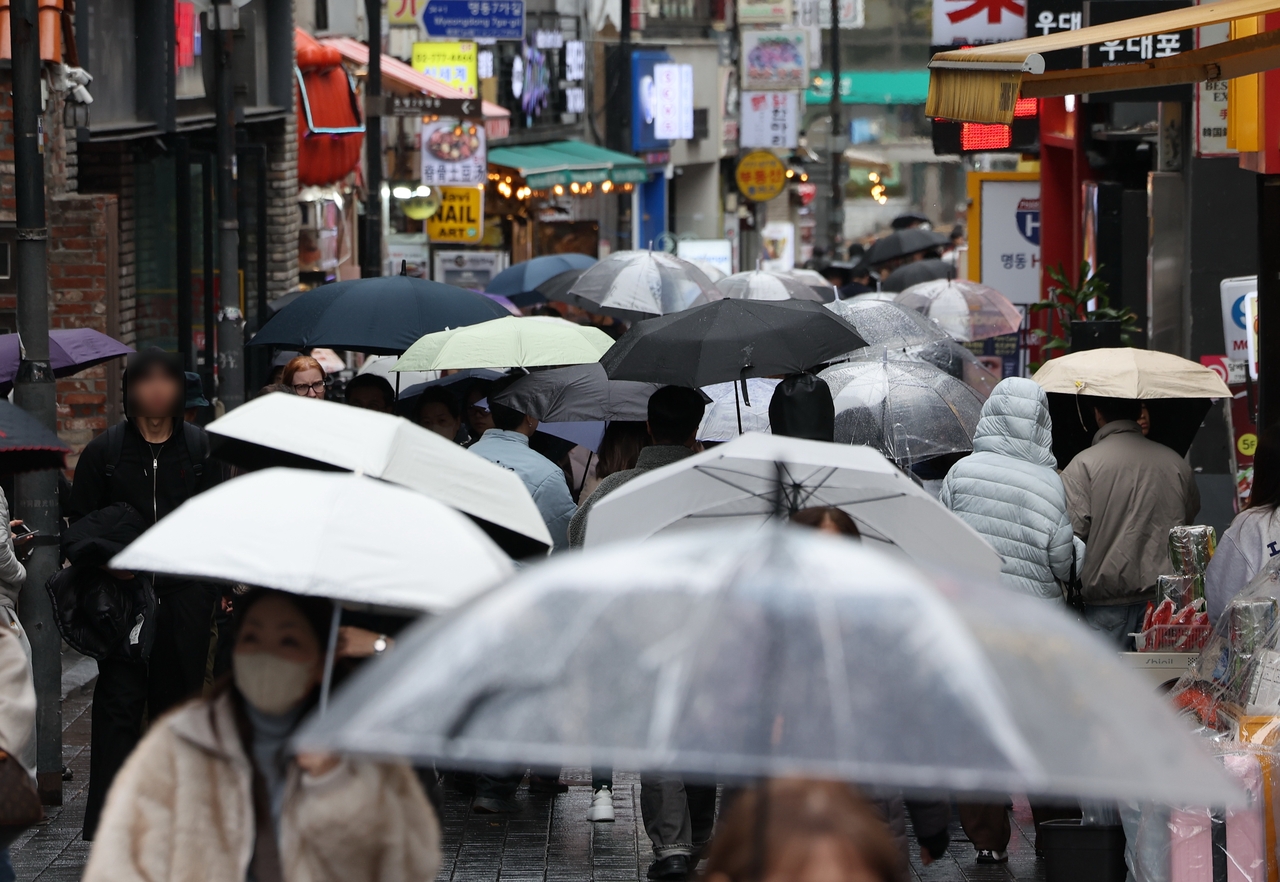
Household consumer spending rose for the 23rd consecutive quarter in the third quarter of this year, but real consumption growth — stripped of price effects — was flat.
Income growth slowed due to a base effect from last year's livelihood-recovery consumption voucher program, while the burden of non-consumption outlays such as taxes and interest expanded, pushing disposable income into negative territory for the first time in 13 quarters.
According to the third-quarter household income and expenditure survey released Thursday by the Ministry of Statistics, average monthly consumer spending per household stood at 3.03 million won ($2,250) in the third quarter, up 2.9 percent from a year earlier — extending a streak of 23 consecutive quarters of growth.
By category, transportation spending rose 9.6 percent, while housing, water and utilities climbed 4.9 percent and food and non-alcoholic beverages gained 3.3 percent.
"Some local governments extended eco-friendly vehicle subsidies through year-end, which drove up new car purchases," said Park Soon-ok, head of the household budget trends division at the Ministry of Statistics.
However, real consumer spending growth — adjusted for inflation — was limited to 0.0 percent. After gains of 3.1 percent in the first quarter and 0.4 percent in the second quarter, the pace of increase slowed to its lowest level since the third quarter of last year, when it fell 0.7 percent.
Among spending categories in real terms, clothing and footwear posted the steepest decline at minus 7.2 percent. Alcoholic beverages and tobacco fell 4.2 percent, recreation and culture dropped 4.0 percent, education slipped 3.7 percent, food services and accommodation fell 2.0 percent, miscellaneous goods and services declined 1.4 percent, and household goods and services edged down 0.6 percent.
In contrast, real spending rose in housing, water and utilities (3.0 percent), food and non-alcoholic beverages (2.8 percent), health (2.3 percent), transportation (1.9 percent) and communications (0.9 percent).
Non-consumption outlays — spending outside of personal consumption — surged in the quarter. Average monthly non-consumption expenditure per household came to 1.17 million won, up 11.0 percent from a year earlier, the highest growth rate in 20 quarters since the third quarter of 2021, when it rose 11.4 percent.
Inter-household transfers jumped 30.0 percent, while interest payments rose 11.0 percent, current taxes climbed 8.0 percent and pension contributions increased 7.8 percent.
As a result, disposable income — household income minus non-consumption outlays — averaged 4.31 million won per month, falling 1.7 percent. It was the first decline in 13 quarters, since the second quarter of 2023, when it dropped 2.8 percent.
Overall household income growth was held to just 0.8 percent, as public transfer income fell 15.4 percent due to the base effect from last year's consumption voucher program, while non-consumption outlays posted double-digit growth.
The monthly surplus — disposable income minus consumer spending — came to 1.28 million won, down 11.2 percent from a year earlier, the steepest drop since the second quarter of 2023, when it fell 13.8 percent. The surplus rate fell 3.2 percentage points to 29.6 percent, while the average propensity to consume — the share of disposable income spent on consumption — rose 3.2 percentage points to 70.4 percent.
Asked whether household purchasing power and spending capacity had weakened, Park said the base effect from transfer income was so large that income growth slowed, and that the overall figures reflect a significant base effect.
Park added that labor income grew in real terms as well, driven by wage increases, and noted that recent price increases have also weighed on real income to some extent.
Among income groups, the consumption burden grew heaviest for low-income households. The bottom 20 percent — first-quintile households — spent an average of 1.41 million won per month on consumption, up 1.6 percent. Food and non-alcoholic beverages accounted for the largest share of total spending at 22.3 percent, followed by housing, water and utilities at 18.4 percent and food services and accommodation at 13.2 percent.
Disposable income for first-quintile households fell 5.4 percent to 1.06 million won. With disposable income shrinking and consumer spending rising, the average propensity to consume climbed to 132.3 percent, up 9.2 percentage points from a year earlier.
The Ministry of Statistics said the decline in labor income among first-quintile households reflected a lower share of wage-earning households and a rise in jobless households within that group. It also noted that temporary workers outnumber regular employees among first-quintile earners, and that this employment pattern affects their consumption behavior.
The top 20 percent — fifth-quintile households — spent an average of 5.3 million won per month on consumption, up 6.7 percent. Transportation spending particularly surged 35.1 percent. Food services and accommodation accounted for the largest share of total spending at 16.1 percent, followed by transportation at 14.2 percent and food and non-alcoholic beverages at 12.7 percent.
Consumer spending by fourth-quintile households fell 0.9 percent, making it the only income group to record a decline among all five quintiles.
y2k@heraldcorp.com