We see the world through food. Welcome to Middam, your guide to delicious stories.
Rising output pushes down prices at the farm gate
But retail costs climb as discounts dry up

Eggs have become so expensive that Koreans have taken to calling them "gold eggs" — and despite a drop in farm-gate prices, retail costs are still climbing. Analysts point to a pullback in discount programs by hypermarkets and the government, compounded by fears over the spread of highly pathogenic avian influenza (AI), as the main reasons prices refuse to come down.
According to the Korea Rural Economic Institute, the average farm-gate price for extra-large eggs in mid-November stood at 1,661 won per 10 eggs — 133 won lower than the same period a year ago and 173 won below mid-October's 1,834 won. The institute forecast that farm-gate prices would fall a further 10 to 30 won in the latter half of this month.
The decline in farm-gate prices reflects a rise in supply. The institute estimated that the number of laying hens in November would reach about 58.96 million — up 1.6 percent from a year earlier. Daily egg output was projected at about 50.4 million, roughly 1.9 percent more than a year ago. The increase in production has intensified downward pressure on the prices farmers receive when they ship eggs.
Retail prices, however, have moved in the opposite direction. According to Korea Agro-Fisheries & Food Trade Corp. (aT), the average retail price for a tray of 30 eggs stood at 7,068 won as of Monday — up 6.3 percent from 6,650 won on the same date a year ago. After dipping into the 6,000-won range from mid-October through early this month, the price of a 30-egg tray has climbed back above 7,000 won.
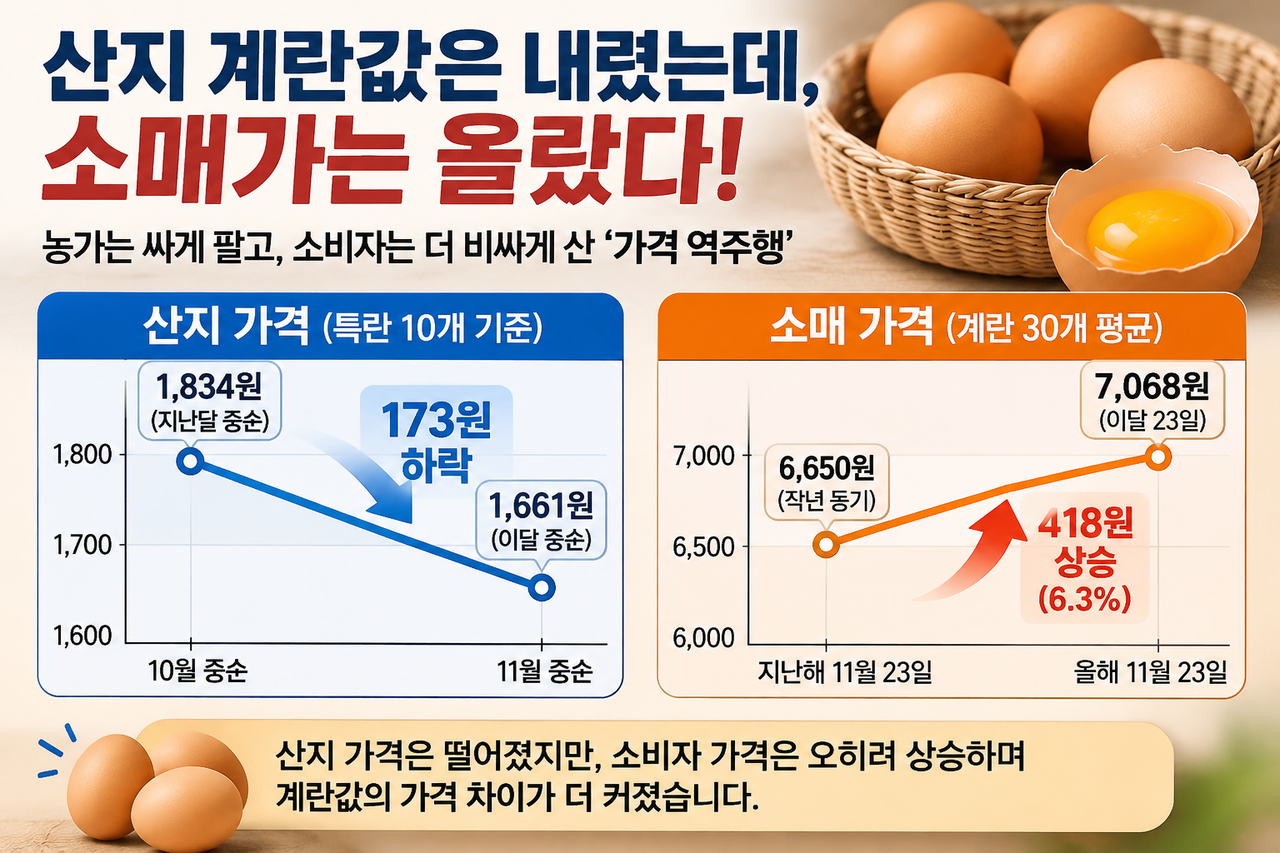
The gap between farm-gate and retail prices widens in the distribution chain. After leaving the farm, eggs go through sorting, inspection, washing and packaging before reaching wholesalers and retailers — a process that adds costs for sorting, packaging, transport, storage and labor. Even when farm-gate prices fall, retailers working through inventory purchased at higher prices under existing contracts cannot immediately pass those savings on to consumers.
The government also points to a reduction in discount support as a factor pushing retail prices up. As egg supply increased, hypermarkets and the government scaled back discount programs, and officials say that pullback has contributed to higher prices at the checkout. When promotional discounts shrink, consumers can end up paying more even as farm-gate prices fall.
Data from the Korea Institute for Animal Products Quality Evaluation bear this out. As of Monday, the farm-gate price for a 30-egg tray of extra-large eggs was 4,979 won — down 9.6 percent from the October average of 5,507 won. The retail price on the same day was 7,068 won, up 2.9 percent from October's average of 6,868 won. In other words, while farm-gate prices fell more than 9 percent in a single month, retail prices actually rose.
The bigger concern is that egg prices could rise again. The spread of highly pathogenic AI during the winter months has emerged as a key variable. This winter season, the first case was confirmed Nov. 3, and 10 cases in total had been recorded through Tuesday. Last year, six cumulative cases were confirmed between the first outbreak on Sept. 12 and Nov. 24. This year's first outbreak came later in the season, but within three weeks of that initial case the cumulative count had already surpassed last year's tally for the same period.
If AI spreads to laying-hen farms, egg supply could shrink. Last year, 62 cases of highly pathogenic AI were confirmed, leading to the culling of about 11.34 million laying hens. The resulting drop in egg output drove prices sharply higher through this past spring. If culling on a similar or larger scale occurs this year, the current downward trend in farm-gate prices could reverse and push retail prices back up.
An official at the Ministry of Agriculture, Food and Rural Affairs said that if the decline in farm-gate prices continues, retail prices are expected to gradually follow suit — but added that the outlook will depend heavily on how far the highly pathogenic AI spreads.
123@heraldcorp.com