
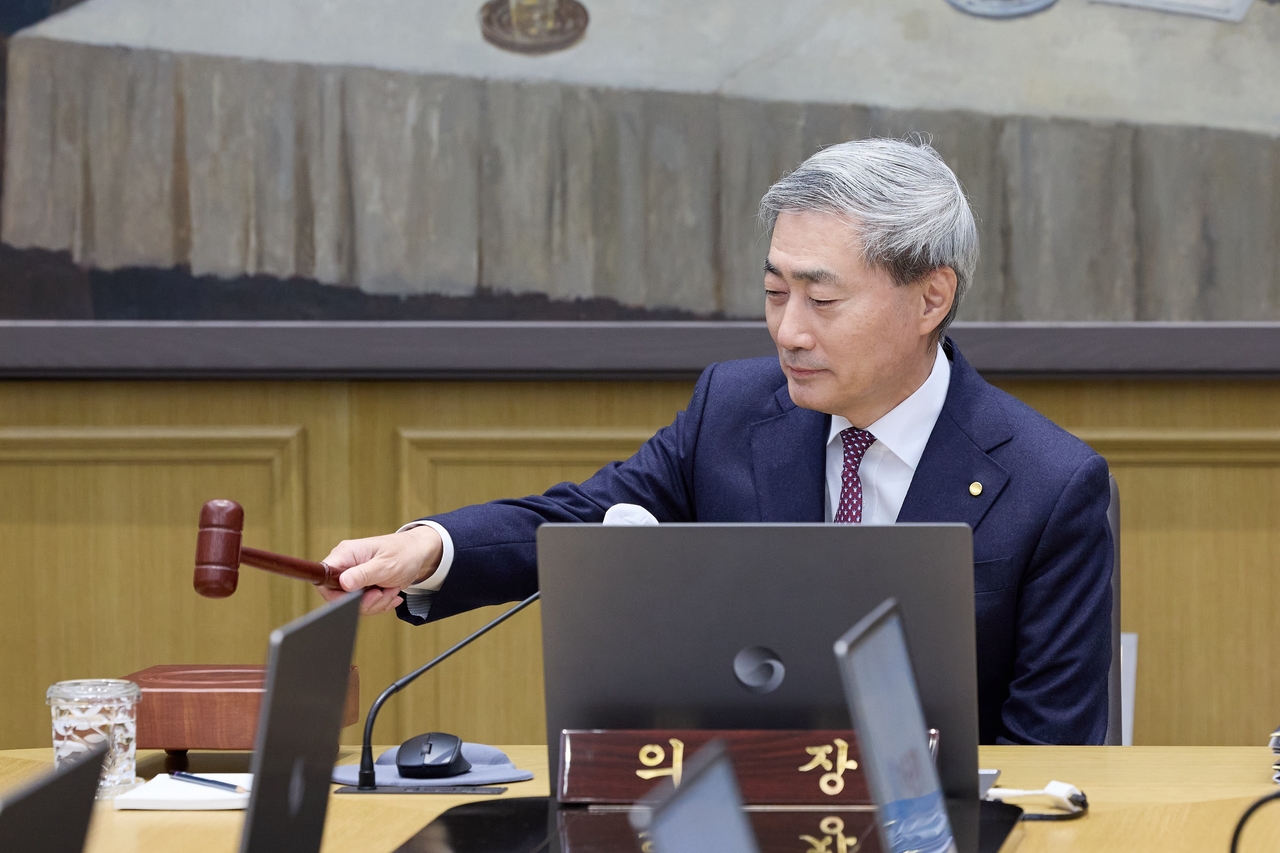
Gov. Shin sports red tie at meeting
Next-year growth forecast raised to 4.1%
Core inflation at 2.8%, staying above target
The Bank of Korea's Monetary Policy Board raised the benchmark interest rate to 3.25 percent per annum at its final rate-setting meeting of the year, while lifting its growth forecast for next year by 1.2 percentage points to 4.1 percent.
The board voted Thursday morning to increase the rate by 25 basis points, from 3 percent to 3.25 percent. It is the third hike this year, following increases in July (2.5 to 2.75 percent) and August (2.75 to 3 percent).
The board had paused in October before resuming tightening within a month. The benchmark rate last stood at 3.25 percent in November 2024, when the central bank cut it to 3 percent — making Thursday's move a return to that level for the first time in roughly two years.
Gov. Shin Hyun-song arrived at Thursday's meeting wearing a deep crimson-purple tie. Markets have come to read a red-toned tie from the governor as a signal of an impending rate hike. At the October meeting, when the board held rates steady, Shin wore the Bank of Korea's institutional tie, which contains neither red nor blue.
Stronger-than-expected growth and above-target inflation were the decisive factors behind the decision. Third-quarter real GDP expanded 1 percent quarter-on-quarter, far exceeding the central bank's August forecast of 0.3 percent. Both headline consumer prices and core inflation continued to rise in the upper-2-percent range in October.
The Bank of Korea believes demand-side pressure from robust growth will continue to push prices higher.
In revised economic projections released alongside the rate decision, the central bank set its growth forecasts at 3.9 percent for this year and 4.1 percent for next year — up 0.6 and 1.2 percentage points, respectively, from its August estimates of 3.3 percent and 2.9 percent. The bank also issued its first growth forecast for 2028, projecting 3 percent. Its consumer price inflation forecast for this year was held at 2.7 percent, while the projection for next year was nudged up 0.1 percentage point to 2.4 percent from 2.3 percent. Inflation in 2028 was projected at 2.1 percent.
Financial imbalance risks also remain. In real estate, home price gains in Seoul's prime districts are gradually cooling, but the broader Greater Seoul area still shows signs of overheating.
The won-dollar exchange rate hovering in the mid-1,300 won range — with upward and downward pressures evenly matched — and expectations that the Federal Reserve will raise rates next month also strengthened the case for a hike.
Concerns persist about the potential side effects of tightening, including sluggish private consumption despite strong headline growth, a correction in share prices, and what some have called a "semiconductor illusion" — the risk that semiconductor-driven GDP figures may be overstating the breadth of the economic expansion.
kimstar@heraldcorp.com
forest@heraldcorp.com




