Yang wins 36.18%, Eom 31.67% — gap of 4.51 percentage points
No candidate clears majority; runoff set for Dec. 6-10
Diverging stances on tripartite dialogue could shape labor policy
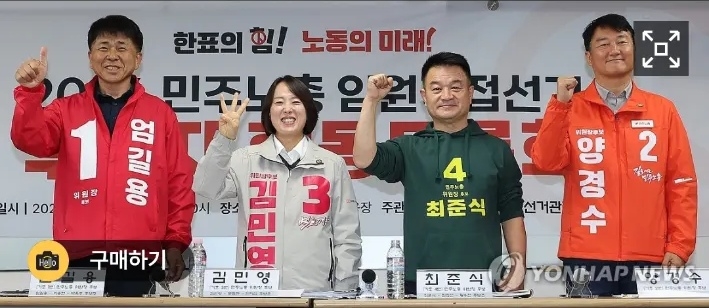
The race to lead the Korean Confederation of Trade Unions has narrowed to a runoff between incumbent chief Yang Kyung-soo, who is seeking an unprecedented third term, and challenger Eom Gil-yong.
The two candidates have staked out sharply opposing positions on tripartite social dialogue between labor, management and the government, meaning the outcome will likely determine not only whether the KCTU returns to formal talks but also whether discussions on labor exemptions in the government's proposed super-regional special zones can move forward.
According to the KCTU, none of the four candidates secured a majority in the election held from Nov. 19 through Wednesday. Of 975,279 eligible voters, 629,822 cast ballots, a turnout of 64.58 percent.
Yang led with 227,901 votes, or 36.18 percent. Eom followed with 199,449 votes, or 31.67 percent, leaving a gap of 4.51 percentage points between them. Kim Min-young received 90,573 votes (14.38 percent) and Choi Jun-sik received 79,759 votes (12.66 percent).
Under KCTU rules, candidates run as a slate comprising a chairperson, a senior vice chairperson and a secretary-general. When no candidate clears a majority, the top two advance to a runoff. That vote will be held from Dec. 6 to Dec. 10.
The central issue in the election has been whether the KCTU should participate in regular tripartite social dialogue through bodies such as the Economic, Social and Labor Council. The two frontrunners took clearly divergent positions on the question throughout the campaign.
Yang has argued that a third term is necessary to see through the social dialogue agenda he has pursued. He has framed the election as a referendum by union members on that approach.
Eom, by contrast, has argued that past attempts at tripartite dialogue produced no meaningful results and instead left labor worse off. He has also called for scrapping the government's proposed special act on super-regional special zones.
The roughly 170,000 votes cast for Kim and Choi — who were eliminated in the first round — are now seen as the key variable in the runoff. Their combined share of 27.04 percent far exceeds the margin separating Yang and Eom.
Ongoing "single-issue" social dialogue on whether to introduce special exemptions for working hours and fixed-term employment within the super-regional zones could also be affected by the direction the incoming KCTU leadership takes. The election is shaping up to be a significant variable not only for the union's internal direction but also for the government's broader labor policy agenda going forward.
fact0514@heraldcorp.com