
Deputy Prime Minister Lee Hyung-il visits model company in Guro-gu
Asung Plastic Valve sees turnover drop from 21.3% to 9.4%, with hiring and sales also up
Pan-government polarization task force to discuss incentives for wage structure overhaul
The government is moving to develop support measures to shift the country's seniority-based wage system toward one centered on job roles and individual ability. The aim is to ease the labor cost burden on companies while building a compensation structure tied to the value of work and personal capability — reducing talent attrition and strengthening corporate competitiveness.
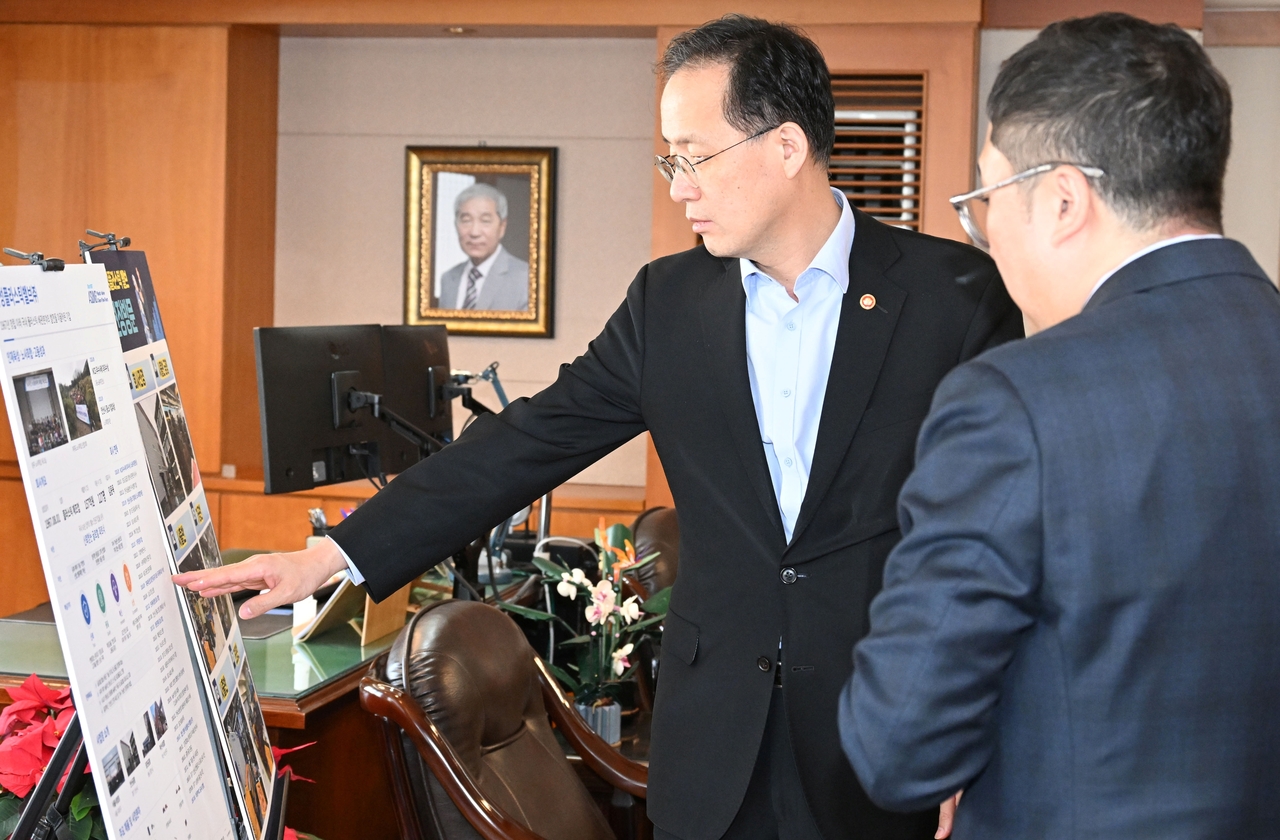
Deputy Prime Minister and Minister of Economy and Finance Lee Hyung-il visited the Seoul headquarters of Asung Plastic Valve in Guro-gu on Wednesday to review the results of the company's wage restructuring and hold a meeting with labor and management representatives. The visit was arranged to examine real-world cases related to wage system reform being discussed by the pan-government polarization response TF, and to explore policy support options.
Asung Plastic Valve had struggled with rising labor costs driven by a growing number of long-tenured employees and a seniority-heavy pay structure, compounded by the departure of skilled workers. In response, the company underwent four rounds of the government's workplace innovation consulting program and gradually introduced a wage-peak system with no pay cuts, along with a job-and-skill-based pay grade for production workers.
Employment indicators improved as the wage restructuring took hold. The turnover rate, which stood at 21.3 percent in 2020, fell to 9.4 percent last year — a drop of 11.9 percentage points. Over the same period, headcount rose 16.5 percent from 109 to 127 employees, and sales grew 29.8 percent from 12.1 billion won ($9.01 million) to 15.7 billion won.
Lee noted that the company had achieved meaningful reform results through labor-management cooperation in the manufacturing sector, where shifting away from seniority-based pay is particularly difficult. A compensation structure that reflects the value of work and individual ability, Lee said, can serve as a foundation for raising workers' motivation and strengthening corporate competitiveness.
The government plans to focus on helping labor and management design their own rational compensation systems autonomously, rather than imposing a uniform wage structure, given that industrial characteristics and business conditions vary from company to company.
The Ministry of Economy and Finance said it will use the pan-government polarization response TF to discuss a range of policy options to support the shift to job- and ability-based pay — including expanding wage information services, strengthening workplace innovation consulting, and broadening incentives for wage structure reform.
fact0514@heraldcorp.com




