The School Non-Regular Workers' Solidarity Council plans a simultaneous nationwide strike Friday, with 50,000 workers expected to march on Seoul. The dispute centers on a wage gap between civil servants and education public service workers, unpaid vacation periods, and a proposed overhaul of education grants.
"If the people responsible for feeding our children could receive fair compensation for their work, I would be willing to pack a lunchbox for a week."
A parent in their 40s raising two sons — one in elementary school and one in middle school — in Sejong expressed support for the school non-regular workers' strike set for Friday. "These are the people responsible for feeding our children, and the compensation they receive for that work is far too meager," the parent said. "At least among the parents around me, I have not heard anyone complaining about this strike."
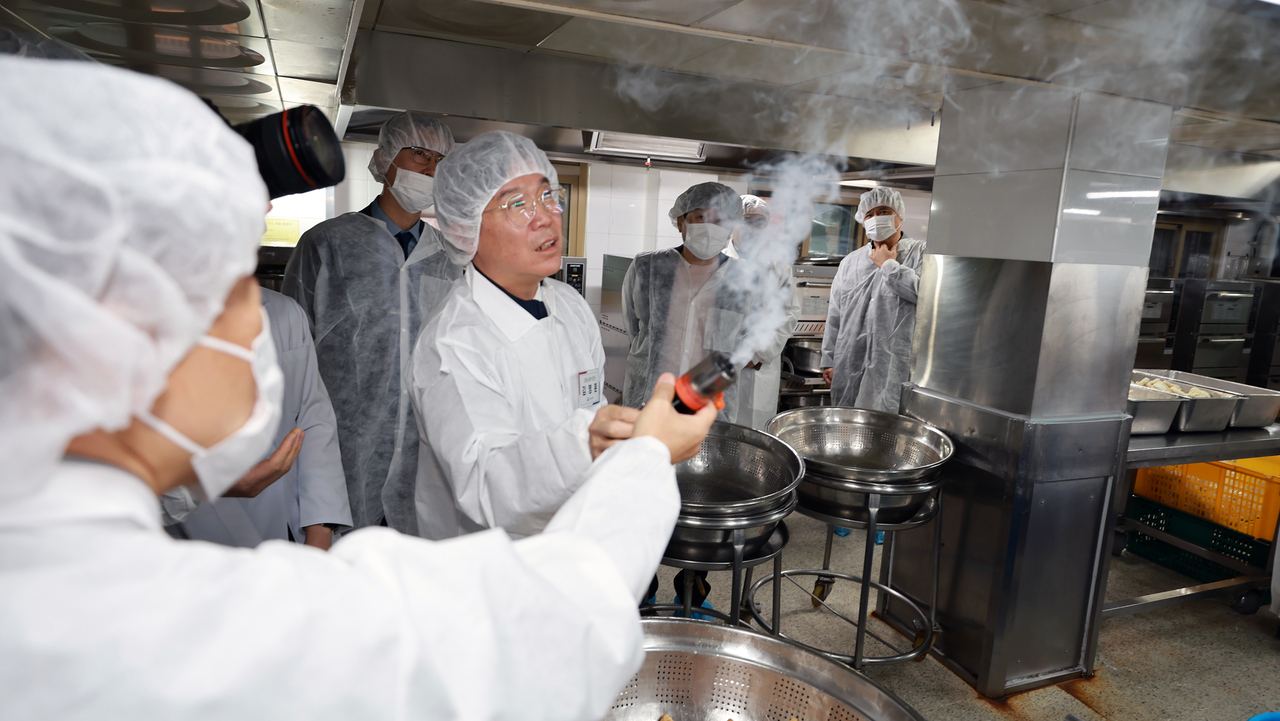
So why have the workers who prepare children's lunches every day decided to swap their hairnets for headbands?
The backdrop is a widening wage gap between civil servants and education public service workers. The government's budget proposal for next year sets the civil servant pay raise at 3.9 percent. By contrast, education authorities offered education public service workers a basic wage increase of only 2.3 percent in collective wage negotiations. Compounding the tension are disputes over unpaid wages during school vacations and the government's proposed restructuring of local education finance grants.
The School Non-Regular Workers' Solidarity Council plans to launch a simultaneous nationwide strike on Friday, according to education and labor sources Wednesday. The council is an alliance of three unions — the National School Non-Regular Workers' Union, the National Education Public Service Workers' Headquarters and the National Women's Workers' Union — with a combined membership of about 92,000. Its members include cafeteria cooks and kitchen workers, as well as elementary school care workers and special education assistants who support educational activities at schools across the country.
Civil servants get 3.9% raise, education workers offered 2.3% — with no pay during vacations
The council demanded collective wage negotiations with the Ministry of Education and 16 city and provincial education offices last July, and formal talks began in September. But the two sides failed to narrow their differences over the size of the basic wage increase and various allowances.
The central sticking point is the scale of the basic wage hike. The council demanded an increase of about 4.9 percent, or 105,000 won ($78) per month. Education authorities countered on Oct. 16 with a 2.3 percent offer, equivalent to 49,300 won a month. That leaves a gap of 55,700 won per month in basic pay.
The authorities' proposed rate is 1.6 percentage points below the 3.9 percent civil servant pay raise built into next year's government budget, and 1.4 percentage points below next year's minimum wage increase of 3.7 percent. Direct comparisons are difficult because the wage calculation systems differ, but the union fears that accepting the offer would widen the pay gap with civil servants even further.
One factor the government cited in setting next year's civil servant pay raise at 3.9 percent was the gap between public and private sector compensation. The Ministry of Planning and Budget said, when it announced the budget proposal, that it had taken into account the ratio of civil servant pay to private sector wages as well as the minimum wage increase rate. The education public service workers' union is similarly demanding that the pay gap with permanent employees be closed.
The loss of income during school vacations is another driver of the strike. A significant number of cafeteria workers are classified as non-working during vacation periods. Even those with indefinite contracts — guaranteeing job security — receive no wages during school breaks. The union is calling for conversion to year-round employment status to address the unpaid vacation problem. Increases to seniority allowances and the elimination of disparities in holiday bonuses are also among the key demands.
In a strike authorization vote the council held from Oct. 19 to Oct. 26, 81.42 percent of all union members participated, and 92.48 percent of those who voted approved the action.
After declaring negotiations broken down on Oct. 22, the council secured the legal right to strike when the National Labor Relations Commission issued a mediation suspension ruling on Nov. 2. The National School Non-Regular Workers' Union announced in a statement Wednesday that 50,000 school non-regular workers from across the country would march on Seoul for the strike on Friday. The actual number of strikers and the number of schools affected by meal disruptions have yet to be confirmed.
Education grants projected to fall 113 trillion won short of current levels; school staffing also at risk
This year, the government's proposed overhaul of local education finance grants has emerged as an additional flashpoint. In September, the government submitted to the National Assembly a bill to scrap the current system that automatically allocates 20.79 percent of domestic tax revenue to education grants, replacing it with a formula that factors in economic growth rates and changes in the school-age population.
The core of the bill is a new grant calculation method that takes the previous year's grant as a base and adjusts it by applying the three-year average annual nominal growth rate along with 35 percent of the three-year average annual change in the school-age population.
According to the National Assembly Budget Office's medium-term fiscal outlook for 2026–2030, if the revised system takes effect, education grants would fall short of what the current system would provide by 34.5 trillion won next year, 30.4 trillion won in 2028, 24.1 trillion won in 2029 and 24.4 trillion won in 2030 — a cumulative shortfall of 113.4 trillion won over four years.
That does not mean the education budget would be cut by those amounts, however. Even under the new system, the grants themselves are projected to grow from 76.4 trillion won this year to 103.7 trillion won by 2030. The government plans to redirect the funds freed up by the new calculation method into education and human resources accounts within a future-response fund.
The union argues that a shrinking student population does not mean reduced demand for education welfare services such as school meals, after-school care and special education. Because the bill does not specify the scale or proportion of funds to be allocated to primary and secondary education, the union contends it would be difficult to secure stable funding for expanding school staffing and improving conditions for education public service workers.
Education authorities, for their part, cannot ignore the fiscal pressure. Personnel costs for education public service workers are paid out of each city and provincial education office's budget. The Seoul Metropolitan Office of Education's personnel costs for education public service workers rose from 742.8 billion won in its 2025 base budget to 841 billion won this year. Next year's budget proposal includes 924.5 billion won — an increase of about 83.5 billion won, or 9.9 percent, over this year. That figure does not yet reflect any additional increases that may result from next year's wage negotiations.
The council plans to hold a large rally in front of the National Assembly on Friday, calling for an end to the low-wage structure for education public service workers, withdrawal of the education grants overhaul bill, and the securing of funds to expand school staffing and improve working conditions.
Unlike last year, when strikes were staged in four regional waves, this year's action will hit the entire country simultaneously, raising concerns about widespread disruptions to school meals and after-school care.
During the nationwide school non-regular workers' strike on Dec. 6, 2024, 26,292 workers — 15 percent of all education public service workers — took part. Normal meal service was disrupted at 3,910 schools, or 30.7 percent of all schools operating cafeterias nationwide — roughly one in three. At 201 elementary schools across the country, after-school care programs also faced disruptions.
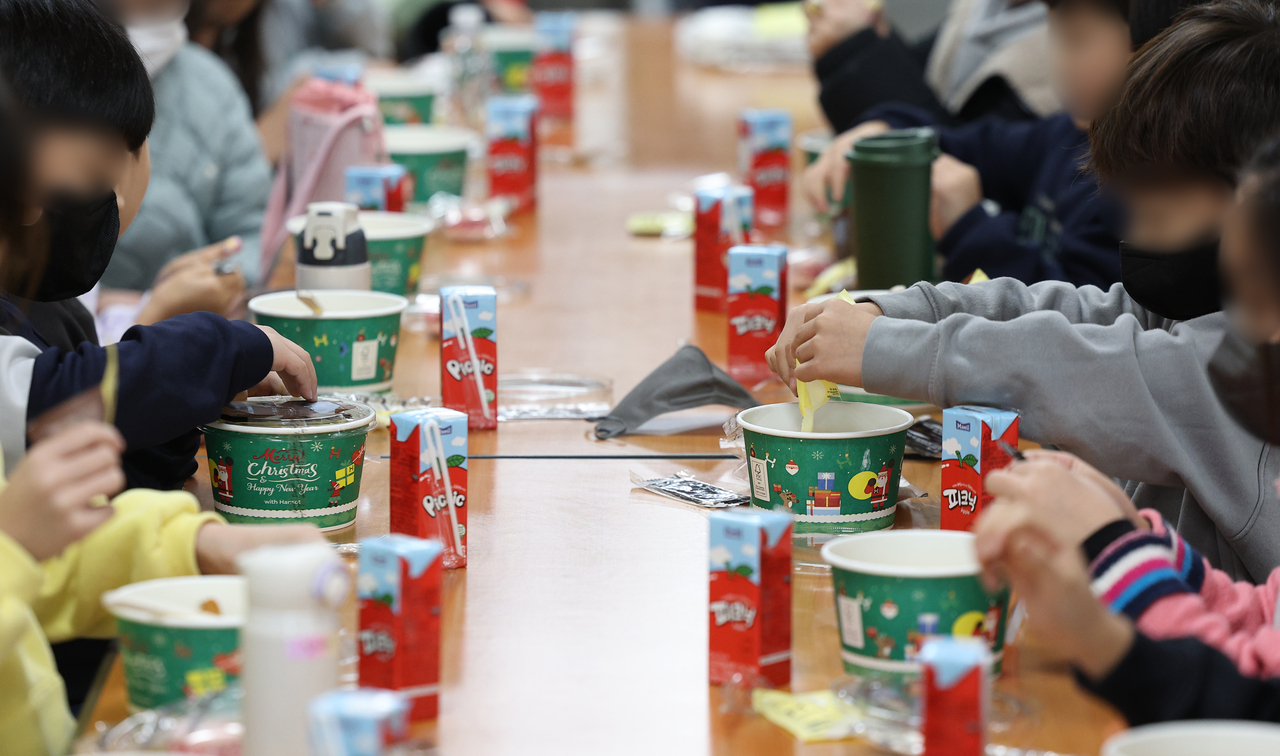
City and provincial education offices have activated emergency response protocols. Schools unable to provide normal meals are arranging substitute food such as bread and milk, or notifying students to bring packed lunches. After-school care classrooms, kindergarten extended-day programs and special education support services will draw on available staff to minimize gaps in coverage.
Even if labor and management reach a last-minute agreement just before the strike, some schools may still be unable to serve normal meals, as advance preparations — including canceling ingredient orders and arranging substitute food — have already been set in motion.
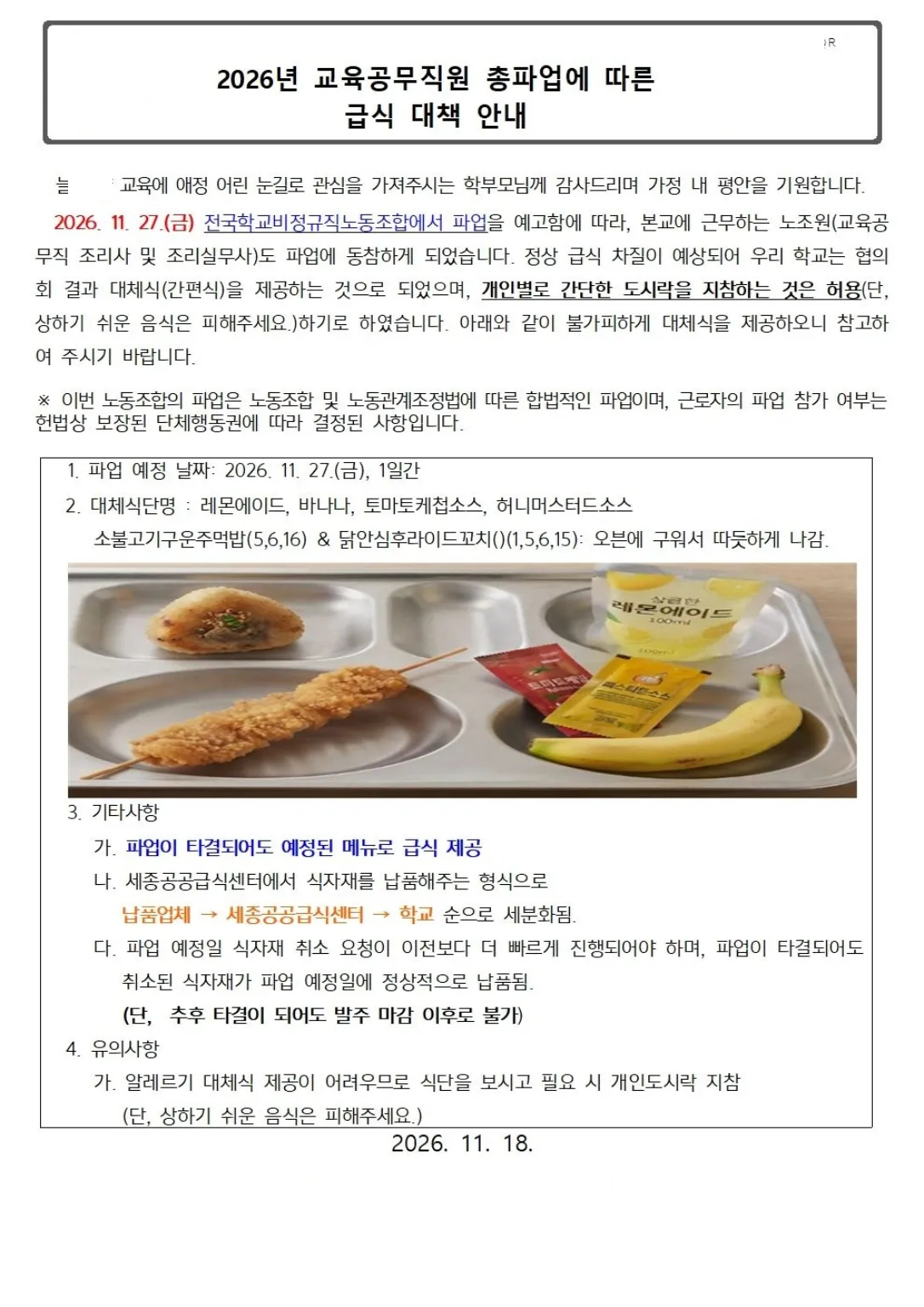
One elementary school in Sejong notified parents Thursday that it would serve bulgogi rice balls, fried chicken skewers, bananas and lemonade for lunch on Friday. A nearby middle school announced Friday that its substitute meal would consist of cream-filled pastries, yogurt, fruit juice, a high-protein energy bar and tangerines. Both schools said the alternative menus would go ahead even if the strike were called off.
fact0514@heraldcorp.com