
Govt projects 50.6% ratio this year vs. Narasallim Research Institute's 43.1%
Gap widens to 5.1 percentage points for next year; nominal growth forecast is key driver
IMF cuts Korea's general government debt ratio forecast for next year from 58.9% to 46.2%
Institute urges updated economic and revenue projections during National Assembly budget review
South Korea's government and a private fiscal research institute are projecting the country's national debt-to-GDP ratio for this year at figures that differ by as much as 7.5 percentage points.
The government expects the ratio to exceed 50 percent this year, while the Narasallim Research Institute estimates it will remain in the 43 percent range once recent economic growth forecasts and a reduction in government bond issuance are factored in. The two sides also diverge by 5.1 percentage points in their projections for next year.
The debt-to-GDP ratio is one of the key indicators used to determine the direction of fiscal policy and the scale of government spending. With the National Assembly currently reviewing next year's budget of 821 trillion won ($611 billion), analysts say the government's fiscal capacity should be reassessed to reflect changed economic and revenue conditions.
According to a report released Wednesday by the Narasallim Research Institute titled "Recalculation of the National Debt Ratio for 2026 and 2027," the D1 national debt-to-GDP ratio is estimated at 43.1 percent this year and 43.2 percent next year. Those figures are 7.5 and 5.1 percentage points lower, respectively, than the 50.6 percent for this year and 48.3 percent for next year that the government presented in its "2026–2030 National Fiscal Management Plan" released earlier this year.
The gap is even wider compared with the government's projections from last year. In its "2025–2029 National Fiscal Management Plan," the government forecast the debt ratio would reach 51.6 percent this year and 53.8 percent next year — 8.5 and 10.6 percentage points higher, respectively, than the institute's estimates.
Semiconductor boom inflates GDP, driving a 9.7-point gap in nominal growth forecasts
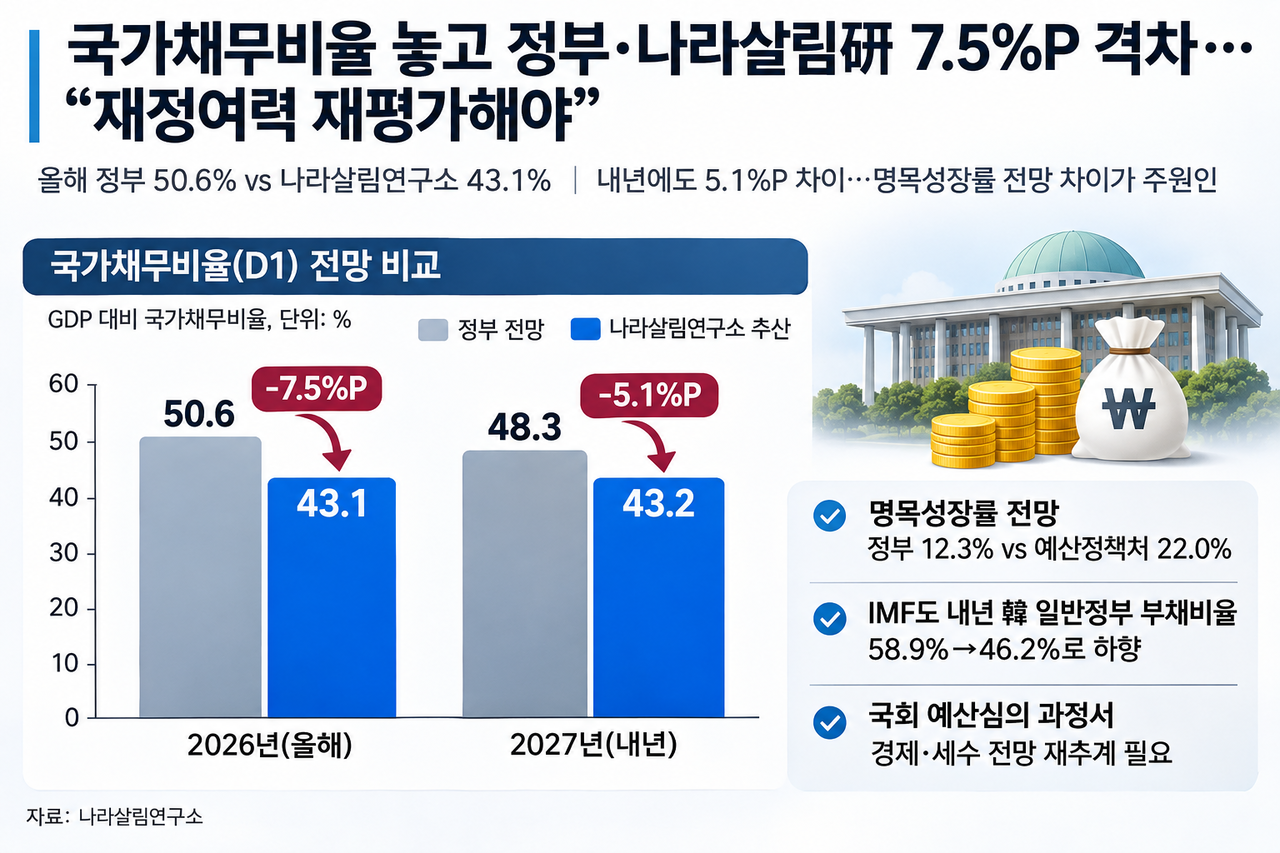
The primary driver of the wide gap between the government's and the institute's debt ratio projections is nominal GDP. Because the debt ratio is calculated by dividing national debt by nominal GDP, the ratio falls as the economy grows even if the absolute level of debt stays the same.
The government applied a nominal GDP growth rate of 12.3 percent for this year in its current fiscal management plan. The IMF, however, projected South Korea's nominal GDP growth at 21.7 percent for this year in its October forecast, and the National Assembly Budget Office put the figure even higher at 22.0 percent — a gap of 9.7 percentage points between the government and the budget office.
The Bank of Korea's actual tally of nominal GDP growth for the first half of this year came in at 21.7 percent. Given that semiconductor prices continued to rise in the second half, the institute said the later-dated projections from the IMF and the National Assembly Budget Office may better reflect reality than the government's estimate.
The Narasallim Research Institute applied the National Assembly Budget Office's nominal growth forecast of 22.0 percent to last year's nominal GDP of 2,676.7 trillion won to arrive at an estimated nominal GDP of 3,265.5 trillion won for this year. Applying next year's projected nominal growth rate of 7.3 percent yields a nominal GDP of 3,503.9 trillion won for next year — 359.7 trillion won more than the government's figure of 3,144.2 trillion won.
Even holding next year's national debt at the government's planned level of 1,519.8 trillion won and adjusting only the nominal GDP figure, the debt ratio would fall from 48.3 percent to 43.4 percent. Factoring in the government's decision in October not to issue an additional 5 trillion won in government bonds — made possible by a tax revenue surplus earlier this year — would bring the ratio down further to 43.2 percent.
IMF cuts Korea debt ratio forecast by 12.7 points, reversing projected upward trend
The IMF has also sharply revised down its forecast for South Korea's general government debt-to-GDP ratio, known as D2. General government debt is a broader measure than national debt, encompassing not only central and local government liabilities but also those of nonprofit public institutions classified under general government — and is the standard metric used for cross-country fiscal comparisons.
In its October 2025 Fiscal Monitor, the IMF projected South Korea's general government debt ratio at 56.7 percent for this year and 58.9 percent for next year. It revised those figures down to 54.4 percent and 56.6 percent, respectively, in its April update.
In its most recent October forecast, however, the IMF cut the projections sharply again — to 47.3 percent for this year and 46.2 percent for next year, lowering the estimates by 9.4 and 12.7 percentage points, respectively, in the span of just one year.
The direction of the projected trend also changed. The October 2025 and April forecasts both showed the debt ratio rising by 2.2 percentage points from this year to next, but the latest forecast projects it will instead fall by 1.1 percentage points.
The institute cautioned, however, against interpreting the scale of revisions to country-level debt ratio forecasts as a direct measure of fiscal improvement. Japan's general government debt calculation methodology changed this year, causing its projected debt ratio for next year to fall by 28.1 percentage points compared with the October 2025 forecast. That statistical reclassification also affected the average figures for major advanced economies, including Japan.
The institute said no comparable change in statistical methodology has been identified for South Korea.
Institute calls for rolling forecasts during budget review and reduced bond issuance
The Narasallim Research Institute recommended that the government move beyond the economic projections used when drafting the budget and instead reassess its fiscal capacity during the National Assembly's budget review process, incorporating the latest economic indicators and revenue data.
The institute called for a rolling forecast approach — continuously updating economic and revenue projections during the review process to reflect newly available national accounts data, corporate earnings, tax collection figures and government bond issuance plans.
Such an approach, the institute said, would allow policymakers to decide whether to direct additional revenue toward support for vulnerable groups and infrastructure investment, set it aside as a fiscal stabilization reserve against future revenue shortfalls, or use it to reduce new government bond issuance.
The institute also proposed depositing idle funds from the Future Response Fund — which the government plans to establish next year — into the Public Fund Management Fund, a move that would allow the government to maintain fund assets while reducing external bond issuance.
The institute cautioned, however, that a lower debt ratio driven by economic growth does not mean the absolute level of national debt or the interest burden has decreased. Rather than using a declining debt ratio alone to justify additional bond issuance, the institute said policymakers should weigh the necessity and effectiveness of fiscal spending alongside government bond yields and other factors.
"Fiscal management must reflect the changed scale of the economy and revenue conditions," said Lee Sang-min, a senior research fellow at the Narasallim Research Institute. "Accurately assessing the improved fiscal capacity relative to past projections, and allocating it appropriately among necessary spending, fiscal stabilization reserves and reduced bond issuance, is the central task of the 2027 budget review."
fact0514@heraldcorp.com




