
Shenzhou-24 docks with China's independent space station, carrying Pakistani astronaut
China counters US-led ISS framework by drawing in allied nations; Xi, Pakistani president exchange congratulatory messages; long-duration stay experiment also underway
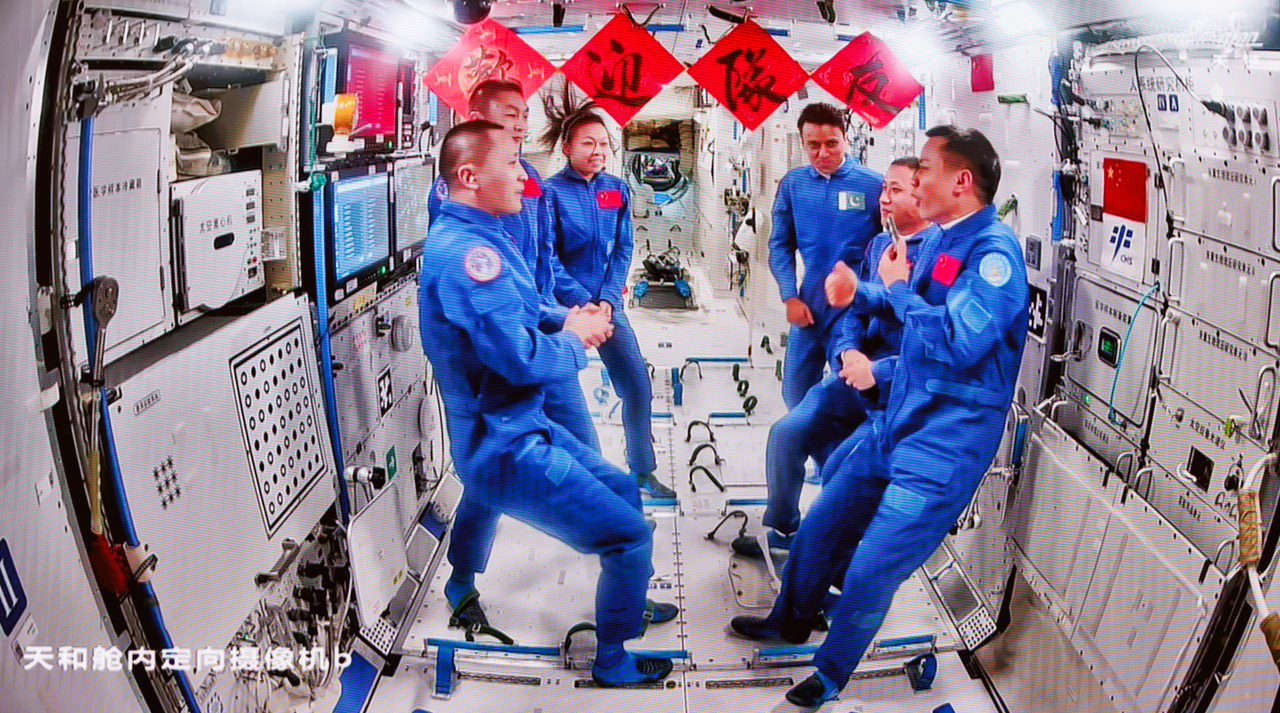
The US-China rivalry in space is expanding beyond lunar exploration into a contest to build competing low-Earth-orbit station ecosystems and rally allied nations. China marked a milestone Wednesday by welcoming the first foreign astronaut aboard Tiangong, its independently built space station, signaling a full-scale push to forge a "space solidarity" bloc to rival the US-led International Space Station framework.
According to China's Human Spaceflight Engineering Office, the crewed spacecraft Shenzhou-24 lifted off Wednesday at 8:18 a.m. (local time) from the Jiuquan Satellite Launch Center in Gansu Province aboard a Long March 2F carrier rocket, and docked successfully with the forward port of Tiangong's core module Tianhe at 11:56 a.m. — roughly three and a half hours after launch.
The mission's most significant dimension in the context of US-China space competition is the first-ever foreign astronaut aboard a Chinese spacecraft. Shenzhou-24 carried two Chinese astronauts — commander Tang Hongbo and flight engineer Wu Yi — along with Pakistani payload specialist Muhammad Zishan Ali.
China was excluded from the International Space Station project, which the United States and Russia launched in 1998, and has since poured resources into building its own station. It is now opening Tiangong's doors to partner nations in a bid to secure space allies.
As the United States rallies South Korea, Japan, Europe and other partners through the Artemis Accords to set the norms for space exploration, China is firing back by forming its own space cooperation bloc centered on Belt and Road partners and developing nations.
Both countries' top leaders moved quickly to frame the mission as a diplomatic and strategic achievement. Xi Jinping and Pakistani President Asif Ali Zardari exchanged congratulatory messages Wednesday, putting their "space honeymoon" on full display.
Xi said the friendship between China and Pakistan had remained "as solid as a rock" over 75 years of diplomatic relations, and said the two countries' astronauts venturing into space together was "a new and important achievement in bilateral cooperation."
Zardari called it "an outstanding achievement of China's space science and technology" and said the mission would "further advance the all-weather strategic cooperative partnership" between the two nations.
After entering Tiangong, Ali met the crew of Shenzhou-23, who were already aboard the station. Ali will work alongside the Chinese astronauts on station operations and conduct joint China-Pakistan scientific experiments.
The crew is scheduled to carry out a series of international joint experiments across fields including space life sciences, human physiology research, microgravity physics and new space technologies.
The mission also serves to demonstrate China's technical self-reliance and long-duration spaceflight capability. After completing the mission, Ali will return to Earth together with Shenzhou-23 astronauts Zhang Zhiyuan and Li Jiaying, who have been aboard Tiangong since May. Chinese astronaut Zhu Yangzhu will remain on the station to begin the first year-long spaceflight endurance experiment by a Chinese astronaut — a data-gathering effort aimed at future lunar base construction and deep-space crewed exploration.
The launch was China's eighth crewed spaceflight since the country entered the operational phase of its space station program, and the 41st launch mission since it began its crewed space development project. With this mission, China has now sent a total of 32 people into space — 31 Chinese and one foreign national — further expanding its independent sphere of influence in the contest for space supremacy with the United States.
silverpaper@heraldcorp.com




