
Former President Yoon Suk Yeol testifies as witness at Kim Tae-hyo trial, denying he ordered messages to allies; disputes Signal call claim, saying he was asleep on a sofa at the time
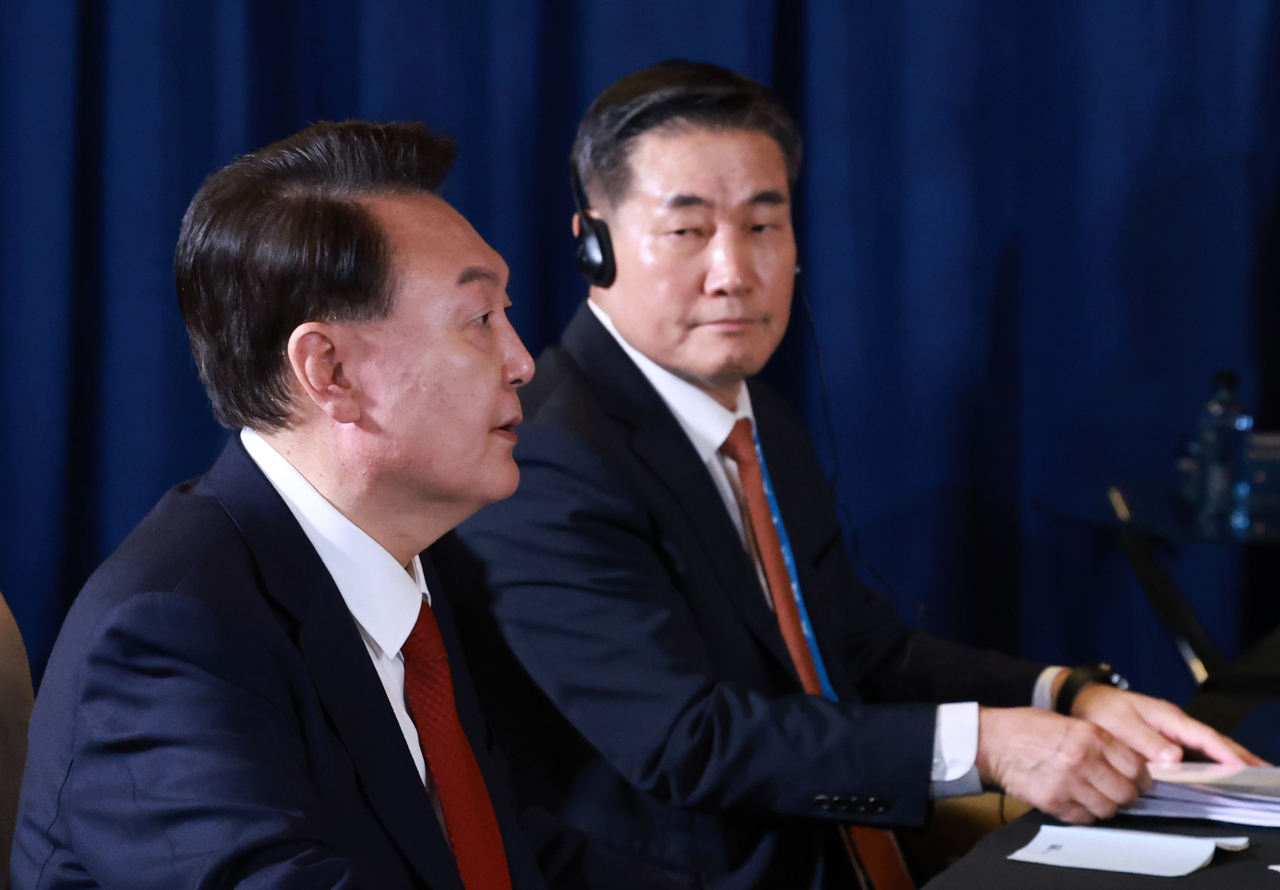
Former President Yoon Suk Yeol and his former top security aide Kim Tae-hyo offered sharply conflicting accounts in court Wednesday over allegations that messages were sent to key allies justifying the Dec. 3 emergency martial law declaration shortly after it was announced.
Yoon appeared as a witness at the Seoul Central District Court trial of Kim, who faces charges of participating in insurrection and obstructing the exercise of rights through abuse of authority. Yoon denied ordering the transmission of messages to justify the martial law declaration.
The two sides clashed in court over how messages delivered to the United States immediately after the martial law declaration came about and whether Yoon had directed their dispatch.
When the special prosecutor's team asked whether the intent behind ordering the justification messages was to secure US support, Yoon pushed back. "If I had staged a military coup like Park Chung-hee's May 16, I would have needed support — but in this situation, what was there to gain or lose from it?" he said.
Yoon also referenced the precedent of the October 1972 Yushin declaration, when the then-government summoned the US ambassador to Cheong Wa Dae for a prior briefing, arguing that the Dec. 3 emergency martial law was not a situation requiring American backing.
According to Yoon's testimony, around 10:50 p.m. on Dec. 3 — the night of the martial law declaration — he instructed then-Foreign Affairs Minister Cho Tae-yul to brief ambassadors stationed in South Korea if they made inquiries, while the presidential office would reach out to the US side first.
Yoon said that at a subsequent meeting with then-National Security Office chief Shin Won-sik and Kim, he directed them to brief US Ambassador to South Korea Philip Goldberg based on the official statement, telling them not to omit two key points: "that this was not a military dictatorship but a firm defense of liberal democracy, and that the Korea-US relationship is not in jeopardy."
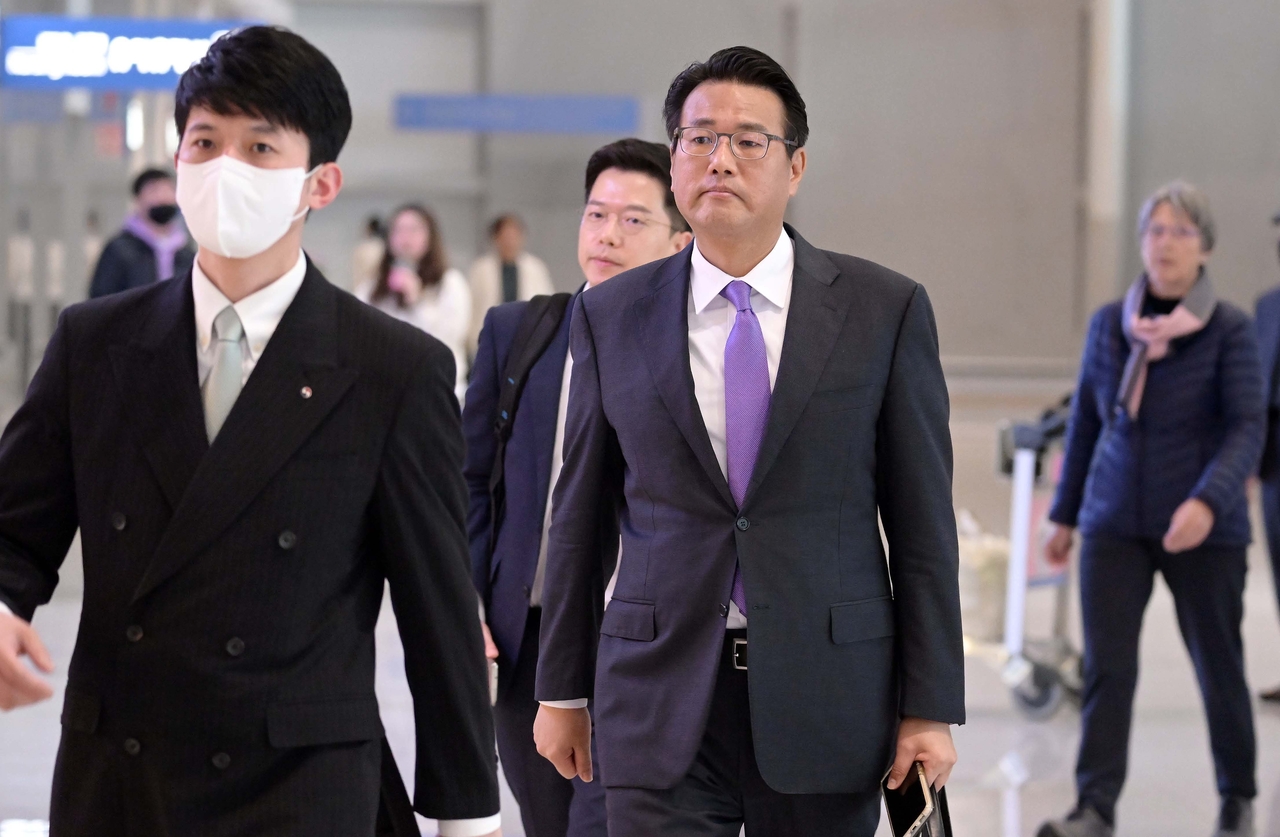
Yoon also said that when Kim reported to him around 2 a.m. on Dec. 4 that Ambassador Goldberg had reacted negatively, he simply replied that lifting martial law soon would resolve the matter — and denied issuing any separate directive to spread justification messages.
Yoon rejected the claim by Kim's side that he had personally dictated messages to be relayed to allied nations during a call over the encrypted messaging app Signal around 9 a.m. on Dec. 4.
"I came home a little after 6 a.m. after talking with the prime minister and the chief of staff. I hadn't slept at all, so after finishing a call with former Defense Minister Kim Yong-hyun at 7:14 a.m., I fell asleep on the sofa in the second-floor living room of the residence," Yoon said. "I have no memory of making a call at that time, and there is no possibility that I did." He added that he had only begun using Signal after returning his secure phone, and that there was no reason to use an encrypted messenger after martial law had been lifted.
The dispute extended to the specific wording of the messages, with Yoon and Kim's defense counsel continuing to argue over the language used.
Regarding the phrase in the messages describing the martial law as "a political demonstration (Political Demonstration) within the bounds of the constitution," Yoon said it sounded "like saying I put on some kind of show" and called it inconsistent with his usual manner of expression.
When Kim's side countered — "You said the purpose of martial law was to deliver an appeal and a warning to the public; isn't that, in short, a 'political demonstration'?" — Yoon shot back: "I have never once used the phrase 'political demonstration.'"
Yoon also questioned the phrase "governing the country based on Christian values," saying it did not fit the circumstances at the time. When Kim's side cited testimony from former National Security Office chief Shin, Yoon pushed back: "Get your facts straight. He said himself that he had been mistaken."
When the presiding judges asked whether Kim and others had reacted negatively when instructed to brief the US ambassador, Yoon said: "If they couldn't do it, they would have said something like 'this is a bit much' — the reaction should be taken as one of acceptance."
Kim is on trial on charges of using foreign ministry officials to promote messages to the United States and other key allies shortly after the emergency martial law declaration, framing the declaration as "a political demonstration within the constitutional framework to defend liberal democracy and counter pro-North Korea leftists and anti-American sentiment."
The comprehensive special prosecutor's team led by Kwon Chang-young has separately indicted both Yoon and former National Security Office chief Shin on the same charges.
silverpaper@heraldcorp.com




