
Kospi falls to 4,697 — lowest since January
Tuesday's surge fully reversed; intraday low off 50% from peak
Foreigners net sell 1.9 trillion won; individuals net buy 1.4 trillion won
Samsung Electronics market cap falls below 1,000 trillion won; SK hynix drops 11%
Sidecar triggers reach 102 times this year — 51 buy, 51 sell
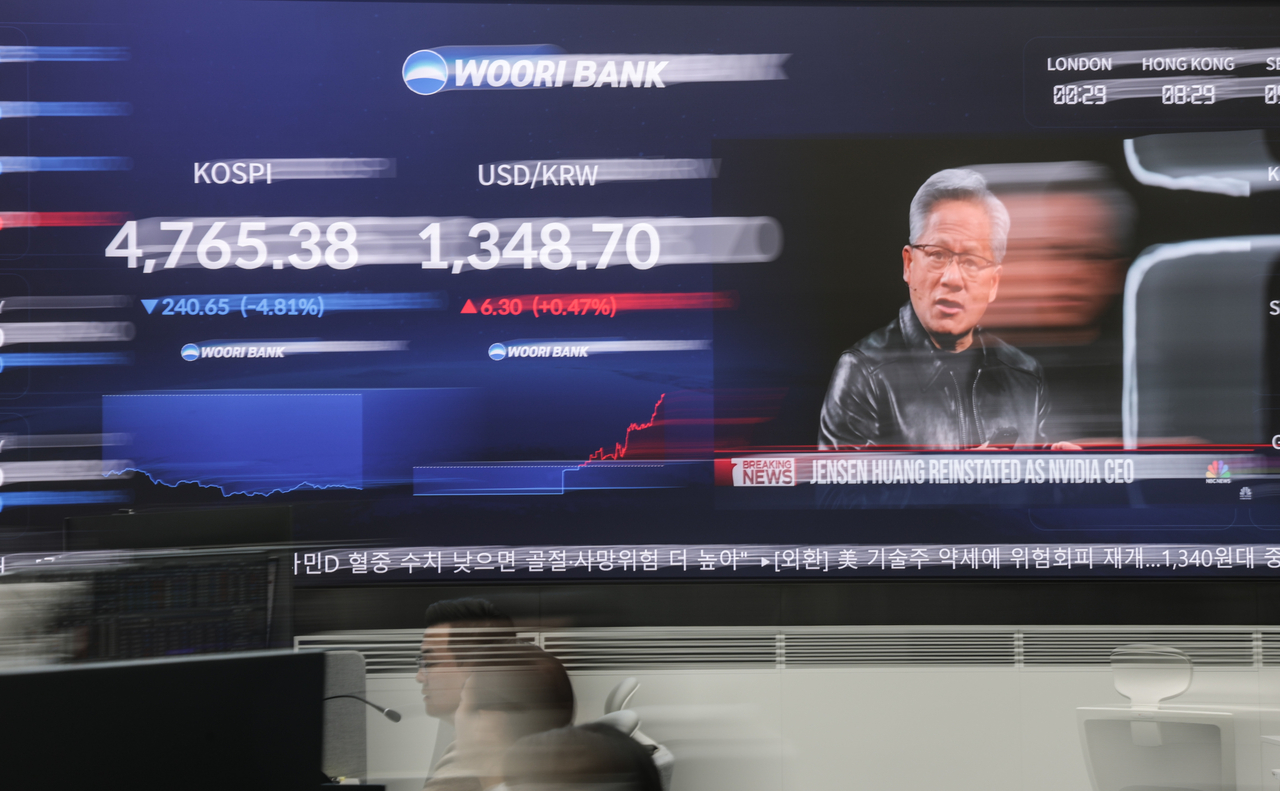
The Kospi surrendered Tuesday's sharp rebound in a single session Wednesday, tumbling more than 6% to fall back below the 4,700 level. Foreigners sold close to 2 trillion won ($1.49 billion) net, while major semiconductor stocks including Samsung Electronics and SK hynix led the decline, pushing the index more than 50% below its intraday peak.
Extreme volatility triggered a sell-side sidecar on the Kospi, bringing the total number of sidecar activations on the domestic market this year to 102 — 51 on the buy side and 51 on the sell side — underscoring the violent swings in both directions throughout the year.
The Kospi closed down 308.52 points, or 6.16%, at 4,697.51, according to Korea Exchange. It was the lowest closing level since Jan. 13 (4,692.64), a span of roughly 10 months. The plunge wiped out all of Tuesday's gain of 297.49 points, or 6.32%, which had been driven by news of Nvidia CEO Jensen Huang's return to management.
The index opened down 197.03 points, or 3.94%, at 4,809.00, and losses deepened from there. A sell-side sidecar — a temporary suspension of program sell orders — was triggered just eight minutes after the open. Selling intensified in the afternoon, with the index touching an intraday low of 4,672.55, down 6.66%, at one point. That trough was 50.22% below the intraday record high of 9,385.59 set on June 19.
Since 2000, the Kospi has fallen 50 percent or more from a peak on only four occasions: the dot-com bubble in the early 2000s, the credit card crisis in 2003, the global financial crisis in 2008, and this year. The index's total market capitalization fell to 3,847.66 trillion won, dropping back into the 3,000 trillion won range in a single day.
Foreigners led the selling, posting net sales of 1.9 trillion won on the main board — flipping to net sellers after a single session of buying. It was the largest net selling since Nov. 6 (2.69 trillion won). Institutions were net sellers of 800 million won, while individuals were net buyers of 1.42 trillion won. Other corporations, a category that reflects corporate buybacks, posted net purchases of 476.9 billion won.
The Kospi's sharp drop appeared to reflect continued weakness in US technology stocks overnight, as sentiment toward AI investment remained fragile. Uncertainty surrounding AI persisted amid a US Senate hearing involving Huang and an accounting investigation into Nvidia.
Caution around AI investment was further heightened by BNP Paribas's warning of a memory chip supply glut and Anthropic's shares trading below their offering price.
Samsung Electronics closed down 9.87% at 170,700 won, its lowest level since March 31 (167,200 won). Its market cap fell to 997.96 trillion won, slipping below the 1,000 trillion won mark for the first time in roughly eight months. SK hynix closed down 11.05% at 1.03 million won, its lowest since April 10 (1.03 million won).
Other large-cap stocks also fell sharply: SK Square dropped 11.19%, Samsung Electro-Mechanics 12.00%, Samsung Life Insurance 10.93%, LG Energy Solution 1.91% and KB Financial Group 2.18%.
Pharmaceutical and biotech stocks bucked the trend, with Samsung Biologics rising 5.66% and Celltrion gaining 3.83%. Kia edged up 0.42%. Cosmetics stocks broadly advanced, with Hankook Cosmetics Manufacturing surging 11.27%, Cosmax climbing 12.18% and APR gaining 10.82%. Daol Investment & Securities soared 25.94% after reports emerged that Daol Financial Group Chairman Lee Byung-chul was considering selling his controlling stake.
The Kosdaq also fell, closing down 15.24 points, or 2.29%, at 650.64. The index opened lower by 11.67 points, or 1.75%, at 654.21, and losses continued through the session.
The index briefly appeared to stabilize and attempted a partial recovery, but selling pressure intensified in the afternoon, with the Kosdaq touching an intraday low of 641.08, down 3.72%. On the Kosdaq, foreigners were net buyers of 1.3 billion won and institutions net buyers of 26.8 billion won, while individuals were net sellers of 34.7 billion won.
Semiconductor materials, parts and equipment stocks were among the hardest hit, with Jusung Engineering falling 11.42%, Simtec dropping 6.51%, Leeno Industrial declining 5.67% and EO Technics sliding 8.89%. Secondary battery stocks also weakened, with Ecopro BM down 4.64% and Ecopro off 5.01%. Robot-related shares retreated as well, with Rainbow Robotics falling 1.8% and Robotis declining 1.87%.
Sidecars — covering both buy and sell triggers — were activated on the main board for four consecutive trading sessions starting Friday. Including both the Kospi and Kosdaq, sidecar activations on the domestic market reached a total of 102 this year through Wednesday.
The won weakened slightly against the dollar. The won-dollar exchange rate stood at 1,343.2 won per dollar at 3:30 p.m. in the Seoul foreign exchange market, up 0.8 won from the previous session.
th5@heraldcorp.com




