
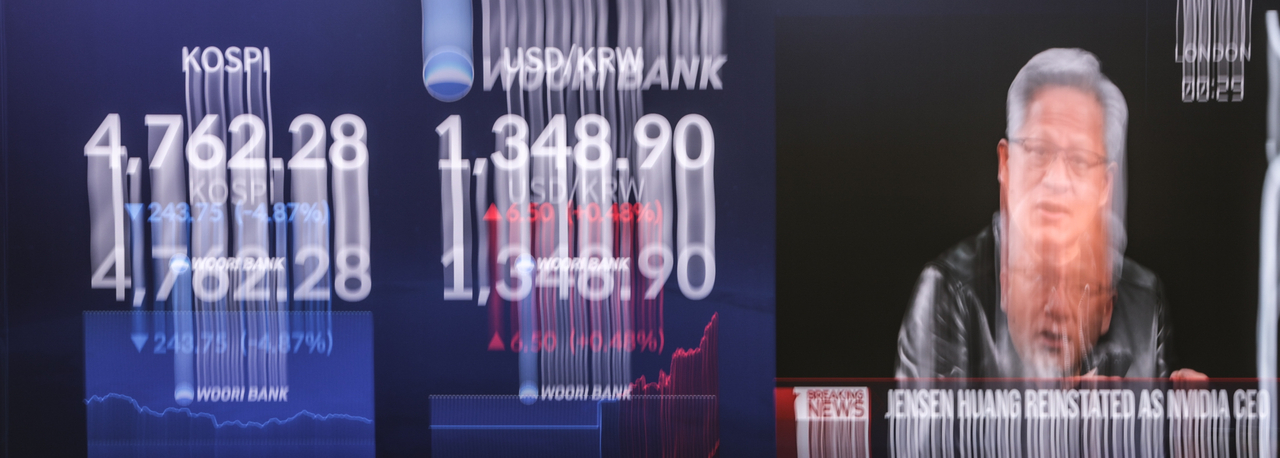
The Kospi, which had surged sharply on Tuesday, reversed course Wednesday, plunging more than 4% to fall back toward the 4,700 level. Samsung Electronics and SK hynix each dropped more than 7% amid weakness in US semiconductor stocks and lingering uncertainty surrounding Nvidia, with a sell-side sidecar triggered in early trading.
Sidecar activations across the Kospi and Kosdaq markets have now reached a combined 102 times this year. With buy-side and sell-side sidecars each triggered exactly 51 times, the figures underscore the extreme two-way volatility gripping South Korean equities.
According to Korea Exchange, the Kospi opened Wednesday down 197.03 points, or 3.94 percent, at 4,809.00 and extended its losses from there. At one point the index was off more than 5 percent, prompting a sell-side sidecar — a temporary suspension of program sell orders — at around 9:08 a.m.
Domestic markets have been experiencing unprecedented volatility this year, with sidecar triggers becoming almost routine and volatility indexes remaining elevated.
As of Wednesday morning, the Kospi had seen 29 buy-side and 33 sell-side sidecar activations this year. On Kosdaq, buy-side sidecars had been triggered 22 times and sell-side sidecars 18 times. Combined across both markets, the tally stands at 51 buy-side and 51 sell-side activations — a near-perfect split reflecting violent swings in both directions.
Foreign investors are leading the decline, posting net selling of 420.6 billion won ($313 million) — a reversal from net buying just one session earlier. Institutional investors are also net sellers, offloading 55.4 billion won. Retail investors are on the buy side with net purchases of 448.7 billion won, while other corporate investors are net buyers of 25.6 billion won.
The early selloff appears to reflect overnight weakness on Wall Street, where the NASDAQ Composite fell 1.48 percent and the Philadelphia Semiconductor Index dropped 7.88 percent.
Although Nvidia CEO Jensen Huang has returned to the helm after stepping down amid a scandal, anxiety persists over a US Senate hearing targeting him and a regulatory accounting investigation. Expectations that the United States will soon announce "overproduction tariffs" imposing relatively high duties on Chinese goods have also weighed on investor sentiment.
Samsung Electronics and SK hynix, which had each gained around 6 percent on Tuesday, are now down 7.39 percent and 7.08 percent, respectively. Daol Investment & Securities is surging after reports emerged that Lee Byung-chul, chairman of Daol Financial Group, may be selling his controlling stake.
Kosdaq is also under pressure. The index opened down 11.67 points, or 1.75 percent, at 654.21 and has since deepened its losses. On Kosdaq, foreign investors and institutional investors are net sellers of 48.2 billion won and 7.8 billion won, respectively, while retail investors hold a net buying advantage of 53.4 billion won.

th5@heraldcorp.com




