
Todd Fox of Visa's Economic Empowerment Institute delivers keynote at Korea Fintech Week 2026
Korea praised for widespread digital payments and global financial access
Blockchain-driven transaction simplification and system interoperability highlighted as priorities
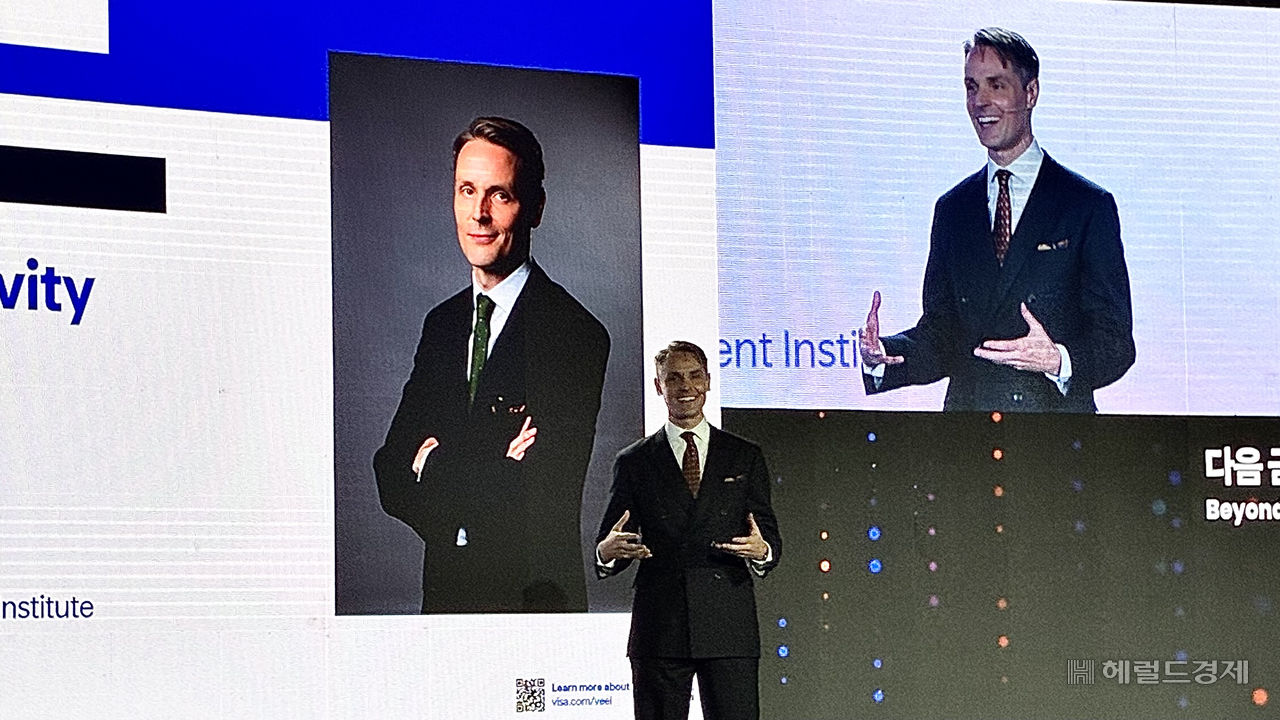
Global payments technology company Visa has described South Korea as a market that already embodies the future of finance — one that other countries aspire to reach. The assessment rests on Korea's widespread adoption of digital payments and its strong connections to global financial markets. However, Visa said significant room remains to deepen connectivity among domestic financial institutions, and identified streamlining transactions through blockchain and ensuring interoperability between legacy and new financial systems as the central challenges ahead.
Todd Fox, head of Visa's Economic Empowerment Institute, made the remarks Wednesday in a keynote address at the opening ceremony of Korea Fintech Week 2026, held at the Korea Agro-Fisheries & Food Trade Corp. (aT) Center in Yangjae, Seoul. Fox named connectivity, interoperability and trust as the three factors that will shape the direction of financial innovation going forward.
Fox also unveiled a new index — the Financial Connectivity Indicator (FCI) — that measures financial connectivity across 42 economies worldwide.
"Connectivity remains one of the biggest unsolved problems in financial technology," Fox said. "The index assesses how much money moves across borders and how well each country's regulatory environment supports that financial connectivity."
The FCI tracks not only actual flows of funds — including trade, investment and remittances — but also how effectively each country's regulations and financial infrastructure facilitate those movements.
According to Visa, cross-border capital flows across the 42 economies surveyed are expanding faster than the institutional and structural conditions that underpin them, meaning that even as money moves more freely, financial infrastructure and regulatory frameworks may struggle to keep pace.
Fox offered a positive assessment of Korea's international financial connectivity. "Korean consumers, merchants and financial institutions access global markets through a robust cross-border network," Fox said. "At a time of deepening geopolitical fragmentation, Korea stands out as a country with particularly strong financial connectivity."
Still, Fox said "there are considerable opportunities to further strengthen connectivity within and among Korean financial institutions," adding that moving digital assets on blockchain could "dramatically simplify domestic and cross-border financial transactions and reduce friction in the process."
Fox also stressed the need to secure interoperability between new payment methods and existing financial systems, warning that new financial services unable to integrate smoothly with legacy infrastructure risk making transactions more complicated rather than less.
"There is still a great deal of friction in the current financial system," Fox said. "If interoperability is not built into system design from the outset, innovations in new payment methods and financial services could make these problems worse."
Fox added that interoperability does not mean full unification of all systems, but that newly built systems must be compatible with those already in place.
Fox also flagged maintaining trust in existing financial systems as a key challenge during the innovation process, warning that technologies driving financial change — including AI and virtual assets — could, if misused, erode confidence in financial services and weigh on economic growth.
Fox called for public and private sector collaboration to strengthen the security and resilience of the financial system, saying cooperation between the two sides is essential throughout the innovation process.
snsd@heraldcorp.com




