
Keynote address at Toss Insight Future Finance Forum on Tuesday
Korea leads in fintech but lags in global industry competitiveness
Frequent CEO turnover, lack of autonomy cited as key obstacles
Won-denominated stablecoin poses capital outflow risk, Lee warns
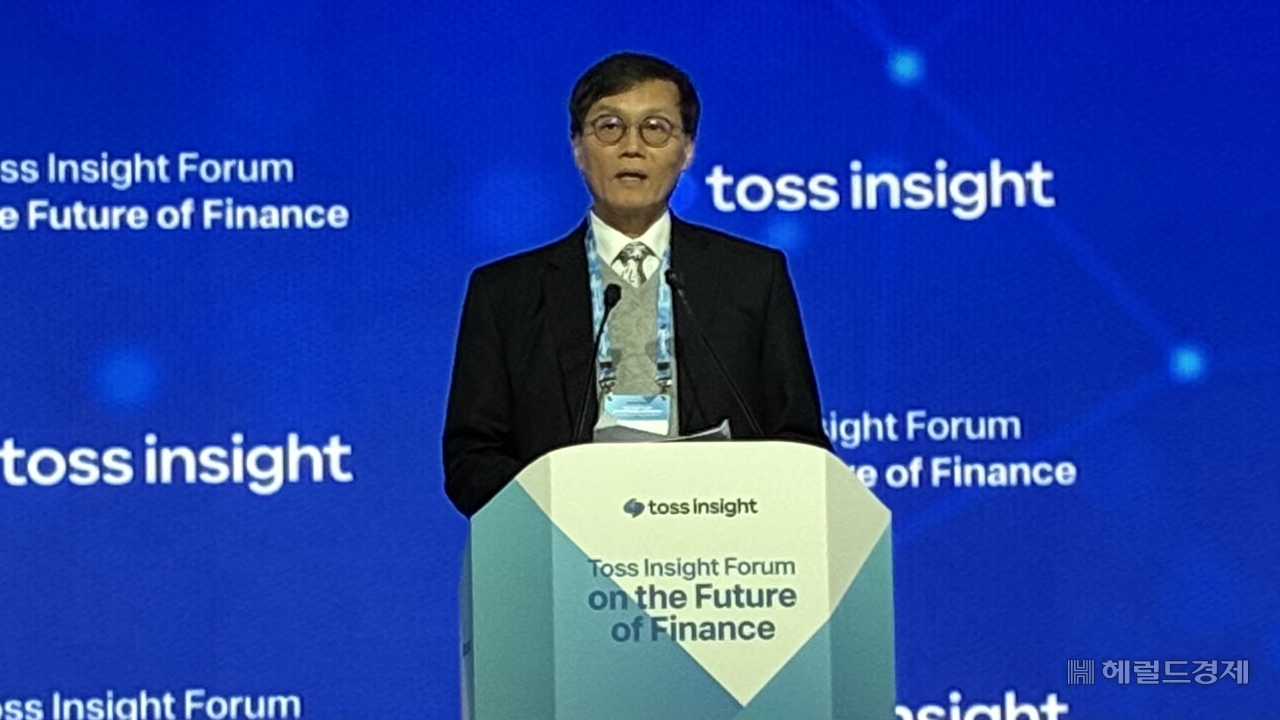
Former Bank of Korea Governor Lee Chang-yong called Tuesday for greater managerial autonomy for financial firms as a way to strengthen the international competitiveness of South Korea's financial industry. Despite domestic financial technology and services having already reached world-class levels, a prevailing social perception that treats finance primarily as a policy instrument — rather than an industry in its own right — is holding back its independent growth, Lee said.
"We must stop repeating the slogan that we want to nurture the financial industry into a high-value-added sector competing in global markets, while at the same time viewing it only as a policy tool," Lee said in a keynote address at the Toss Insight Future Finance Forum held at the Westin Josun Seoul in Jung-gu, Seoul.
Lee's assessment was that while domestic fintech and financial services have reached the level of advanced economies, the industry's international standing has not kept pace. Manufacturing has produced global champions such as Samsung Electronics and SK hynix, he noted, yet the financial sector has failed to produce a single globally recognized firm of comparable stature.
Data Lee presented at the forum illustrated the gap. The combined overseas assets of 16 domestic securities firms stood at just 7.2 percent of their domestic assets at the end of last year. South Korea-based trading desks accounted for only 0.7 percent of global over-the-counter foreign exchange transactions last year. As of March this year, the average price-to-book ratio of major domestic banks was 0.7 — far below the roughly 2 times recorded by major US banks.
Lee pointed to a divergence in how financial public interest is understood at home and abroad as a key reason for this gap. "The public interest of finance is fundamentally about the stability of the financial system and consumer protection," he said. "In Korea, however, the concept has increasingly been linked to supporting the real economy and protecting vulnerable groups, which has fostered a tendency to view financial firms' pursuit of profit or overseas expansion in a relatively negative light."
Lee said this mindset is also reflected in what society demands of financial firms — expecting them to give back to the community when they post strong earnings, or pressuring them to prop up the stock market when share prices fall even without any underlying problem in the financial system.
He argued the same attitude can impede the development of risk management capabilities. "If financial firms do not accumulate enough experience making their own business judgments and taking responsibility for the outcomes, their capacity to assess and manage the risks of new industries will also struggle to develop," Lee said. He added that domestic financial firms' heavy reliance on real estate loans backed by solid collateral, rather than channeling funds into new industries, reflects the limits of this entrenched practice.
Lee also offered pointed criticism of the frequent turnover of bank executives. "If there is a culture that considers it strange for a bank chief executive to serve more than three years, truly professional bank chiefs cannot emerge," he said. "Overseas market expansion, which requires long-term investment and consistent strategy, will inevitably be stifled as well."
He reiterated that it was contradictory to keep calling for the financial industry to become a globally competitive, high-value-added sector while simultaneously treating it as nothing more than a policy instrument.
Lee was more cautious, however, on capital market liberalization and the internationalization of the won, citing the risk that domestic funds could flow out en masse if military tensions related to North Korea were to escalate.
"If won-denominated stablecoins make cross-border fund transfers easier, there is a risk that existing capital flow regulations could in effect be rendered meaningless," Lee said. He explained that his earlier advocacy, during his tenure as Bank of Korea governor, for won stablecoins issued through banks was intended to keep that risk manageable within the existing financial supervisory framework.
"If possible, I would like to see a framework in which foreign investors have fully open access to domestic markets, while necessary oversight is maintained over the overseas transfer of funds by domestic residents," he said. He added, however, that it was hard to be confident whether applying different regulations to domestic and foreign residents would be practically feasible given the rapid spread of new digital payment instruments.
On areas within financial technology itself that still need improvement, Lee singled out cybersecurity. "Even if we have reached an advanced level across financial technology broadly, security is the exception," he said. He noted that network separation regulations have contributed to the safety of the financial system but have also constrained the development of new security technologies and widened the gap with international standards.
Lee called for security regulations to be reformed to allow broader use of new technologies such as AI and cloud computing while enabling more sophisticated risk management. Improving compatibility with international standards, he said, was essential for domestic financial services to remain competitive in overseas markets.
snsd@heraldcorp.com




