
Hiring-track intern positions fall from 4,616 to 2,903 in one year
Some public institutions scrap intern programs entirely to avoid litigation
Lawsuit payouts counted against total wage bill, unlike for civil servants
Rigid rules seen as obstacle to semiconductor, nuclear energy workforce needs
The number of hiring-track interns at public institutions fell by more than 37 percent in a single year.
A structural flaw in how public institutions manage their total wage bills has been identified as a key factor suppressing youth hiring. When an institution loses a lawsuit — over wage-peak schemes or intern hiring practices — the amount it must pay workers is counted toward its total wage bill. Exceeding that cap then triggers penalties in management evaluations. Critics say the Lee Jae Myung government's push to expand youth employment is being undercut by the very rigidity of the public sector's wage management regime.
According to a report released Wednesday by Ha Tae-wook, director of the Health and Jobs Research Institute, titled "Outcomes and Challenges of the Lee Jae Myung Government's Public Sector Wage Policy," the number of hiring-track interns at public institutions dropped from 4,616 at the end of September last year to 2,903 at the end of September this year — a decline of 1,713, or 37.1 percent. Hiring-track internships are one of the main pathways for young people to enter public institutions, as interns who complete a set period and pass an evaluation can be converted to permanent staff.
Ha noted that some public institutions that lost lawsuits related to hiring-track interns had scrapped their intern programs entirely out of concern over further litigation. He argued that because total wage bill management at public institutions is structured around after-the-fact punishment rather than proactive oversight, institutions have developed an incentive to be cautious about hiring.
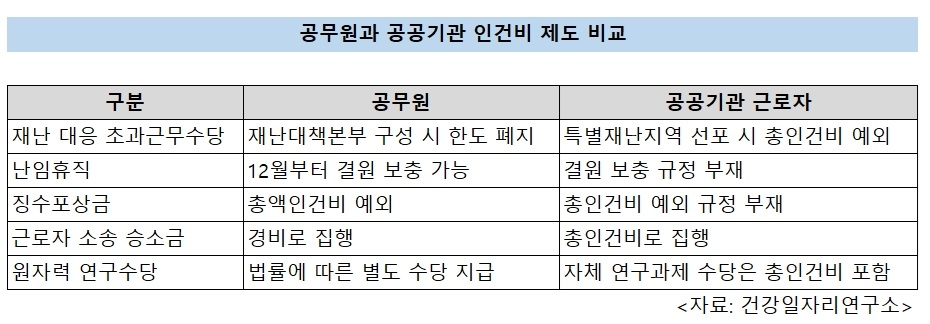
Korea Credit Guarantee Fund (KODIT) offers a concrete example: after losing an annual leave allowance lawsuit brought by employees subject to its wage-peak scheme last year, it was penalized in its management evaluation for exceeding its total wage cap. Under current rules, any amount a public institution pays out following a court loss is counted as part of its total wage bill. By contrast, when a civil servant wins a lawsuit against a central government agency, the payout comes from an operating expense account rather than the total wage bill.
Since the Lee Jae Myung government took office, public institutions have moved gradually toward greater flexibility in managing their total wage bills.
The government last year recognized additional wage bill allocations stemming from the Supreme Court's revised ruling on ordinary wages in July. Starting this year, institutions may carry over unspent wage budget from the previous year. The threshold for backfilling positions vacated by parental leave was also eased, from six months to three months.
Yet a significant gap in wage regulation between civil servants and public institution workers remains.
Tax collection officers, for instance, have been able to receive collection incentive bonuses — introduced in June last year — outside their total wage bill. Workers at public institutions that collect the four major social insurance premiums and public utility fees perform comparable duties but are not entitled to the same exemption for such bonuses.
Civil servants responding to disasters are exempt from overtime pay caps once a disaster response headquarters is activated, while public institutions can only claim a total wage bill exemption after a special disaster zone is formally declared. Starting in December, civil servants will also be allowed to fill vacancies created by fertility treatment leave, but no equivalent provision exists for public institutions.
Concerns are growing that the rigid total wage bill rules could also hamper the development of key national industries.
If a bill on broad special economic zones currently under discussion in the National Assembly includes an exemption from the 52-hour workweek cap, public institutions that supply power and water to the semiconductor industry and other strategic sectors could face significantly heavier workloads. Keeping the total wage bill rules unchanged in that scenario could restrict their ability to pay corresponding overtime allowances.
There are already precedents in which institutions expanded their headcount to carry out national policy mandates but were left without the wage budget to match.
Korea Workers' Compensation and Welfare Service is a prime example. After the government approved an increase of 71 positions following a 2008 revision to the Industrial Accident Compensation Insurance Act, the wage costs for those new hires were never reflected in the institution's total wage bill. The organization has since covered their salaries by drawing on funds originally earmarked for existing staff. Over the past 18 years, the self-funded amount has reached 98.5 billion won ($73.1 million). In effect, existing employees have borne the wage burden created by government policy.
In the nuclear energy sector, research allowances for public institution researchers working on government-funded research and development projects are exempt from the total wage bill, but allowances for internally initiated research projects are not.
Ha proposed that public institutions, like government agencies, should in principle cover lawsuit payouts from operating expense accounts rather than the total wage bill, with inclusion in the wage bill reserved only for cases involving repeated litigation aimed at circumventing wage limits.
Ha also called for stronger pre-emptive reviews of legally vulnerable schemes such as wage-peak arrangements during management evaluations, and urged revisions to budget operation guidelines for public enterprises and quasi-government institutions — as well as to the Nuclear Energy Promotion Act — to expand wage bill exemptions where policy needs demand it.
fact0514@heraldcorp.com




