
Labor minister holds talks with Samsung C&T, SK Eco Plant on workforce shortage
More than 63% of domestic construction workers are in their 50s or older; workers in their 20s and 30s make up just 18%
Training precision pipefitters alone takes one to two years or more
Government to sharply expand vocational training, explore use of retired military personnel
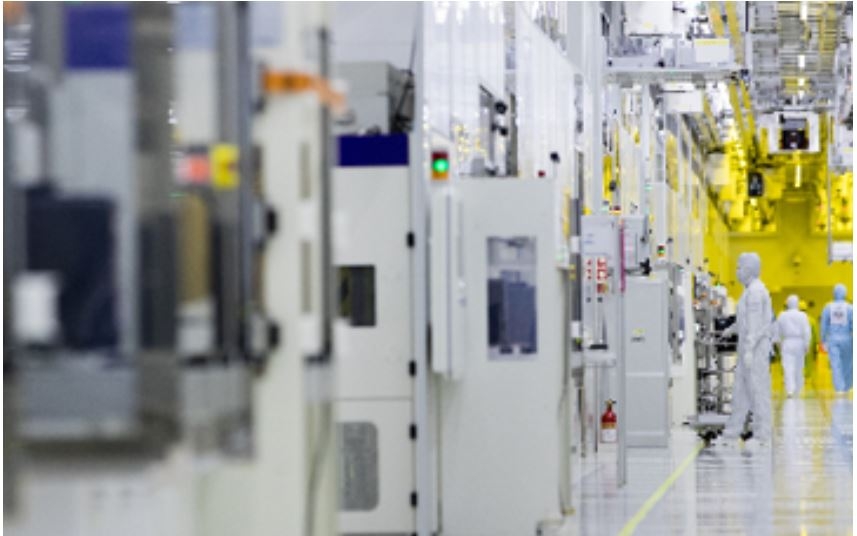
As South Korea's semiconductor megaprojects gather pace, the number of workers needed to build chip fabrication plants is projected to exceed 260,000 by around 2030.
Yet the domestic construction workforce has shrunk by more than 190,000 over the past three years, and more than six in 10 Korean construction workers are now in their 50s or older. A shortage of skilled workers in the mechanical, electrical and piping trades — all essential to building semiconductor production facilities — has emerged as a new bottleneck for large-scale chip investment, prompting the government to roll up its sleeves on workforce development.
The Ministry of Employment and Labor held a meeting Wednesday at the Korea Press Center in Jung-gu, Seoul, chaired by Minister Kim Young-hoon, to discuss training and support for skilled construction workers needed for semiconductor fab projects. Executives from Samsung C&T and SK Eco Plant, officials from the Construction Workers Mutual Aid Association and related industry groups, and the Ministry of Land, Infrastructure and Transport's construction policy director attended.
The meeting was convened ahead of fab construction projects in the southwestern region and elsewhere, with the aim of identifying companies' workforce needs and obstacles and discussing government support measures to ensure skilled workers can be trained and deployed on time. The Ministry of Employment and Labor plans to mobilize all available policy tools, including a sharp expansion of vocational training support in the construction sector.
Unlike ordinary buildings, semiconductor fabs require ultra-precision infrastructure such as specialized piping and cleanrooms. Supplying gases, chemicals and ultrapure water to each production process without contamination or leaks demands highly skilled workers. Yet key trades — mechanical, electrical and piping — are already short-staffed, and training skilled workers quickly is no easy task.
The construction industry raised these concerns at a meeting hosted by the Ministry of Land, Infrastructure and Transport on Tuesday, warning that semiconductor megaprojects will generate massive demand for labor. Companies particularly urged the government to act preemptively on training precision pipefitters, noting that workers in that specialty need more than one to two years of on-site experience and instruction.
Industry estimates put the current workforce at semiconductor fab construction sites at up to 70,000. That figure is expected to rise to about 100,000 by the end of next year, roughly 150,000 by the end of 2028, and between 260,000 and 270,000 by around 2030. Security concerns make it difficult to deploy foreign workers on processes tied to key semiconductor equipment, making a domestic pool of skilled workers critical.
If piping and electrical work proceeds simultaneously at multiple semiconductor factories and AI data centers across the country, competition for a limited supply of skilled workers could intensify, potentially driving up labor costs and delaying construction schedules.
"Without skilled workers to connect the pipes, lay the electrical lines and build the cleanrooms, fabs cannot be completed on time," Kim said. "Companies know best which trades are needed, when and in what numbers, so the government will work closely with industry to ensure workers are supplied when they are needed."
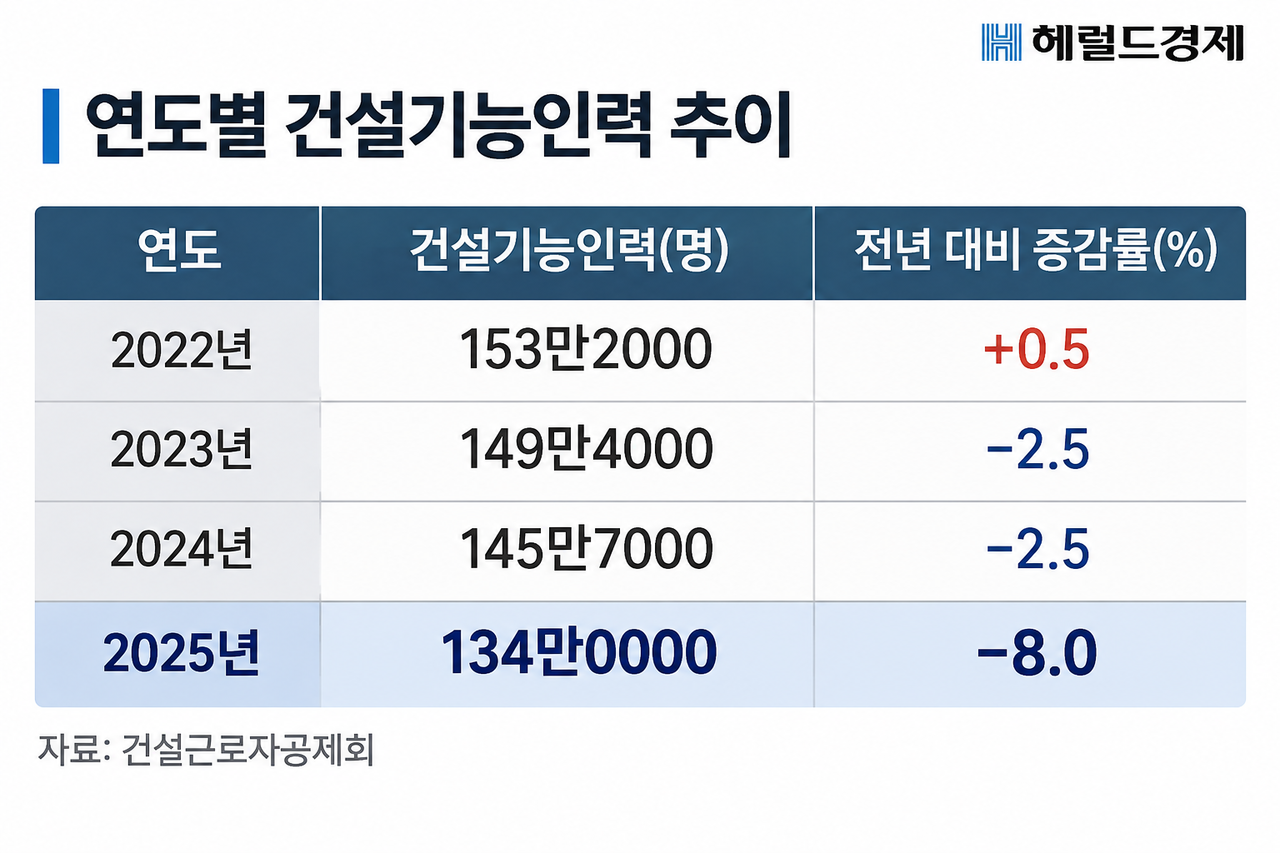
The problem is that even as demand for construction workers surges, the domestic supply base is contracting. According to Construction Workers Mutual Aid Association data, the average annual number of skilled construction workers fell from about 1.532 million in 2022 to about 1.494 million in 2023, about 1.457 million in 2024, and about 1.34 million last year — a decline of 192,000, or 12.5 percent, over three years. The rate of decrease accelerated sharply last year to 8.0 percent, compared with 2.5 percent the year before.
Aging in the construction workforce is equally serious. According to the Ministry of Land, Infrastructure and Transport, as of the end of October this year, workers in their 50s accounted for 33.5 percent of domestic skilled construction workers and those in their 60s or older made up 29.4 percent, together comprising 62.9 percent of the total. Workers in their 20s and 30s accounted for just 18.0 percent. By trade, there are roughly 1,152 plant piping workers and 620 plant welding workers.
Corporate-level workforce development also has its limits. Even when construction companies and their subcontractors invest their own resources in training skilled workers, those workers sometimes move to other firms once their training is complete. A lack of job-matching infrastructure and poor living conditions for construction workers were also cited as factors making it harder to secure labor.
The government is also exploring new sources of workers beyond the existing construction workforce. The Ministry of Land, Infrastructure and Transport announced Tuesday that it would form a public-private joint construction workforce council and work to draw idle skilled construction workers and retired military personnel into construction sites. About 10,000 army officers and non-commissioned officers leave active duty each year.
The Ministry of Employment and Labor said it plans to sharply expand vocational training support in the construction sector and work closely with companies to supply the skilled workers the industry needs on time.
Preventing industrial accidents from the deployment of large numbers of workers was also highlighted. Tight construction schedules aimed at completing semiconductor production facilities early, combined with large numbers of workers concentrated on a single site, could significantly raise the risk of workplace accidents.
"When schedules are tight and large numbers of people are working on the same site at the same time, the risk of accidents rises accordingly," Kim said. "Nothing can take precedence over a worker's life." Kim added that companies should "approach safety as the fastest path forward, and build it in from the design stage."
fact0514@heraldcorp.com




