
Eli Lilly's oral drug wins first China approval; Novo Nordisk files for same
IL Dong, Huons, Hanmi push small-molecule oral obesity candidates
Daewoong, Alteogen challenge monthly injectable market with proprietary platforms
The global obesity drug market is rapidly shifting its competitive axis away from once-weekly injections toward innovations in dosing convenience — including oral pills and long-acting once-monthly injectables.
Eli Lilly's oral obesity drug has secured product approval in China, expanding its licensed markets, while rival Novo Nordisk pursues its own Chinese approval, signaling the start of a full-scale oral drug race among global pharmaceutical giants.
South Korean pharmaceutical and biotech companies are also accelerating their push for a share of the next-generation obesity drug market, leveraging proprietary small-molecule synthesis technologies and drug-delivery platforms.
Eli Lilly's oral glucagon-like peptide-1 (GLP-1) receptor agonist orforglipron — sold in China under the brand name Muyuda — recently received approval from China's National Medical Products Administration for use as a weight-management treatment in adults, making it the first oral GLP-1 obesity drug approved in China.
Originally discovered by Japan's Chugai Pharmaceutical and developed globally by Lilly, the drug has now been approved in four markets — the United States, UAE, the United Kingdom and China — following its FDA approval in April. Taken as a once-daily small-molecule, non-peptide tablet regardless of food or beverage intake, it demonstrated an average weight reduction of 12.4 percent at the highest dose in a 72-week clinical trial (ATTAIN-1).
Competitor Novo Nordisk filed an application with the NMPA earlier this year for approval of an oral version of Wegovy and is pursuing Chinese authorization.
As global pharmaceutical majors broaden their front to include oral formulations, South Korean companies are focusing their next-generation pipelines on maximizing dosing convenience. Their strategy is to directly address the limitations of existing once-weekly injectables — patient reluctance toward injections, cold-chain logistics burdens and high production costs.
In the oral obesity drug space, IL Dong Pharmaceutical, Huons and Hanmi Pharm are each advancing candidates through different mechanisms and targets. IL Dong confirmed a maximum weight loss of 13.8 percent after just four weeks of dosing with its small-molecule oral GLP-1 candidate ID110521156 in a Phase 1 trial. The company secured data showing no serious adverse events related to hepatotoxicity — a persistent challenge in small-molecule oral drug development — or gastrointestinal disorders, and recently continued global partnering discussions at the Jefferies London Healthcare Conference.
Huons presented preclinical results for HUC1-622, an oral melanocortin-4 receptor (MC4R) agonist designed to replace daily peptide injections, as a late-breaking abstract at Obesity Week 2026 in the United States. Animal studies confirmed reductions in body weight and fat mass, and the drug's selectivity for the therapeutic target MC4R over MC1R — which is involved in skin pigmentation — could reduce concerns about skin pigmentation side effects, the company said.
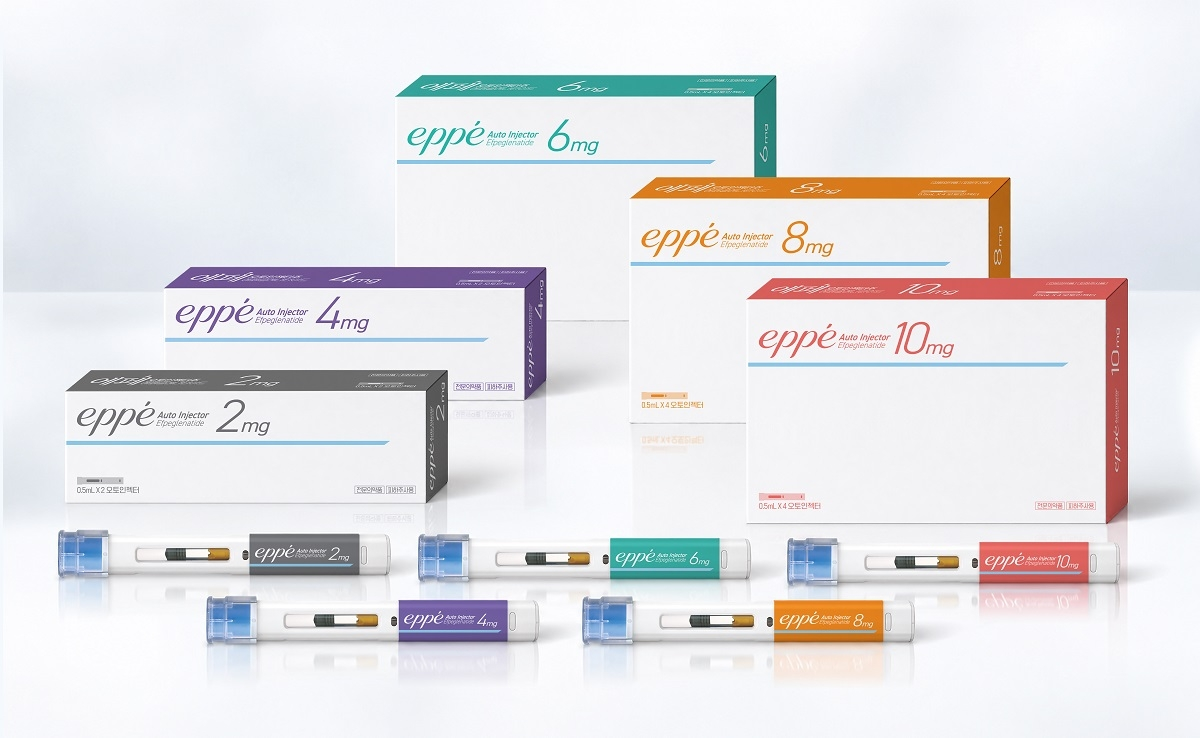
Hanmi Pharm, which last month became the first company to win domestic approval for a GLP-1-class obesity drug with efpeglenatide, is also diversifying its oral pipeline by advancing preclinical research on its small-molecule oral GLP-1 agonist HM101460.
Development of ultra-long-acting formulations that extend the injection interval from once a week to once a month is also gaining momentum.
Daewoong Pharma and Tionlab Therapeutics have combined their respective proprietary drug-delivery platforms — Cure and Cuject Sphere — to develop TION-L002, a semaglutide-based long-acting injectable targeting a reduction in annual injections from 52 to 12, and received investigational new drug approval for a domestic Phase 1 trial. The key design feature is a controlled-release mechanism that suppresses the initial burst of drug release immediately after injection while maintaining a steady release rate over an extended period.
Alteogen is pursuing commercialization of a once-monthly formulation with ALT-M5, the first pipeline candidate from its ultra-long-acting platform built on proprietary conjugation technology. Animal study results presented at the recent American obesity conference showed that ALT-M5B4, a candidate in the ALT-M5 series, had a half-life in test animals more than four times longer (68.1 hours) than Eli Lilly's triple agonist retatrutide. Its weight regain rate two weeks after the end of dosing was 34.7 percent, lower than the control group's 44.2 percent, confirming the feasibility of a once-monthly formulation.
According to an issue brief published by the Korea Bioindustry Association's Bio-Economy Research Center, citing analysis by Asia-Pacific biopharma publication BioPharma APAC, oral formulations are expected to compete with injectables on convenience, manufacturing cost and accessibility, even though they produce somewhat smaller weight-loss results. The association projected that "a significant number of next-generation weight-loss treatments to be launched in the future will incorporate intellectual property developed in Asia."
silverpaper@heraldcorp.com




