
Startup sets five-level swarm drone standard, eyes 100,000-unit production next year after acquiring 40-year-old defense manufacturer Volk

"I'm not particularly interested in doing what everyone else is doing. I enjoy taking roads no one is traveling, trying things no one has tried, pushing all the way to extreme environments. Beyond swarm technology in aviation, I ultimately want to achieve swarm integration across land and maritime systems as well."
The company behind South Korea's most dazzling drone light shows has set its sights on reshaping the modern battlefield with autonomous swarm unmanned systems. Pablo Air Chairman Kim Young-jun was in full stride when he sat down for an interview Thursday at the company's headquarters in Songdo, Incheon.
The trajectory of this seven-year-old startup — which acquired a 40-year-old defense manufacturer and expanded from pyrotechnic drone shows into military unmanned systems — mirrors the company's own slogan: "Limits, Redefined." Kim's background as a Special Forces staff sergeant who served as a special operations instructor in the UAE's Al Ain and Abu Dhabi shines through in his relentless drive.
After watching a foreign company's drone show at the opening ceremony of the 2018 PyeongChang Winter Olympics, Kim resolved to build one using Korean technology and founded Pablo Air that August. Starting with a 100-drone flight in March of the following year, the company broke the Guinness World Record three times in the drone show field — with a Kia logo unveiling show using 303 drones, a Hanwha 70th-anniversary event with 511 drones, and an Incheon Songdo performance featuring 1,068 drones.
Armed with a pyrotechnic ignition technology co-patented with Hanwha and a full-stack solution spanning a dedicated airframe (PabloX F40), operating software (PabloX Live) and design software (PabloX Studio), Pablo Air this year landed solo contracts for the Omani sultan's accession anniversary ceremony, national day celebrations in the Middle East and the first-ever drone show in Ghana — cementing its presence in global markets.
'Flying 2,000 drones on GPS is still level 2 — level 4 is swarm intelligence that thinks for itself'

Kim's vision was never confined to entertainment. "Drone shows were the foundation for accumulating data on precisely operating hundreds or thousands of aircraft and controlling on-site safety," he said. He defined swarm AI — the technology that moves multiple unmanned vehicles as a single organism — as the common root of the company's three business lines: defense unmanned systems, industrial inspection including aircraft exterior checks being developed in collaboration with Korean Air, and drone art shows.
On Nov. 12, Pablo Air and KAIST jointly proposed a five-level "Level of Swarm (LoS)" classification framework to the academic community. The system quantifies swarm technology capability — previously as loosely defined as Tesla's autonomous driving levels — along three axes drawn from a US Air Force framework: networking (N), collaboration (C) and autonomy (A).
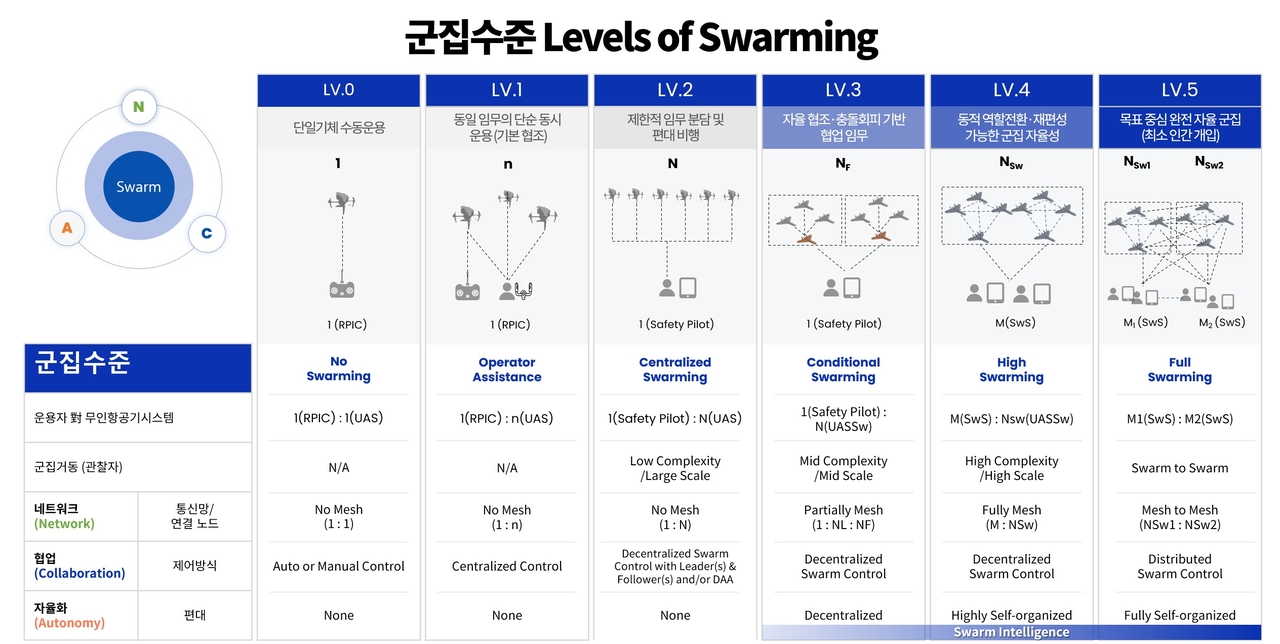
Kim said conventional drone shows operate at swarm level 2, where each aircraft flies independently according to GPS coordinates and time synchronization fed from a central controller. "Because the drones don't communicate with each other, if one malfunctions, the others have no way of knowing," he said.
Level 4, the critical threshold for defense applications, is a different matter entirely. "At level 4, there is no distinction between leader and follower aircraft — the drones communicate in real time over a mesh network and autonomously reassign roles among themselves," Kim said. "You don't pre-program a route; you just designate a target point, and whether it's 50 or 100 drones, they maintain spacing and fly there on their own. If one is shot down mid-mission, the remaining drones complete the operation by themselves."
Pablo Air has already demonstrated level 4 capability in live trials. In an October exercise conducted by the Korea Research Institute for Defense Technology, the company successfully struck a target with precision using vision-based reference navigation and visual terminal guidance in an environment with complete GNSS signal jamming. This month, at the 2026 Korea Drone Offense and Defense Competition, Pablo Air advanced to the finals after placing first in the preliminary round and was the only drone team to achieve a direct hit on the target in the final.
"Only a handful of companies worldwide have achieved level 4," Kim said, expressing confidence that Pablo Air will reach level 5 — full swarming, in which all unmanned systems across land, sea and air collaborate autonomously toward a single objective — by 2030. The company is also preparing joint research with Hyundai Rotem and others to mount drones on unmanned ground vehicles and tanks for combined operations.
Acquiring 40-year-old defense maker Volk — 100,000-unit production next year, domestic supply chain taking shape
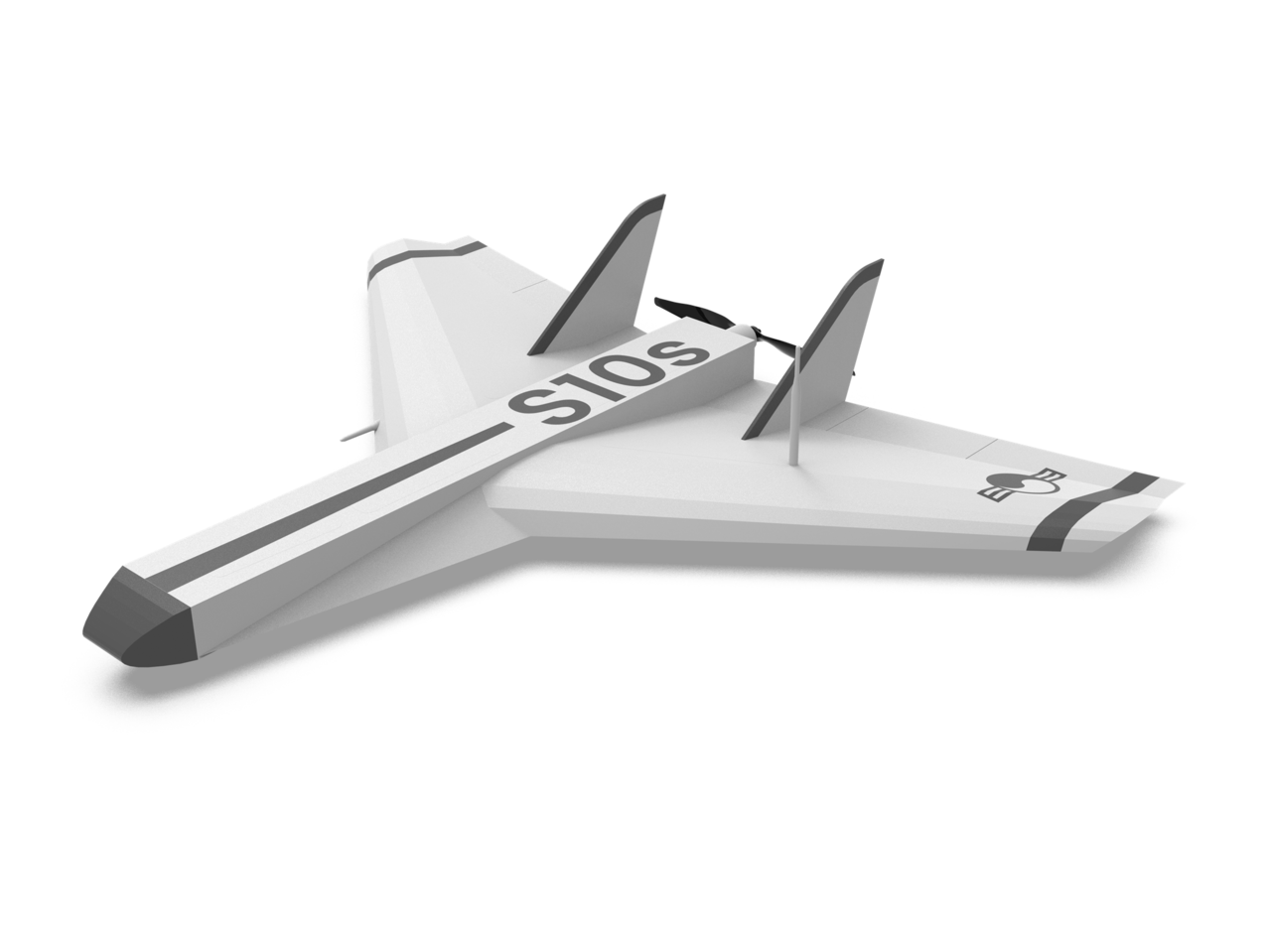
The decisive move that transformed Pablo Air from an R&D-focused startup into a mass-production defense company was the absorption merger of Volk, a precision defense manufacturing firm, in September last year.
"Producing a good prototype at the R&D stage and mass-producing to the military-specification quality customers demand are completely different capabilities," Kim said. "Foreign defense companies told us they would not sign contracts if we outsourced hardware manufacturing through OEM — they required us to prove our own production capacity. That is why we acquired Volk, a 40-year-old company with automated line design and mil-spec certification capabilities."
Integrating a 120-person, 40-year-old manufacturer into a 140-person, seven-year-old startup was not without friction — the two sides had to reconcile dozens of differences, from vacation policies to corporate culture. Today, Volk has been reorganized as Pablo Air's land and maritime division. Its first factory in Changwon continues producing components for existing Army and Navy combat systems, while a second factory is being built out as a dedicated drone production line, with plans to launch an annual production capacity of 100,000 units next year for key models including the S10s loitering munition and T10 target drone.
The "Team Pablo" sovereign drone project — aimed at eliminating dependence on Chinese-made components — also reflects Kim's characteristic competitive instinct. Launched in February, the initiative brings together 14 domestic small and medium-sized enterprises that manufacture batteries, motors, propellers, speed controllers, communications equipment and imaging modules to localize the supply chain. "American and European components were too expensive to make 100,000-unit production feasible," Kim said. "We directly invested in 14 domestic companies and committed to a 5,000-unit purchase contract to build a system capable of developing and mass-producing domestically made training drones for the Army."
'Average sales of 170 million won among Korea's 6,000 drone firms — the race-to-the-bottom structure must change'

The structural limitations of South Korea's domestic drone industry stand in stark contrast to global peers. "There are 6,000 drone-related companies in Korea, but average annual sales are only 170 million won ($126,000), and just two companies — including us — have more than 100 employees," Kim said. "Anduril, the top US drone company, has raised 18 trillion won over nine years and surpassed a valuation of 100 trillion won. We are the most-funded drone company in Korea, yet our cumulative investment of 112.5 billion won is 160 times smaller."
Kim said structural reforms to government support and procurement are urgently needed. "Companies are losing money on every project they execute — a 10 billion won contract actually costs 12 billion to 13 billion won to deliver," he said. "We need to conduct a proper survey and then concentrate strategic investment boldly in three to five competitive companies if we want to build the future of K-defense."
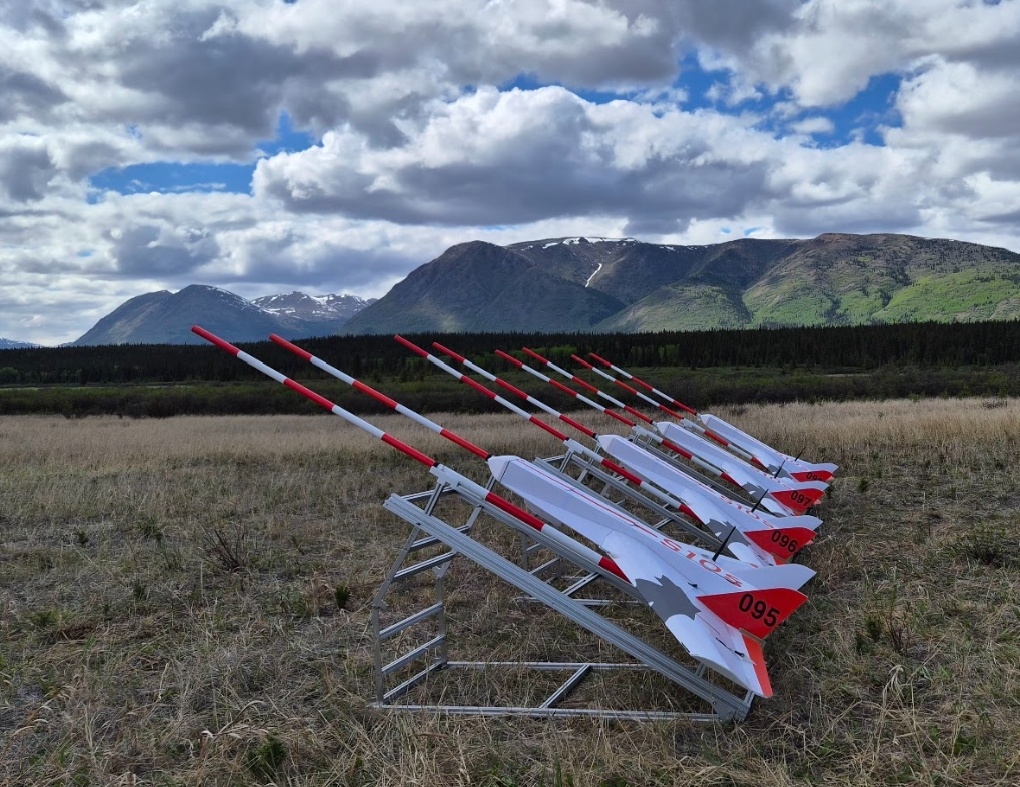
Those constraints are precisely why Pablo Air turned to overseas markets early. In April, the company signed a letter of intent with IMT Group — a Canadian ammunition and defense firm with 120 years of history — and concluded a contract to supply swarm technology to IMT's Arctic Training Centre. In June, at the Arctic Advancement Expo held in Inuvik, Canada, Pablo Air successfully completed six swarm flight demonstrations before NATO officials to strong reviews. The company is currently validating airframe performance in temperatures as low as minus 45 to 50 degrees Celsius and plans to begin supplying NATO forces once testing is complete in mid-year next year, using IMT Group's local manufacturing and supply chain as a bridgehead.
In the Middle East, Pablo Air has made Oman — a regional diplomatic mediator — its strategic hub. A performance at the Omani sultan's accession anniversary ceremony in January earned the company recognition for its technology, leading to contracts for the same event next January at a scale of 1,500 drones, as well as national day and armed forces day shows in November and December this year. The company is also expanding its defense and performance footprint into neighboring Middle Eastern countries by deepening ties with the Oman Investment Authority and other entities.
From speed to detail and profitability — with Kosdaq IPO next year and NASDAQ in the crosshairs

As the business has grown, so has the management philosophy. "For the first eight or nine years after founding, we operated under the belief that you buy time with money — we opened markets through speed and breakthrough," Kim said. "Now, through a transition to a co-CEO structure, we are focused on the details of balancing technological innovation with commercialization and profitability." The plan is to delegate authority and accountability to specialists in each division while preserving a research culture where people are free to experiment with technologies that do not yet exist anywhere in the world.
Named after Pablo Picasso in the spirit of breaking convention, Kim said the swarm technology battle-tested in Korea's fiercely competitive market is more than capable of meeting global standards. "We will use the capital raised through a Kosdaq IPO next year to further solidify our technology and production base," he said, "and in 10 years, alongside a NASDAQ listing, we aim to establish ourselves as a global technology company spanning land, sea and air mobility."
silverpaper@heraldcorp.com




