
South Korea should manage the supply chain risks posed by China's expanding dominance in green industries — particularly in critical minerals and batteries — at the level of a national disaster, experts said Tuesday.
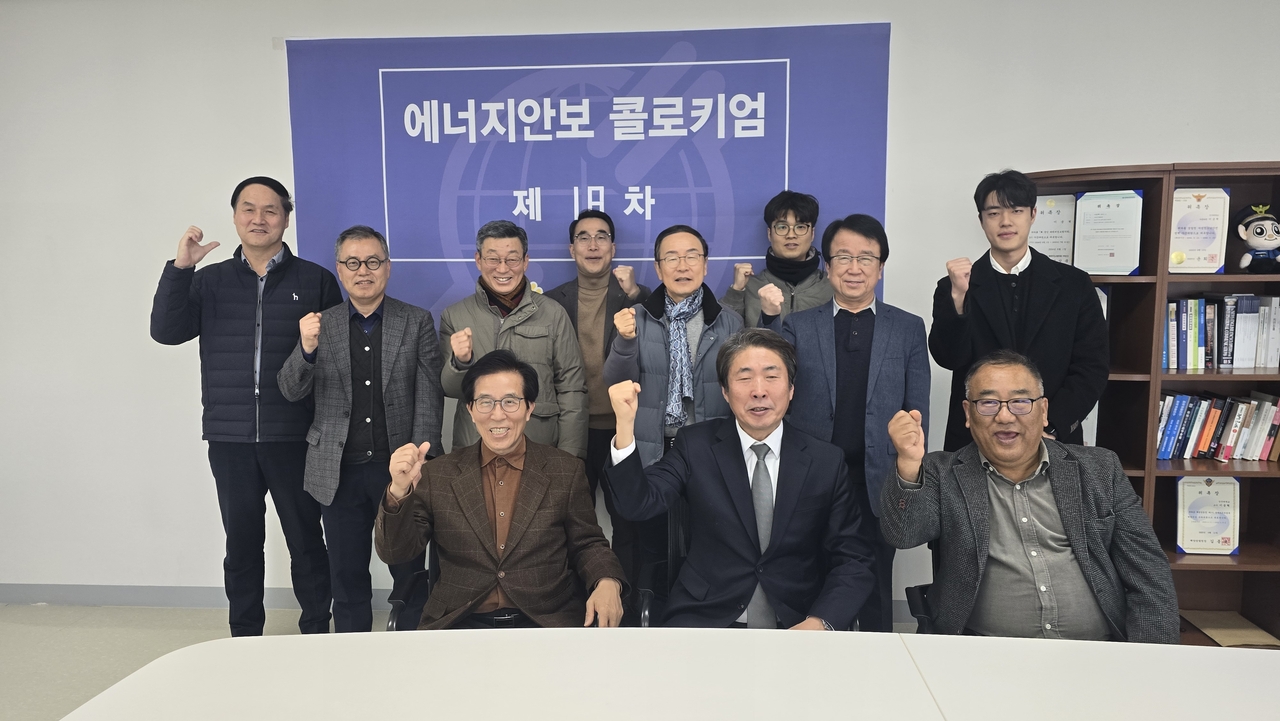
The Korea Energy Security Environment Association held its 18th Energy Security Colloquium Tuesday afternoon at the association's conference room, under the theme "Reading the Future of Global Green Hegemony Through the Lens of the Shenzhen APEC."
The event brought together specialists in energy, power, trade and environmental policy, along with representatives from industry, the media, retired military generals and members of the intelligence community. Participants assessed the global competition for green industry dominance and discussed South Korea's energy security strategy, linking low-carbon power with critical supply chains and operational capabilities.
Choi Seung-cheol, chair of the association's renewable energy subcommittee and the colloquium's lead presenter, said the conventional view of green hegemony — measured solely by output and export market share — needs to be abandoned.
The real foundation of international influence, some analysts say, lies in the ability to reliably provide an entire industrial ecosystem: critical mineral mining and refining, mass production of materials and components, low-carbon power and grid infrastructure, storage and demand management, and trade, certification and data systems.
Choi said China's rise in green industries should not be reduced to government support or low-price competition alone. China has secured more than 70 percent of global electric vehicle production and about 40 percent of exports, he said, but it also faces structural problems — redundant investment and oversupply driven by competition among local governments to attract capital.
For South Korea's response, Choi proposed a strategy of leveraging China's industrial competitiveness while diversifying vulnerable supply chains. He said the country must assess how difficult it would be to replace each stage of production and how long recovery would take, while building independent capabilities in low-carbon power procurement, emissions verification and skilled operations personnel.
He also said the government's performance metrics should shift away from installed capacity toward actual operation, carbon reduction results and the ability to recover after a supply disruption.
"The future of green hegemony will be decided not by the country that produces the most, but by the most trustworthy actor," Choi said.
Lee Ung-hyeok, the association's president, who moderated the discussion, said China's pursuit of green hegemony goes beyond competition in clean technology — it is a national strategy to secure control over energy supply chains, industrial competitiveness and the international economic order.
Lee outlined three policy priorities: managing supply chain risks at the level of national disaster preparedness, prioritizing supply chain resilience over price competition, and leading in green industry technology, operations and international standards.
"If the crisis in the Strait of Hormuz revealed the dangers of fossil fuel chokepoints, the concentration of critical minerals, batteries and solar supply chains represents a new chokepoint for the era of green transition," Lee said.
To address this, Lee recommended resetting stockpile targets for hard-to-replace strategic materials — including graphite for anodes, cathode precursors and permanent magnets — while institutionalizing regular recovery drills for supply disruptions and establishing an early-warning system to track export control developments.
Lee warned that while China's low-cost solar panels, batteries and electric vehicles help reduce the cost of carbon neutrality, the concentration of critical mineral refining and materials production in China could become a structural vulnerability for the South Korean economy if international tensions or export controls arise.
Lee also said South Korea should leverage its strengths in semiconductors, batteries, power equipment and digital technology to lead in systems operation and international standard-setting, and build a Korean-style energy security industrial model — centered on industrial complexes that combine low-carbon power, storage, emissions verification and supply chain resilience.
123@heraldcorp.com




