
Stake restructuring looms as 34% exception leaves exchanges scrambling
Up to 6-year grace period after designation; excess shares lose voting rights

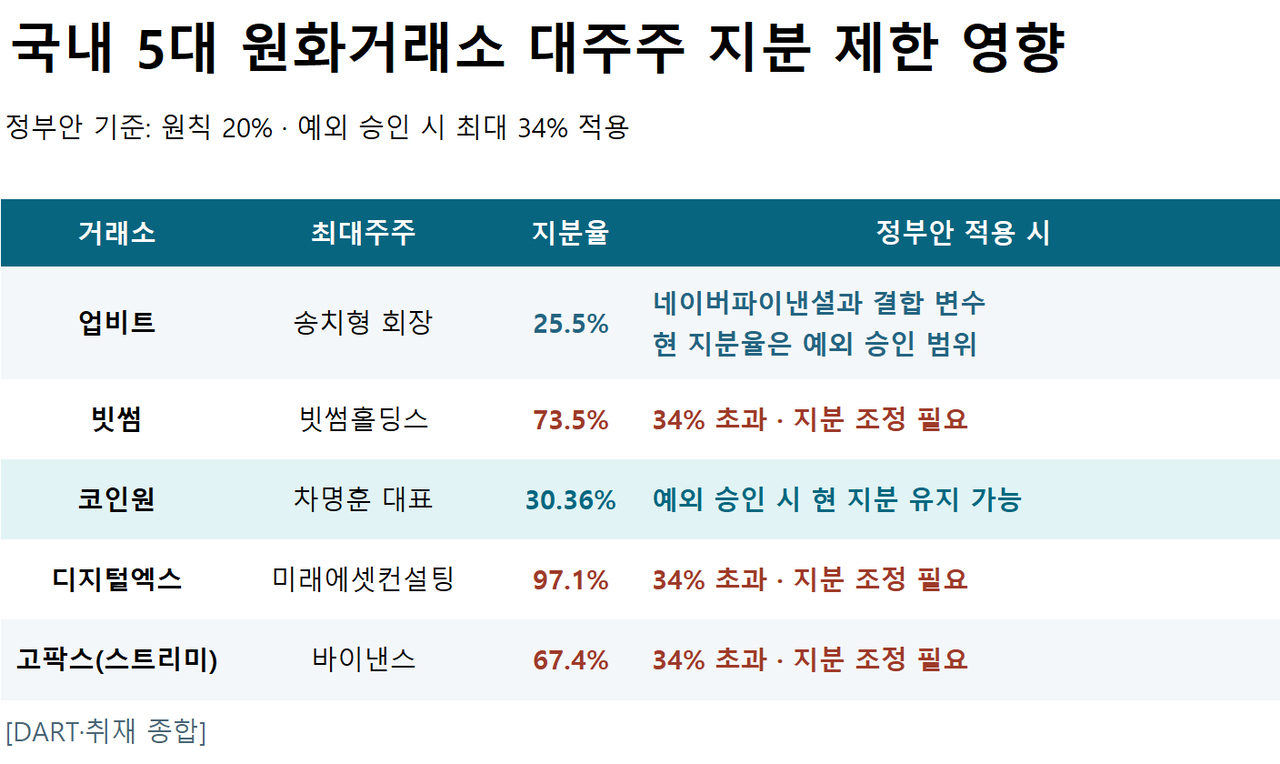
The government has unveiled its long-awaited cap on major shareholder stakes in virtual asset exchanges — a central flashpoint in the drafting of South Korea's Digital Asset Basic Act. Under the proposal, ownership is capped at 20% in principle, though shareholders who obtain Financial Services Commission approval may hold up to 34%.
Both existing and new exchanges will receive a three-year grace period after being designated by the FSC before the ownership rules take effect, with smaller exchanges eligible for an extension of up to six years. Shares held above the limit will be stripped of voting rights. The government bill includes grounds for issuing corrective orders in cases of violation, but stops short of requiring the forced sale of excess shares. How far friendly shareholders' stakes will be counted toward a major shareholder's total is left to be spelled out in enforcement decrees.
Under the government bill the FSC announced Tuesday, anyone seeking to operate a virtual asset exchange must first obtain licenses for trading, brokerage and custody services, then be designated a digital asset platform operator by the FSC. Operators must also maintain a minimum level of equity capital and put in place standards for trading support, market surveillance and conflict-of-interest prevention. Existing virtual asset businesses must apply for the relevant licenses within prescribed deadlines depending on the type of business they intend to operate.
20% stake cap in principle, with grace period of up to 6 years
The ownership cap is the centerpiece of the government bill. Authorities said they modeled the 20% limit on the dispersed-ownership rules that apply to alternative trading systems in the capital markets. Yu Yeong-jun, director of digital finance policy, said the cap was necessary to strengthen the public interest and neutrality of exchanges as trading infrastructure, noting that the number of accounts opened on exchanges has surpassed 10 million.
An exception allowing approved shareholders — such as financial companies — to hold up to 34% will be set out in enforcement decrees. Authorities said that threshold was drawn from the ownership limit applied to internet-only banks. Whether individual shareholders will be eligible for the exception, and the specific approval criteria, will also be determined through enforcement decrees.
The FSC said the ownership cap applies based on a major shareholder's stake and that shares held by specially related persons will be counted together. Questions remain, however, over how broadly friendly stakes will be aggregated, and authorities plan to spell out the scope and detailed criteria in enforcement decrees.
The ownership restrictions will be suspended for three years from the date the FSC designates an exchange as a digital asset platform operator, with the same standard applying to both existing and new exchanges. Smaller exchanges may receive an additional three-year extension in consideration of their need to attract investment. The FSC is considering using market share as the criterion for classifying an exchange as small or mid-sized.
Exchanges rattled by stake cap; excess shares to lose voting rights, face corrective orders
The exchange industry is unsettled. Some in the industry had quietly hoped that major shareholders would be allowed to retain their full stakes while having voting rights capped at 20%, which would have eliminated any need to restructure ownership. The FSC, however, said that even if voting rights on excess shares are restricted, holding shares above the limit still constitutes a legal violation, and it intends to enforce the ownership cap.
If the bill passes as proposed, exchanges whose major shareholders exceed the limit will have no choice but to restructure their stakes.
Dunamu, the operator of Upbit, is in the process of being acquired through a merger in which Naver Financial would own 100% of its shares. Mirae Asset Consulting has acquired a 97.15% stake in DigitalX. Bithumb Holdings, the largest shareholder of Bithumb, holds a 73.56% stake. Coinone CEO Cha Myung-hun, however, could maintain a current stake of 30.36% if FSC approval is granted under the up-to-34% exception.
The government bill also restricts the exercise of voting rights on shares held above the limit and empowers financial authorities to issue corrective orders for violations. It does not, however, include a provision requiring the forced sale of excess shares. One industry official said exchanges that receive a corrective order but fail to remedy the violation would face disadvantages in future digital asset business license reviews, leaving them with little choice but to restructure their stakes on their own.
The bill is also expected to face a difficult path through the National Assembly. Controversy over property rights infringement surrounding the ownership cap persists, and within the ruling party there are still voices calling for an approach that would allow major shareholders to retain their full stakes while capping voting rights at 20%. On the question of whether the ownership cap could be unconstitutional, Yu said the FSC had conducted multiple internal legal reviews and had consulted with both ruling and opposition parties through various channels.
Mandatory disclosure for coin issuance and distribution
The government plans to overhaul exchange governance to a standard comparable to that of financial companies. Boards of directors must be composed of a majority of outside directors, and audit committees must be established. Key standards for trade execution, trading support (listing) and abnormal transaction surveillance — previously governed by self-regulation — will be codified in law. Exchanges will be required to report any changes to their operating rules to the FSC, which will have the authority to demand rule changes.
The government also plans to revamp exchange operating frameworks. Mandatory disclosure requirements will be introduced at the coin issuance and distribution stages. Any party that issued a digital asset or actively participated in its issuance, development or operation, and that seeks to solicit an unspecified number of people to acquire the asset, must file a white paper with the FSC disclosing how funds will be used, the issuance volume, project details and risk factors.
Where an issuer is difficult to identify, or where solicitation involves a digital asset issued overseas, a digital asset business operator assisting or acting on behalf of the solicitation may fulfill the disclosure obligation. Once the FSC accepts the filing, the white paper and related materials will be published on an integrated disclosure system, and solicitation will be permitted after a set period has elapsed.
Before listing a coin, exchanges must submit to the FSC and publicly disclose a trading support report and prospectus covering the issuer, issuance volume, project details and risk factors. If a white paper has already been published, it may be updated to serve in place of the trading support report.
After listing, any information that could have a material impact on price — such as changes to issuance or distribution volume, or hacking incidents — must be disclosed immediately. False statements or omissions of material information in a white paper or report will expose those responsible for disclosure and the relevant executives to liability for damages, and grounds for surcharges and criminal penalties will also be established.

forest@heraldcorp.com
kyoung@heraldcorp.com




