
Bank-majority consortiums get first shot at stablecoin issuance; domestic ICOs allowed with prior disclosure; exchange stake limit set at 20% in principle, 34% with approval and up to 6-year grace period; major shareholder curbs signal industry ownership overhaul; no-fault liability introduced for hacking and system failures
South Korea's Financial Services Commission has unveiled a government-drafted bill that would allow stablecoin issuance first to consortiums in which banks collectively hold a majority stake — while also permitting a fintech or technology firm to become the single largest shareholder, as long as banks' combined holdings exceed 50 percent. Virtual asset exchanges would face a 20 percent ownership cap in principle, with FSC approval required to hold up to 34 percent.
The FSC announced Tuesday its plan to legislate the Digital Asset Industry Innovation and User Protection Act. The proposal marks the government's first concrete blueprint on stablecoin issuance eligibility and exchange ownership structure, following more than a year of deliberations.
FSC Chairman Lee Eok-won said he expects the bill to "not only raise the credibility and transparency of Korea's digital asset market and elevate the competitiveness of the digital asset industry to the next level, but also make a significant contribution to nurturing new industries and creating jobs through fresh capital inflows."
Banks hold combined majority; fintech firms can still be top individual shareholder
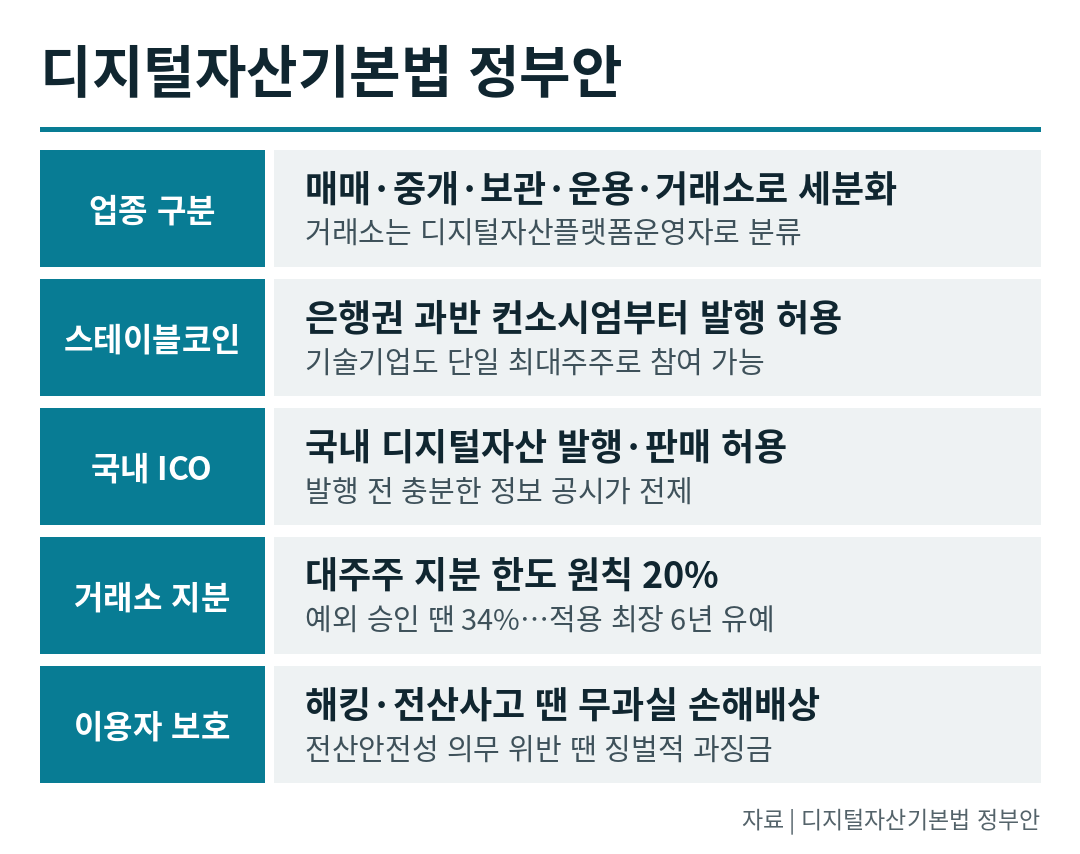
The government defines stablecoins as "digital payment tokens" — instruments pegged to a single currency value and used primarily as a means of payment. Any operator seeking to issue or redeem such tokens domestically must obtain FSC authorization, meeting requirements that include minimum equity capital of 5 billion won ($3.71 million), a qualifying shareholder structure, and adequate personnel and facilities. Detailed shareholder composition requirements will be set out in enforcement decrees.
To limit the impact on the financial system during the early stage of the regime, the FSC plans to permit issuance only by consortiums in which banks collectively hold a majority stake. If combined bank shareholdings exceed 50 percent, a fintech or technology company may still become the single largest individual shareholder.
Issuers must submit an issuance plan to the FSC for approval, covering issuance limits, reserve asset management and redemption procedures. They must deposit or place in trust with a reserve asset custodian — such as a bank — an amount equal to at least 100 percent of outstanding issuance, and must redeem tokens at equivalent monetary value without delay upon a holder's request. Paying interest to token holders is prohibited.
Stablecoins with outstanding issuance of 1 trillion won or more may be designated "systemically important digital payment tokens," with authorities weighing their impact on financial stability and monetary policy. The bill also grants the Bank of Korea the right to request joint inspections of such issuers.
Exchange stakes capped at 34%; grace period up to 6 years
Virtual asset exchanges would be subject to dispersed-ownership rules modeled on those applied to alternative trading systems in the capital markets, reflecting the government's view that exchanges serve as core public infrastructure for digital asset distribution and must remain neutral. Share ownership would be capped at 20 percent in principle, with the FSC able to grant exceptions allowing up to 34 percent. Stakes exceeding the limit would carry no voting rights.
The ownership restrictions would be suspended for three years after an exchange is designated as a digital asset platform operator, with smaller exchanges eligible for an additional three-year extension based on their fundraising needs — giving each exchange up to six years before the rules take full effect. The grace period is designed to give exchanges time to restructure their ownership, recognizing that fundraising conditions vary across platforms.
If the bill passes as drafted, major virtual asset exchanges are expected to face unavoidable ownership restructuring. Aside from Coinone — whose representative shareholder Cha Myung-hun holds a 30.36 percent stake — Dunamu, which is pursuing a merger with Naver Financial, along with Bithumb and Digital X, all have major shareholders exceeding the 34 percent exception threshold and would need to adjust their ownership structures within the grace period.
In addition, the bill would divide the digital asset industry into trading, brokerage, custody and management businesses, each subject to separate authorization or registration requirements. Domestic digital asset issuance and sales — initial coin offerings — would be permitted provided issuers meet disclosure requirements, including filing and publishing a white paper. Operators would face strict liability for user losses caused by hacking or system failures, regardless of fault.
The Digital Asset Framework Bill is expected to be jointly introduced no later than Wednesday under the name of Rep. Yoo Dong-su, chair of the National Assembly's Political Affairs Committee. Lee said the FSC "will do its utmost to ensure the bill is legislated as swiftly as possible after sufficient deliberation in the National Assembly."

forest@heraldcorp.com
kyoung@heraldcorp.com




