
Five drones fly autonomously at the same time, avoiding obstacles and detecting missing persons with AI; 3D spatial data and thermal imaging analyzed in real time before transfer to police
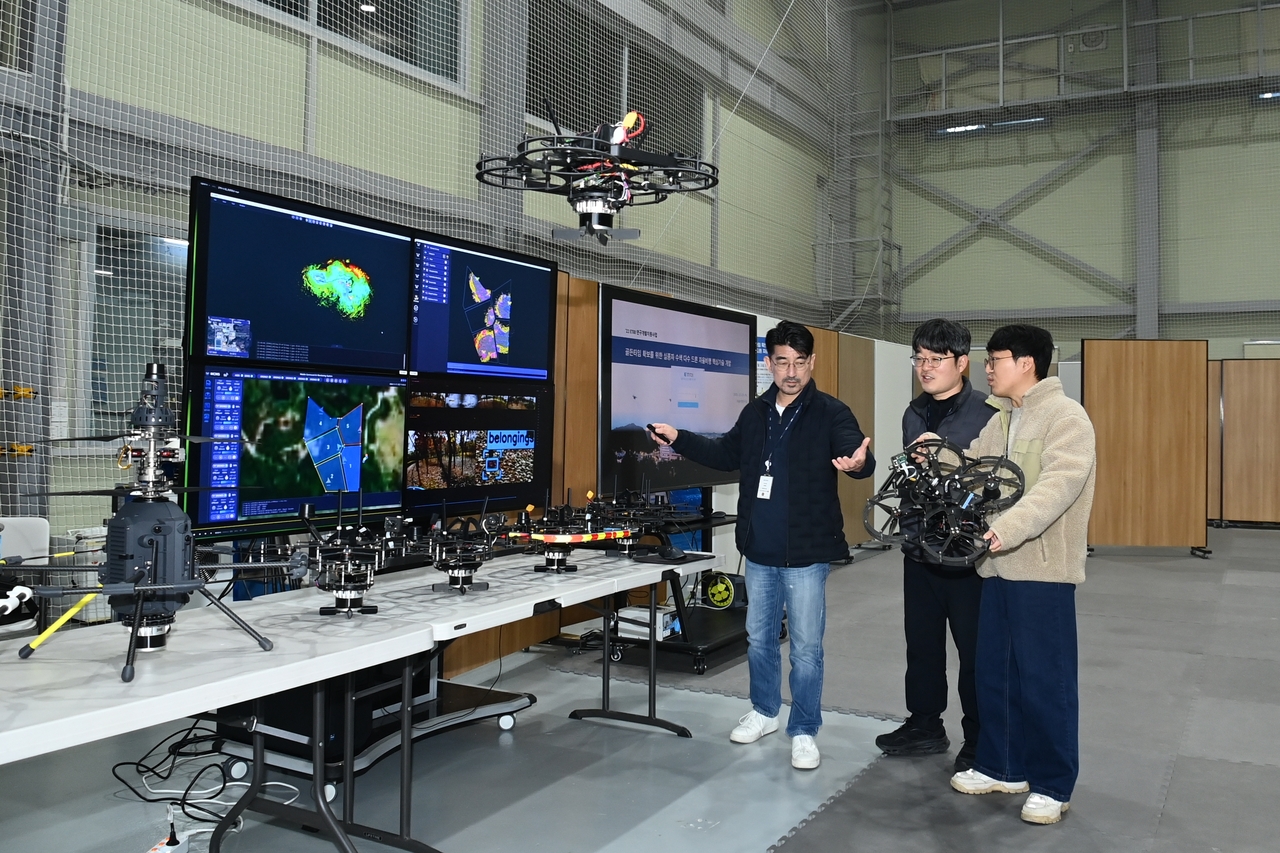
A technology that deploys five drones simultaneously to search for missing persons — even deep in forests where GPS signals are unreliable — has been developed by South Korean researchers.
The Electronics and Telecommunications Research Institute (ETRI) announced Tuesday that it had successfully completed a final field demonstration of its multi-drone autonomous flight system, which allows five drones to fly and conduct searches at the same time in wooded areas where GPS use is limited.
The demonstration took place Nov. 3 at Hanbat Arboretum in Daejeon, with officials from the Korean National Police Agency, the Army and experts in defense and drone technology in attendance. The drones divided the search zone among themselves and carried out their missions simultaneously, simulating a real missing-person search scenario.
The core of the technology is the drones' ability to determine their own position and navigate without a functioning GPS signal.
Each drone uses simultaneous localization and mapping, or SLAM, technology to build a three-dimensional picture of its surroundings — including terrain and obstacles such as trees — estimate its own location and avoid collisions in flight.
Standard video footage, infrared imagery and 3D spatial data captured by the drones are transmitted in real time to a mobile control system, which reconstructs the forest terrain in three dimensions and uses AI to detect missing persons and personal belongings.
When a missing person is found, the system automatically generates a mission report containing the detection location and photographs. The feature helps search-and-rescue personnel quickly assess the situation and decide on a rescue response.
ETRI has been developing the technology since 2022 as part of a five-year project. A first demonstration using three drones was held at Jawoon-dae Solbat Park in Daejeon in November 2024; the latest test expanded the fleet to five.
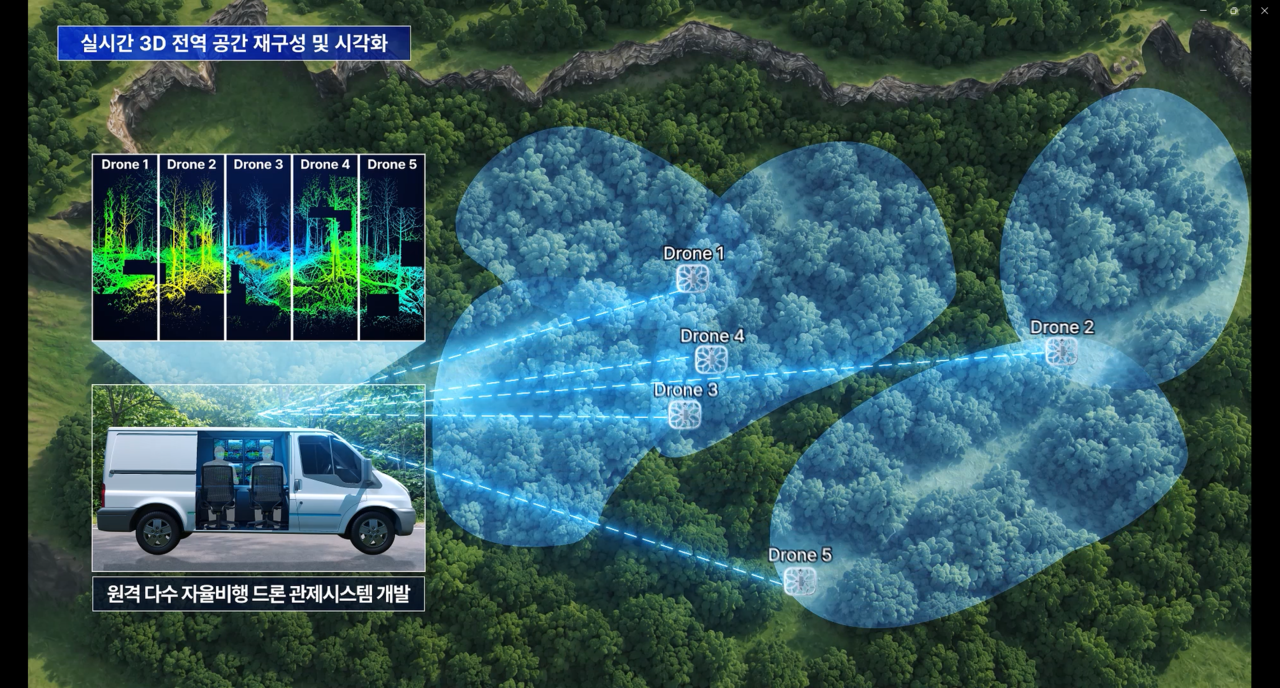
The demonstration focused particularly on whether multiple drones could divide search duties and cover a wider area within a limited time. ETRI also compiled and released AI training data for detecting missing persons and personal belongings in both daytime and nighttime conditions.
Personnel directly responsible for search operations — including staff from the Korean National Police Agency's equipment operations division and a drone specialist team from the South Gyeongsang Province police — took part in the demonstration. ETRI said it plans to incorporate feedback from the field exercise to refine the system further.
ETRI expects to wrap up its research and development by the end of the year and transfer the technology to the Korean National Police Agency. Police will then conduct additional verification and training ahead of deploying the system in actual missing-person searches.
"In missing-person searches, what matters most is how quickly a wide area can be covered within a limited time," said Cha Ji-hun, a principal researcher at ETRI. "The significance of this demonstration lies in the fact that we validated, together with the actual end-user agency, a technology that lets five autonomous drones search a complex forest environment simultaneously."
Cha added that the institute would work to improve the system's real-world applicability so that police can use it at actual missing-person search scenes, contributing to public safety and securing the critical window for rescue operations.
nbgkoo@heraldcorp.com




