
- UNIST analyzes genomes of 10,239 Koreans, identifying 61.22 million genetic variants in total
- Genetic differences found to affect biological age measurements, with implications for precision medicine and aging research
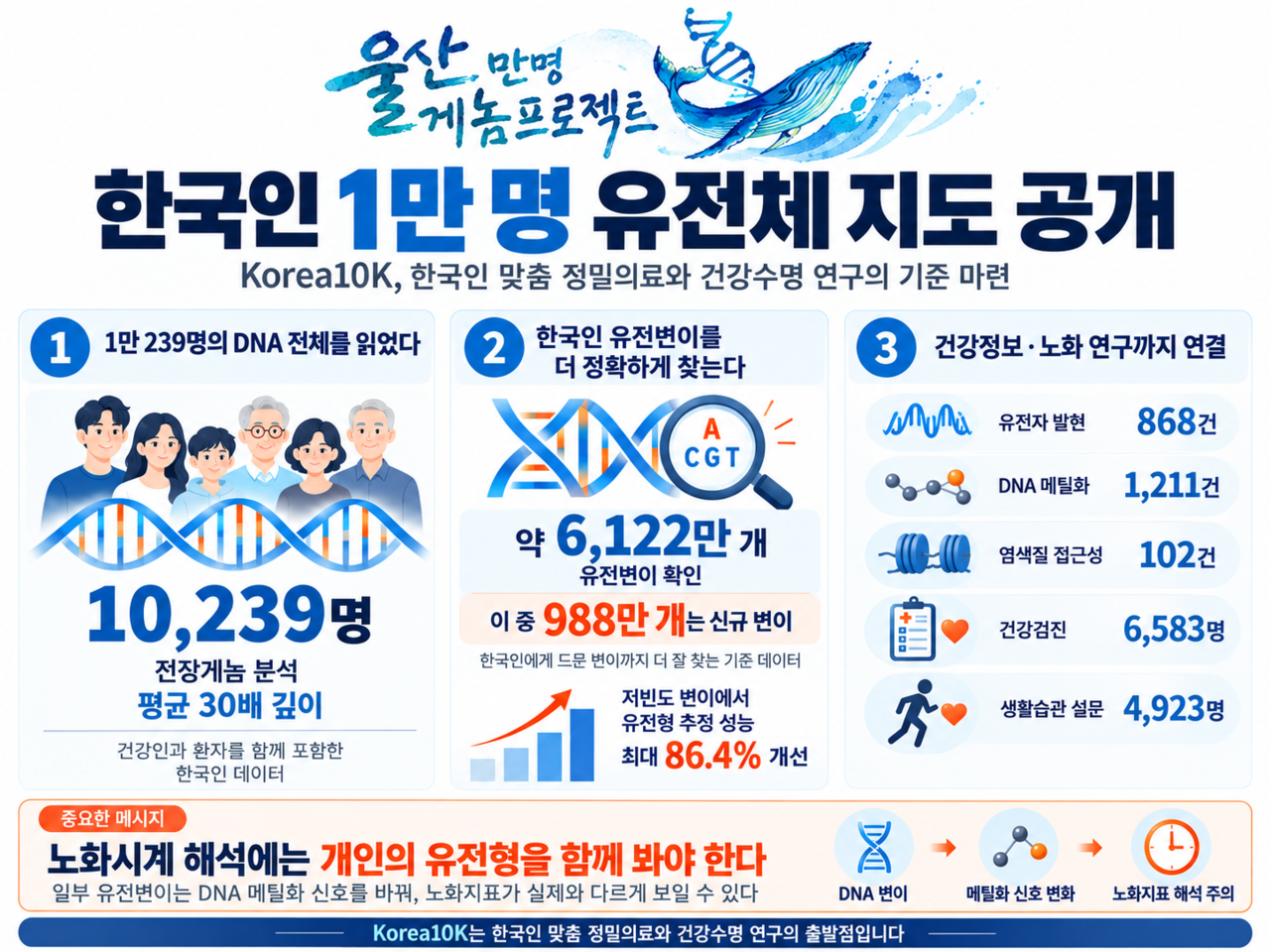
A large-scale analysis of the genomes of more than 10,000 Koreans has uncovered about 9.88 million genetic variants not previously recorded in international databases, researchers announced Tuesday. The study also found that individual genetic differences can affect the accuracy of biological age measurements.
The Ulsan National Institute of Science and Technology (UNIST) said its Genome Center (KOGIC) analyzed whole-genome data from 10,239 Koreans to build a large-scale genomic reference dataset called Korea10K.
The research involved the Korea Bioinformation Center (KOBIC) under the Korea Research Institute of Bioscience and Biotechnology, Ulsan University Hospital, the Korea Research Institute of Standards and Science (KRISS) National Reference Standards Center, and Harvard Medical School. The findings were published Friday in the international journal Genome Biology.
Korea10K serves as a reference resource for interpreting the genetic information of Koreans. By analyzing how frequently individual DNA sequence variants — differences that vary from person to person — appear in the population, researchers can use the dataset to distinguish variants associated with disease.
The team identified a total of 61.22 million genetic variants across the genomes of the 10,239 participants. Of those, about 9.88 million, or 16.1 percent, were not registered in the international genetic variant database dbSNP. Nearly half — 48.5 percent — of the newly identified variants were rare, appearing in only one or two individuals.
The study also found that genetic differences can distort biological age estimates.
Biological age is typically estimated by analyzing patterns of methylation, a process in which chemical groups attach to specific sites on DNA. When a genetic variant eliminates one of those attachment sites, the absence can be misread as an age-related change, the researchers said.
The team analyzed six widely used biological aging clocks and confirmed that this phenomenon occurs across all population groups examined. However, the specific genetic sites affected differed from one population to another.
The findings suggest that accurately measuring biological age requires accounting not only for an individual's genetic information but also for the genetic characteristics of the population to which that person belongs.
The study also identified differences in paternal and maternal genetic lineages among Koreans. Two lineages accounted for 92.6 percent of Y chromosomes — passed from fathers to sons — while mitochondrial DNA, inherited from mothers, showed comparatively greater diversity across lineages.

The achievement is the product of two decades of Korean genome research that began in 2006. Building on the Ulsan 10,000 Genomes Project, launched in 2015 with support from the city of Ulsan, the effort progressed through Korea1K — a dataset of 1,000 individuals completed in 2020 — and Korea4K, covering 4,000 individuals in 2024, before expanding to its current scale of 10,000.
Jeon Sung-won, the researcher who led the project's day-to-day work, said Korea10K is "a national asset built over 20 years through the efforts of researchers from more than 30 institutions, the citizens who donated their genomes, and the city of Ulsan," adding that it represents "not the end of a project, but the starting point for new research."
Jeon said the team plans to conduct long-term follow-up studies of participants to analyze how genetic differences influence the progression of aging and disease.
The research data has been registered with the National Bio Data Station (K-BDS). Individual-level genomic data will be made available for research purposes following review by an institutional ethics board and approval from a data access committee.
nbgkoo@heraldcorp.com




