First executive order after taking office: operation of a livelihood economy situation room
Core vision for the 9th elected term: 'Jeju, climate economy capital'
Plans to link solar and other clean energy production to income and jobs
AI-powered governance a priority; AI Jeju travel planner and AI resident assistant in development
Second-round public institution relocation targets include Korea Racing Authority and Korea Airports Corporation
'Jeju-style basic society' campaign pledge to guarantee essential living conditions in transport, healthcare and more
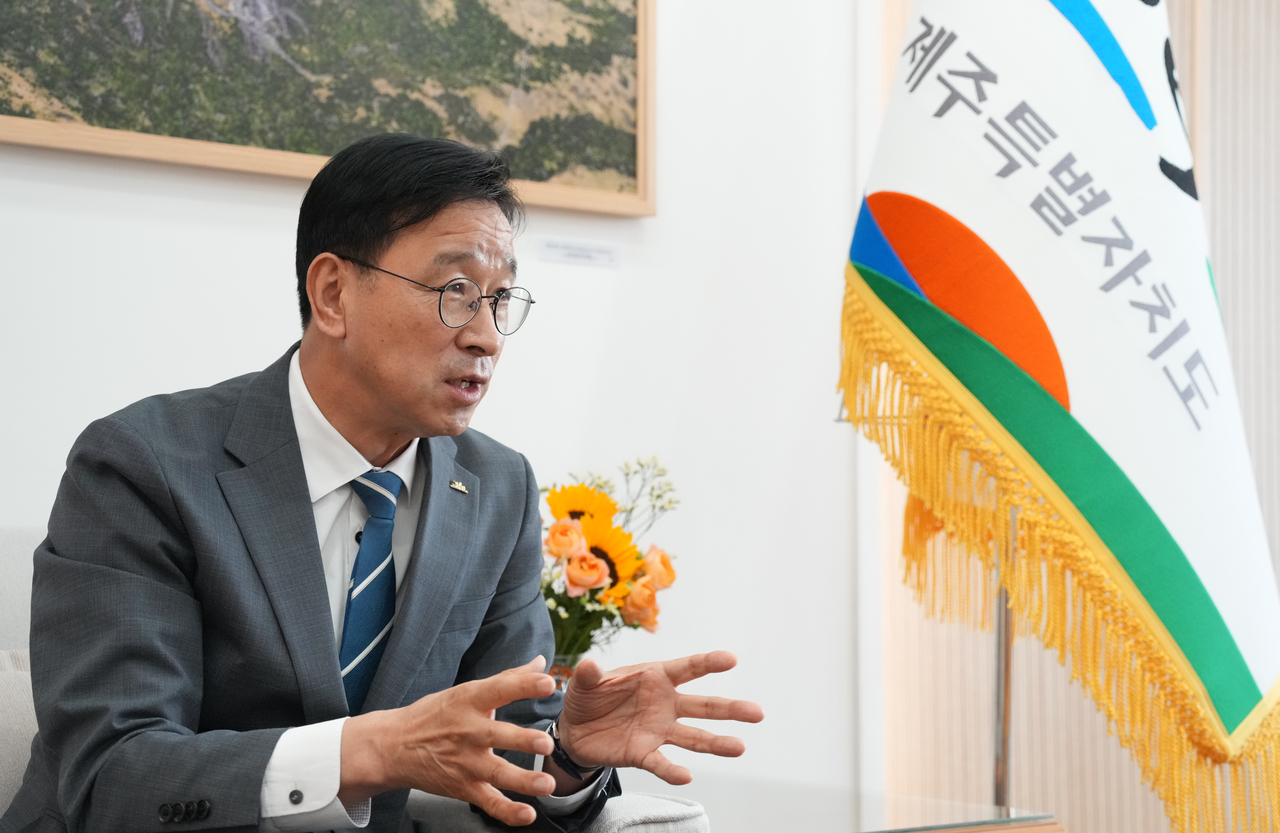
Wi Seong-gon, who took office as Jeju governor in July, has made restoring livelihoods the centerpiece of his administration. His first executive order after taking office was the establishment of a livelihood economy situation room directly under the governor — a command center designed to monitor Jeju's struggling economy in real time and let the governor take direct charge of pressing livelihood issues.
Jeju Island also submitted to the Jeju Provincial Council earlier this month a budget proposal of 8.04 trillion won ($6.04 billion) for next year — the first time the province's main budget has exceeded 8 trillion won. Provincial officials said the budget is focused on restoring the livelihood economy and securing future growth engines, including an AI-driven transformation.
Wi underscored those priorities in a written and telephone interview Tuesday. "Stabilizing the livelihoods of Jeju residents and reviving the local economy are the top priorities of this administration," he said. "It is more urgent than anything else to stabilize the lives of residents struggling with high prices, shrinking consumption and a slump in tourism and construction, and to breathe new vitality into the local economy."
To that end, Wi has put forward "Jeju, climate economy capital" as the core vision of the 9th elected term. "Jeju has favorable conditions for expanding renewable energy, with abundant wind and sunlight," he said. "We must now go beyond producing clean energy from wind and solar power and connect it to industry, jobs and residents' income. We will first expand renewable energy sources such as wind and solar, then build up energy flexibility resources — including energy storage systems, electric vehicles and power grids — to establish a system that efficiently produces, stores and uses energy."
The following is an edited transcript of the interview.
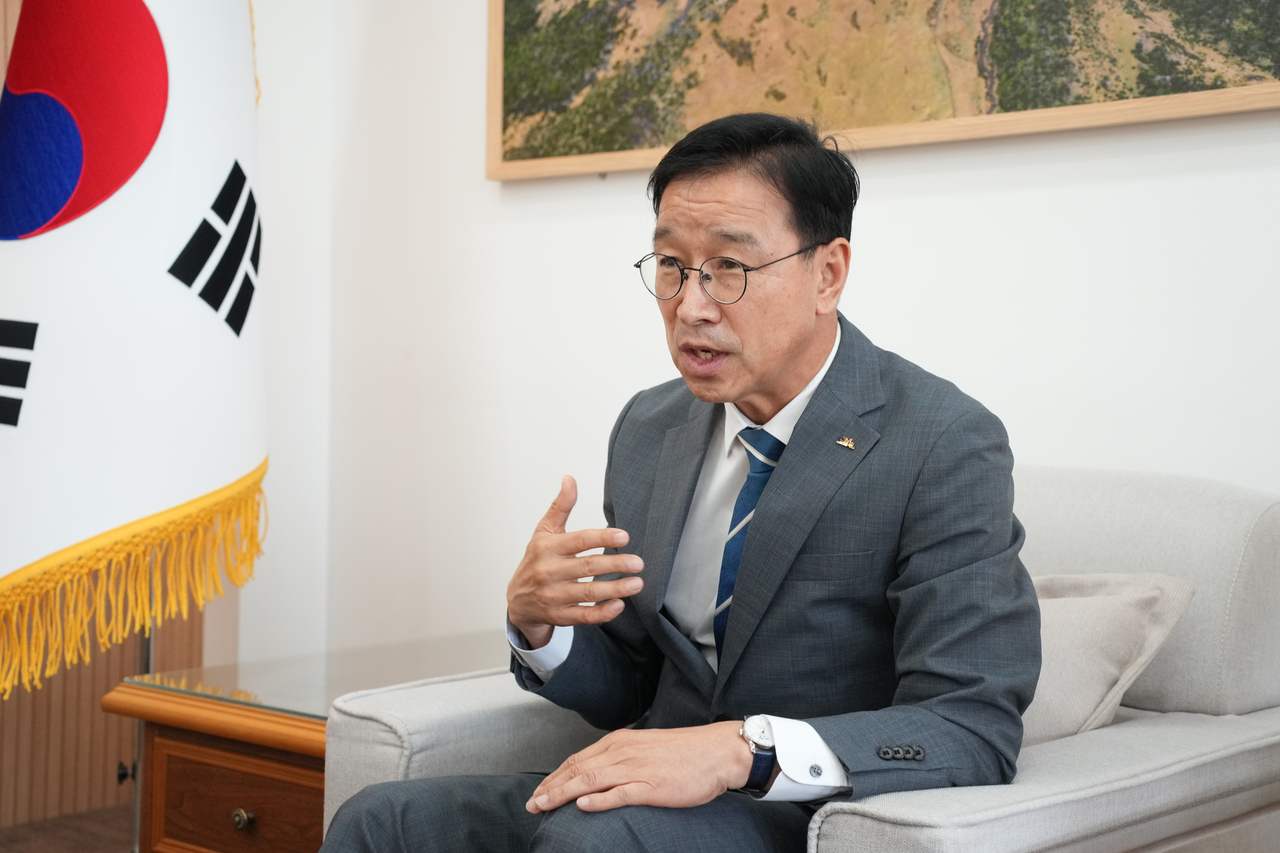
— It has been about four months since you took office. What has the experience of leading the provincial government been like?
▶ Taking charge of Jeju's provincial government, I feel every day the weight of being responsible for the island's issues and the lives of its residents. Above all, the performance of this administration should be judged not by policy numbers or announcements, but by whether residents' daily lives have actually improved. With that in mind, I have made restoring the livelihood economy the top priority, listening to voices from the field and acting on them one by one. Since taking office, I have visited livelihood sites including tangerine farms — the lifeblood of Jeju's agricultural sector — fish farms hit by high water temperatures, and town hall meetings. Each site was different, but the hardships residents faced were very concrete and urgent. Listening to them helped me reconfirm what this administration needs to tackle first. In response, I established the livelihood economy situation room, drew up a supplementary budget for livelihood recovery, and have been pushing support measures to ease the burden on farmers, fishers and small-business owners.
— There are reports that Jeju's tourism industry has been hit by the economic slowdown. Late-night travel disruptions caused by flight delays are also a problem.
▶ On Monday I personally chaired the "Jeju Tourism Strategy Conference" to advance the development of Jeju's tourism industry. Starting with that meeting, I plan to continue discussing key tasks in areas including improving year-round tourism readiness, expanding tourism content by sector, and integrated promotion and marketing. As a first step, I will conduct regular checks on factors that inconvenience tourists — transportation, safety, sanitation and the environment — and proactively address the off-season to create a safe and convenient tourism environment. There is also a growing gap in how well individual foreign tourists can access travel information and use services in Jeju. In response, Jeju Island has introduced an "AI Jeju Travel Planner" to keep pace with the rapidly changing generative AI landscape and shifts in tourism services. Through the planner, users enter their travel dates, companions, means of transport, accommodation and travel style, and an AI-based itinerary is generated. By expanding multilingual, location-based personalized AI travel services, we expect to improve information accessibility and on-site convenience for individual tourists both domestic and foreign, and to help grow demand for Jeju tourism.
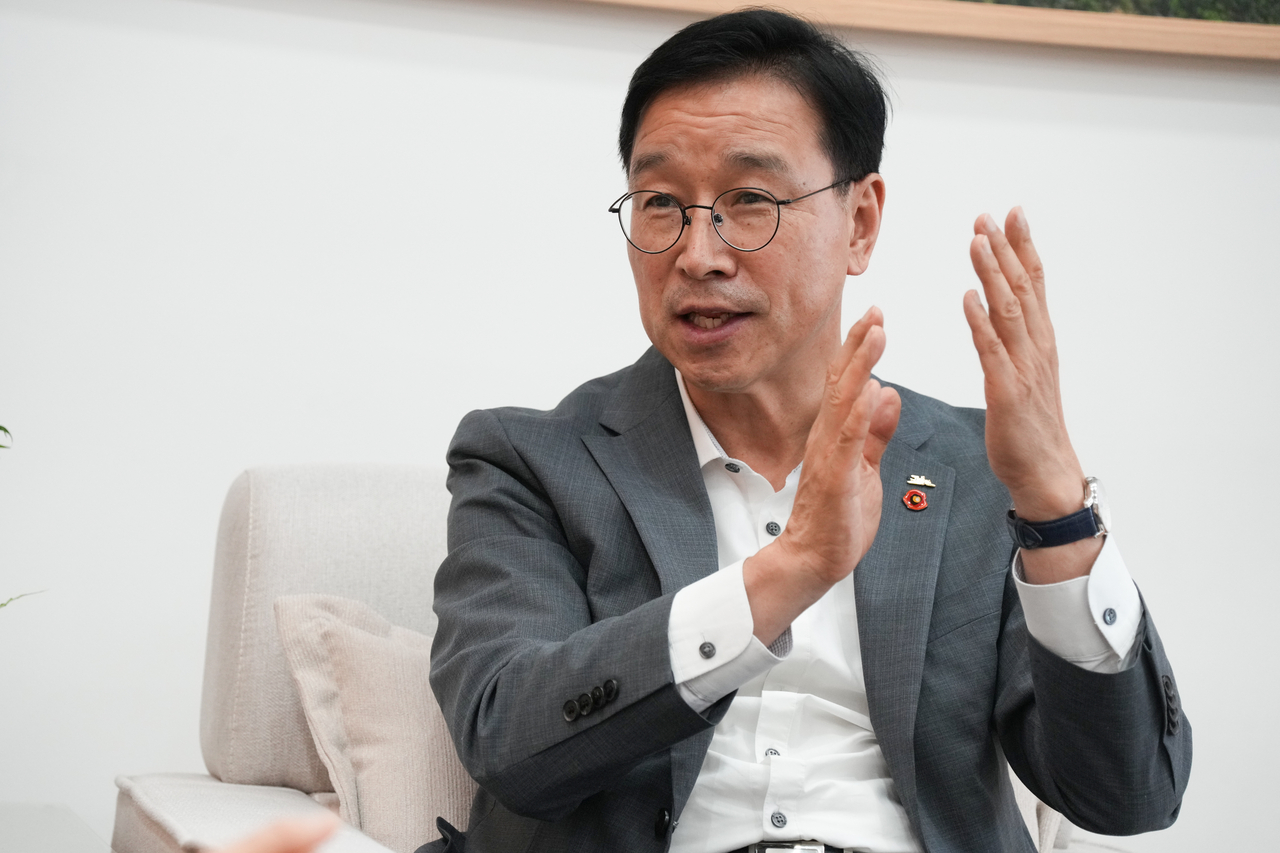
— AI transformation is becoming a major goal not only in tourism but across everyday life, and not just for the central government but for local governments as well.
▶ The heart of Jeju's AI transformation is changing the way the administration works through AI and spreading that change into residents' daily lives and industrial sites. Under the banner of "governance driven by AI," the administration is leading AI innovation. We have designated an "AI partner" in each department to embed a culture of effective AI use throughout the organization; 118 people are currently active, handling repetitive tasks such as accounting and budgeting. We have built "AI Connect," a platform that turns various public information into a knowledge asset. This year we are developing an "AI administrative assistant" for civil servants, and next year we will expand it into an "AI resident assistant" that provides residents with accurate information around the clock.
— There are criticisms that the second airport project is stalling. Conflict among residents continues. What are your plans going forward?
▶ The second airport has been a source of conflict between supporters and opponents for the past 11 years. What matters most is gathering sufficient public opinion and reaching a conclusion through that process. Jeju Island is discussing the methods and procedures for collecting public opinion through the Second Airport Conflict Mediation Council, which launched Nov. 5. Based on those results, we will complete the public opinion-gathering process by the first half of next year and realize residents' right to self-determination.
— Many tourists point to severe traffic congestion in Jeju, particularly around Jeju city.
▶ Jeju faces recurring traffic congestion — during rush hours and peak tourism seasons alike — due to the growth in tourists and rental cars and a transportation structure centered on private vehicles. A comprehensive approach is needed: shifting from a car-centered system to one focused on public transit and pedestrians, while also expanding road and parking infrastructure to meet demand. We will improve the trunk and branch route structure of public transit to cut travel times between major hubs, and reform the transfer system to reduce inconvenience for public transit users. We will continue subsidizing public transit fares for residents to encourage greater use. In particular, the commercialization of urban air mobility is expected to divert some of the ground travel demand from the roughly 13.8 million tourists who visit each year into the air, and "tourism-oriented urban air mobility" could help revitalize the local economy. It is also expected to lay the groundwork for expanding youth employment through related industry development and for achieving carbon neutrality.
— Attracting six second-round public institution relocations, including the Korea Racing Authority, is an immediate challenge for Jeju Island.
▶ Attracting public institutions is an important task for strengthening Jeju's industrial base and expanding job opportunities for residents. The focus is on linking each institution's expertise with Jeju's industrial, research and education base to create an industrial ecosystem where the relocating institutions and the region grow together. The Korea Racing Authority in particular is a key institution that can be linked to Jeju's horse breeding and training base, its horse racing and equestrian facilities, and universities' talent development functions. Korea Airports Corporation can identify opportunities for local companies to participate in airport operations and aviation services, and support youth employment through education and internship programs in partnership with universities. The Korea Energy Technology Evaluation and Planning Institute can use Jeju's renewable energy demonstration infrastructure to connect joint research and development and commercialization among companies, universities and research institutions, while the Korea Marine Environment Management Corporation can expand cooperation in marine ecosystem conservation and pollution response. We will work to make these cooperation plans concrete by linking them to Jeju's regional development strategy and growth engine cultivation plan.
— The government has designated a "small satellite system" as a growth engine for the Jeju region.
▶ The core competitive advantage of a small satellite system lies in the speed and connectivity that come from manufacturing, launch, control and data utilization all happening in one place. Jeju Island is building a domestically unique, self-contained space supply chain: small satellites produced at the Hanwha Jeju Space Center within Hawon Techno Campus can be moved directly to nearby waters for launch without being transported to the mainland, then immediately received and utilized by ground stations on the island. In the satellite manufacturing and verification phase, we plan to fully activate a mass production system for small satellites — including ultra-high-resolution synthetic aperture radar satellites — centered on the Hanwha Jeju Space Center, and to intensively attract satellite materials, components and equipment partner companies to the Hawon Urban Advanced Industrial Complex in connection with large-scale follow-on facility investment. We will also expand space environment testing facilities on the island so that small and medium-sized partner companies can handle everything from parts manufacturing through environmental testing to final satellite assembly entirely within Jeju, creating a self-contained manufacturing ecosystem. We will also work to secure an additional government designation of a space industry cluster specializing in satellite information utilization, completing the national space economy value chain.
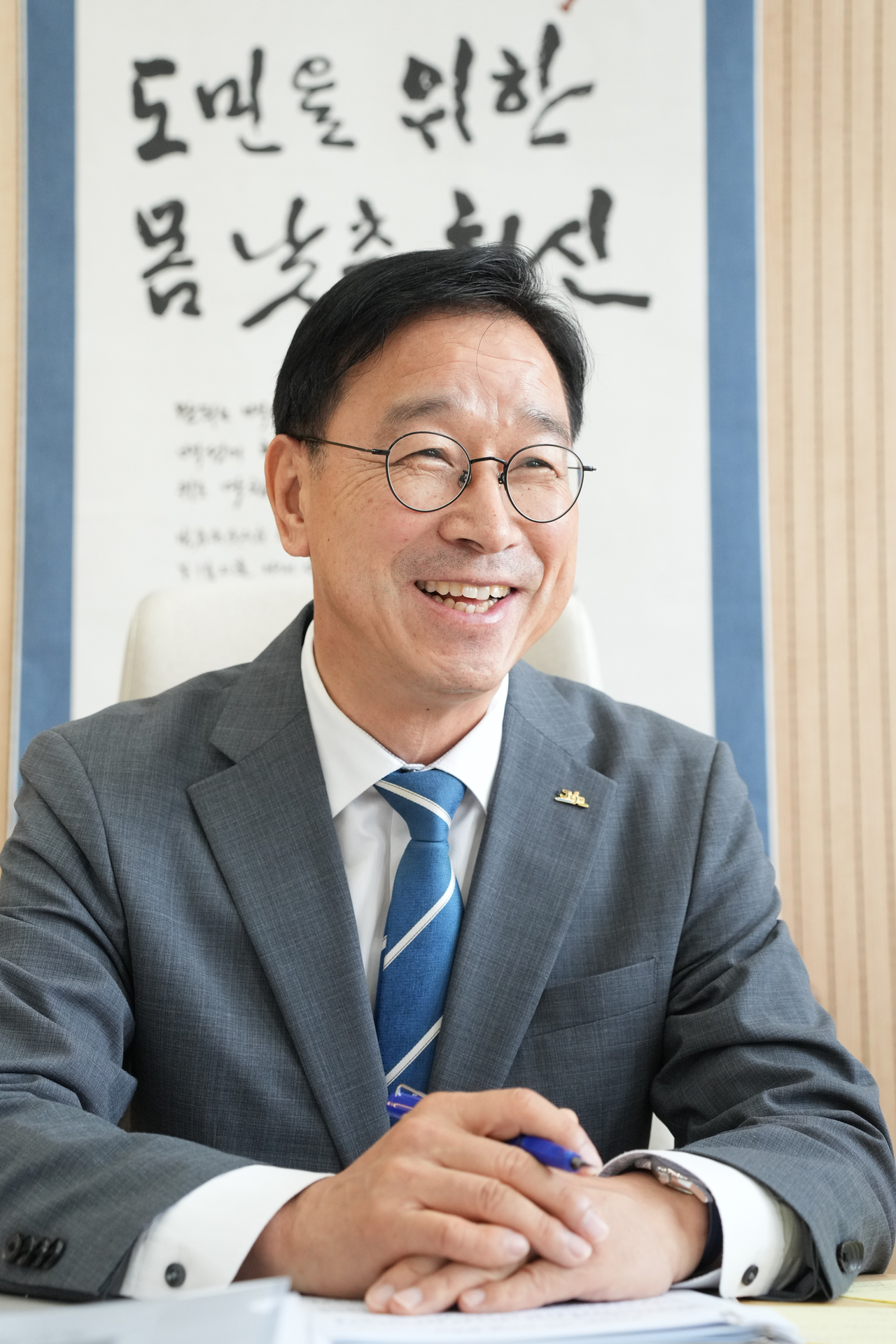
— The 9th elected term's campaign pledges were finalized last month. Among them, the "Jeju-style basic society" stands out.
▶ Last month Jeju Island finalized 100 campaign pledges for the 9th elected term administration and drew up an implementation plan investing around 9.7 trillion won through 2030. The core of these pledges is to restore livelihoods and lay the groundwork for future growth, while ensuring that the results translate into real change in residents' lives. At the center of that is the Jeju-style basic society — a concept aimed at ensuring that every resident, wherever they live, can stably enjoy the basic conditions necessary for life, tailored to the island's unique characteristics. This means supporting young people taking their first steps in society with income and employment assistance for self-reliance; bridging the mobility gap for residents in towns and villages through a dedicated taxi service; and enabling elderly residents to receive the care and medical services they need without leaving their communities. Particularly distinctive to Jeju is an "energy basic society" that shares with residents the profits generated from the island's abundant wind and sunlight. Early next year, we plan to conduct a public awareness survey and run a resident participation group to gather broad public input and reflect it in a comprehensive basic society plan.
— Jeju Island has been at the forefront of carbon neutrality through agreements with Hyundai Motor Group and others.
▶ Jeju Special Self-Governing Province is pursuing a structural transition across energy, transport and industry as a whole — going beyond expanding renewable energy — with a target of achieving carbon neutrality by 2035. We will accelerate the low-carbon transition in the energy and transport sectors so that carbon neutrality can be achieved while preserving the competitiveness of Jeju's key industries. We intend to make carbon neutrality not a burden on industry but an opportunity to build competitiveness and generate new income. For Jeju's key industries — tourism, agriculture and livestock — we will integrate renewable energy and RE100 to lower companies' energy costs and support the shift to a low-carbon industrial structure. We will build a Jeju climate economy capital where activities that reduce carbon, such as a greenhouse gas resident practice mileage program, translate into income for residents and businesses.
— "Jeju, climate economy capital" is also the core vision of the 9th elected term administration. Could you elaborate?
▶ We will leverage Jeju's natural environment — wind and solar power — to expand renewable energy, and build up energy flexibility resources including energy storage systems, electric vehicles and power grids to establish a system that efficiently produces, stores and uses energy. We will also nurture the clean energy industry and connect it with AI and data industries to create a future new-industry ecosystem. To that end, we will attract corporate investment and create quality jobs. We will expand community-participatory renewable energy projects and develop a model for sharing power generation profits with residents. We will ensure that the fruits of the energy transition flow through to residents' income and local economic vitality. The ultimate goal is to make Jeju a place where climate crisis response, economic growth and improvements in residents' quality of life are achieved together. Building a virtuous economic cycle — where Jeju's wind and sunlight become industry and jobs, and the results are shared with residents — is the essence of the Jeju climate economy capital vision.
— Distortions and denigration of the April 3 Jeju Incident continue to surface.
▶ The April 3 Jeju Incident is a matter of national historical record, confirmed on the basis of the official "Report on the Truth of the April 3 Jeju Incident" — adopted with bipartisan agreement by the government — and a wide range of related historical materials. Grounded in that objective historical evidence, efforts are needed to uphold the truth of the April 3 Jeju Incident and counter historical distortion and denigration. Jeju Island has formed and is operating a legal advisory panel and an expert advisory panel to respond to distortion of the incident's history. We will also work actively to ensure that an amendment to the Special Act on the April 3 Jeju Incident — which includes provisions penalizing historical distortion — passes the National Assembly as soon as possible. Furthermore, we will respond firmly to historical distortion so that the historical truth of the April 3 Jeju Incident is passed on without wavering, and we will uphold the values of the April 3 Jeju Incident grounded in truth and justice.
— In just over a month it will be the new year — the second year of your administration, and the year when a truly Wi Seong-gon-branded governance begins in earnest. Do you have plans to share?
▶ Next year, we must go one step further from setting the direction of the 9th elected term administration and deliver results that residents can actually feel. I will hold to the principle that the starting point of governance, and the standard by which its results are judged, must be residents' lives. First, I will make restoring the livelihood economy the top priority of the administration and work to strengthen the competitiveness of Jeju's foundational industries — primary industries and tourism. I will develop renewable energy convergence, small satellites and clean biotech as Jeju's new growth engines.
Wi Seong-gon — career highlights
Born in 1968 in Jangheung, South Jeolla Province; graduated from Seogwipo High School; earned a degree in horticulture from Jeju National University and completed a master's program in political science at Jeju National University's Graduate School of Public Administration. Wi served as student body president of Jeju National University in 1991, chair of the Democratic Party of Korea's Jeju chapter in 2018, and the party's senior floor policy deputy representative in 2022. In 2024 he co-chaired the National Assembly Forum on Local Extinction and Climate Crisis Agricultural Innovation, and in 2025 served as chair of the National Assembly Special Committee on the Climate Crisis and as a member of the Lee Jae Myung government's state affairs planning committee. He served three terms as a member of the Jeju Special Self-Governing Provincial Council (Donghong-dong) and three terms as a National Assembly member representing Seogwipo, Jeju, before becoming the 40th governor of Jeju Special Self-Governing Province.
ken@heraldcorp.com