Foreign selling continues despite Nvidia's strong earnings
US PCE data due Wednesday, Bank of Korea rate decision Thursday
Semiconductor profit forecasts revised up; Kospi seen in 5,000–6,100 range
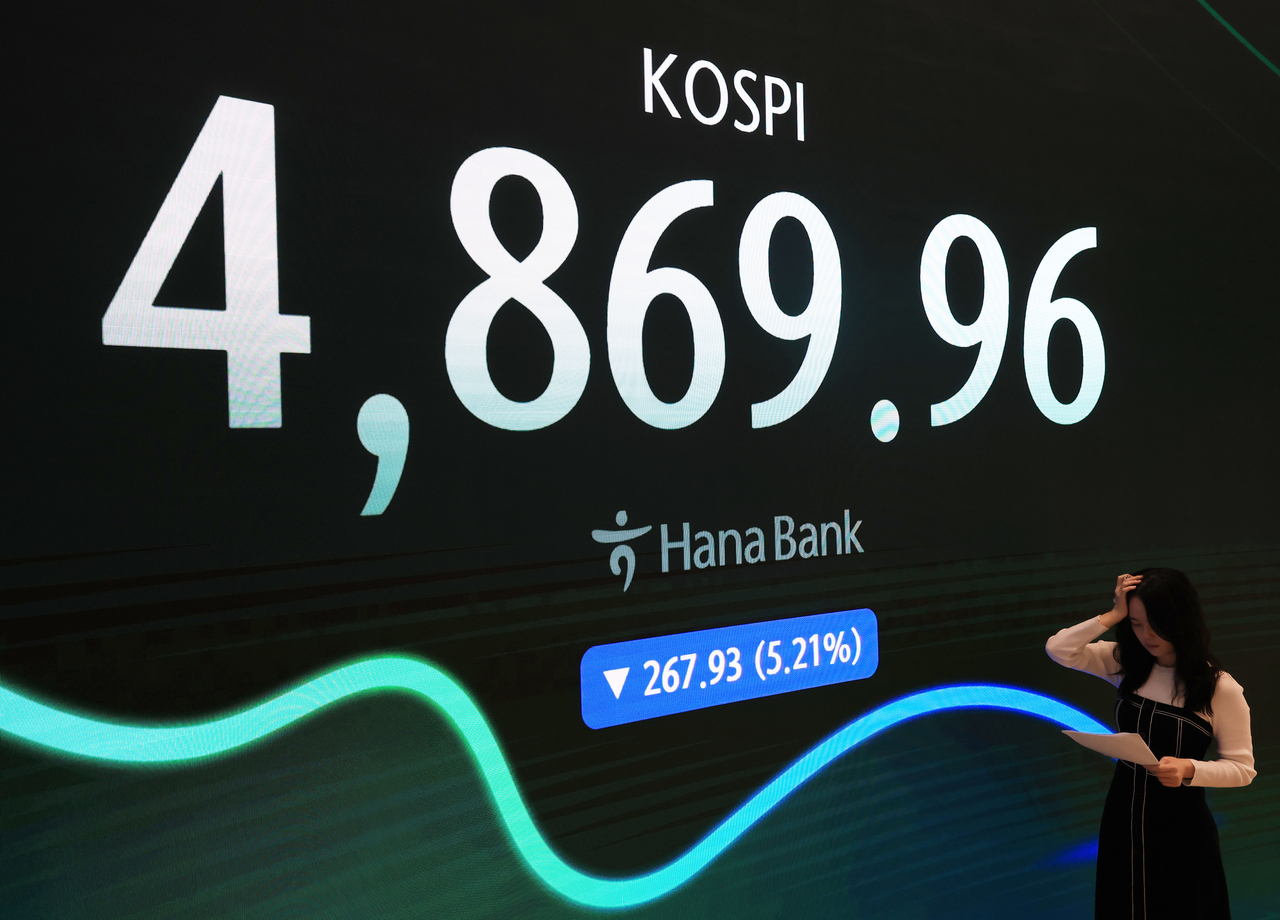
The Kospi slipped back below the 5,000-point mark, dragged down by sustained foreign selling and fears of further US interest rate hikes. Even as Nvidia posted stronger-than-expected earnings, weakness in AI-related stocks persisted, and analysts say next week's US inflation data and foreign investor flows will determine whether the market can stage a recovery.
According to Korea Exchange, the Kospi closed Friday down 267.93 points, or 5.21 percent, at 4,869.96. The Kosdaq fell 39.13 points, or 5.71 percent, to finish at 645.68. For the week of Monday through Friday, the Kospi lost 7.95 percent and the Kosdaq shed 7.72 percent.
Domestic markets were under pressure throughout the week amid concerns over additional US rate increases and uncertainty surrounding AI investment. Although Nvidia reported results that beat market expectations, worries lingered that funding for AI companies could dry up following the departure of former CEO Jensen Huang. Moves by the United States to tighten semiconductor export restrictions on China also dampened investor sentiment.
Kang Jin-hyeok, a researcher at Shinhan Securities, noted that the Kospi's 12-month forward price-to-book ratio has fallen to 0.96 times, easing valuation concerns, but that foreign capital outflows continue. With the earnings season now over, he said macroeconomic variables — including economic indicators and monetary policy — are likely to drive market direction next week.
The key variable for markets next week will be the US personal consumption expenditures price index for October, due Wednesday (local time). According to Bloomberg consensus forecasts, headline PCE inflation is expected to rise 3.8 percent year on year, while core PCE is seen up 3.2 percent. A reading above expectations would heighten fears of further Fed rate hikes and weigh on equities.
"If PCE inflation comes in above expectations, concerns about additional rate hikes and upward pressure on government bond yields will intensify, likely limiting the market's ability to rebound even with positive AI news," said Lee Kyung-min, a researcher at Daishin Securities. "On the other hand, if inflation shows signs of cooling, we can expect monetary policy pressures to ease and risk appetite to recover."
The Bank of Korea's Monetary Policy Board meets Thursday. Markets widely expect the central bank to raise its benchmark interest rate by 25 basis points, from the current 3.00 percent to 3.25 percent annually.
The US Thanksgiving holiday will also create a liquidity gap. US markets will be closed Thursday and will close early Friday. Analysts warn that reduced foreign participation could thin domestic market volumes and amplify share price volatility.
On a more positive note, earnings forecasts for domestic companies are improving. According to Yuanta Securities Korea, the 2027 net profit forecast for Kospi-listed companies was revised up this week, rising from last week's 1,132.5 trillion won ($851 billion) to 1,147.3 trillion won, an increase of 14.8 trillion won. The IT sector accounted for 15.6 trillion won of that upward revision.
"The correction has been driven more by rising discount rates and deteriorating supply-demand conditions than by any actual erosion of corporate earnings," said Lee Jae-won, a researcher at Yuanta Securities Korea. "Even without a new wave of buyers entering the market, a slowdown in the pace of foreign selling alone could be enough to trigger a rebound."
NH Investment & Securities set its projected Kospi range for next week at 5,000 to 6,100 points, citing upward revisions to domestic corporate earnings forecasts and export growth as tailwinds, while flagging hawkish remarks from Federal Reserve officials as a downside risk.
"In the short term, a gap between share prices and fundamentals persists," said Na Jeong-hwan, a researcher at NH Investment & Securities. "But it is difficult for the divergence — where earnings forecasts keep rising while share prices keep falling — to continue for an extended period."
hajun825@heraldcorp.com