Kospi at 4,706.22 as losses deepen after open
Samsung Electronics down 4.64%, SK hynix down 3.95%
Investor sentiment sours despite market stabilization fund preparations
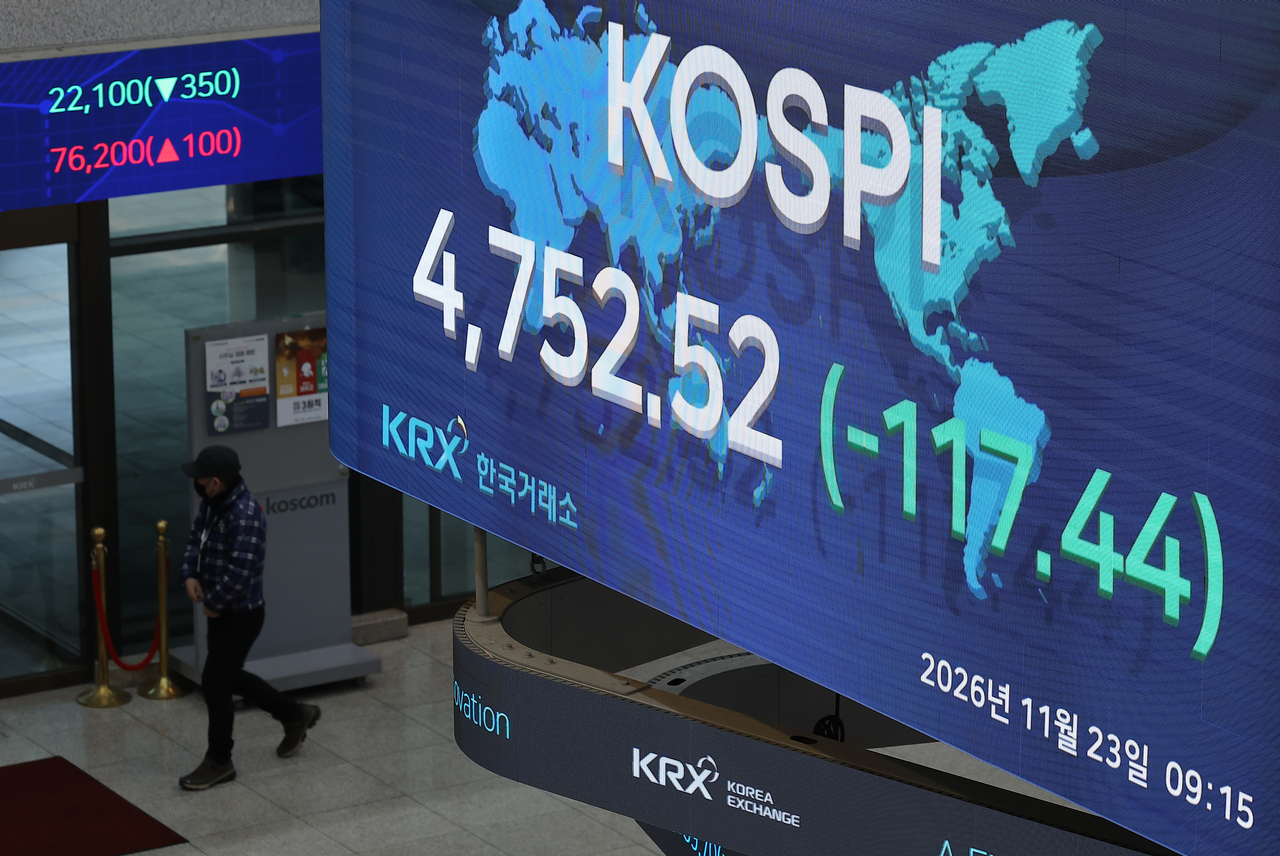
The Kospi dropped more than 3 percent in early trading Monday, sliding toward the 4,700 level, as a selloff in AI-related technology and semiconductor stocks on Wall Street rippled through domestic markets. The government moved to ready its stock market stabilization fund, but selling pressure concentrated in large-cap semiconductor names such as Samsung Electronics and SK hynix continued to push the index lower after the open.
As of 10 a.m., the Kospi was trading at 4,706.22, down 163.74 points, or 3.36 percent, from the previous session, according to Korea Exchange. The index opened at 4,734.90, already down 135.06 points, or 2.77 percent, before extending its losses.
On the main Kospi market, retail investors and foreign investors were net sellers of 284.5 billion won ($213 million) and 13.8 billion won, respectively. Institutional investors were net buyers of 243.3 billion won, providing some support against the decline.
Among large-cap stocks, Samsung Electronics was trading at 174,600 won, down 8,500 won, or 4.64 percent, from the previous session, while SK hynix fell 44,000 won, or 3.95 percent, to 1.069 million won.
Other top market-cap stocks were broadly lower, with Samsung Electronics preferred shares down 3.74 percent, SK Square down 1.33 percent, LG Energy Solution down 2.17 percent, Samsung Biologics down 5.39 percent, Samsung Electro-Mechanics down 0.65 percent, KB Financial Group down 4.13 percent, Hyundai Motor down 3.92 percent, and Celltrion down 4.69 percent.
The domestic market's sharp drop is attributed to a technology-led selloff on Wall Street last week. The Nasdaq Composite plunged 5.28 percent on Friday (local time), while the Philadelphia Semiconductor Index collapsed 10.73 percent. Persistent anxiety over AI investment weighed on investor sentiment, particularly in semiconductor stocks.
The government's move to prepare the stock market stabilization fund is seen as a potential brake on further declines. Financial authorities convened an emergency market review meeting Sunday and decided to stand ready to deploy the fund depending on market conditions.
The Kosdaq also fell. As of 10 a.m., the index was trading at 634.83, down 10.85 points, or 1.68 percent, from the previous session. It opened at 634.93, already down 10.75 points, or 1.66 percent.
On the Kosdaq market, retail investors were net sellers of 110.8 billion won, while institutional and foreign investors were net buyers of 80.1 billion won and 30.4 billion won, respectively.
Among top Kosdaq stocks by market cap, Alteogen fell 3.90 percent, Rainbow Robotics dropped 2.94 percent, Ecopro declined 2.91 percent, Ecopro BM slid 2.06 percent, HLB fell 1.11 percent, Sam Chun Dang Pharm dropped 1.04 percent, and Jusung Engineering edged down 0.90 percent. Bucking the trend, Robotis gained 3.00 percent, Simtech rose 1.10 percent, and EO Technics added 0.52 percent.
Market analysts say the Kospi's rapid decline has opened room for a technical rebound. However, they caution that downside risks remain as uncertainty over the AI industry has yet to be resolved.
Han Ji-young, a researcher at Kiwoom Securities, said the index had entered a range where a technical rebound was possible, noting that the Kospi's roughly 46 percent plunge from its peak over four and a half months was "exceptional in both scale and speed." Han added that the government's decision to prepare the stabilization fund "signals it will not stand by as markets fall sharply, which should help calm supply-demand anxiety."
Han also warned that "lingering anxiety over the AI industry and distrust of corporate earnings mean we must keep in mind a worst-case scenario where the Kospi falls to the 4,200–4,300 range." Even so, Han said the probability of that scenario materializing was low given that the market had already entered extreme oversold territory and the stabilization fund could be deployed. "At this point, holding existing investment positions and riding it out would be the more effective strategy," Han said.

hajun825@heraldcorp.com