32 students develop sign-language subtitles, conversation-aid tools
Teams build XR-AI prototypes for follow-up research support
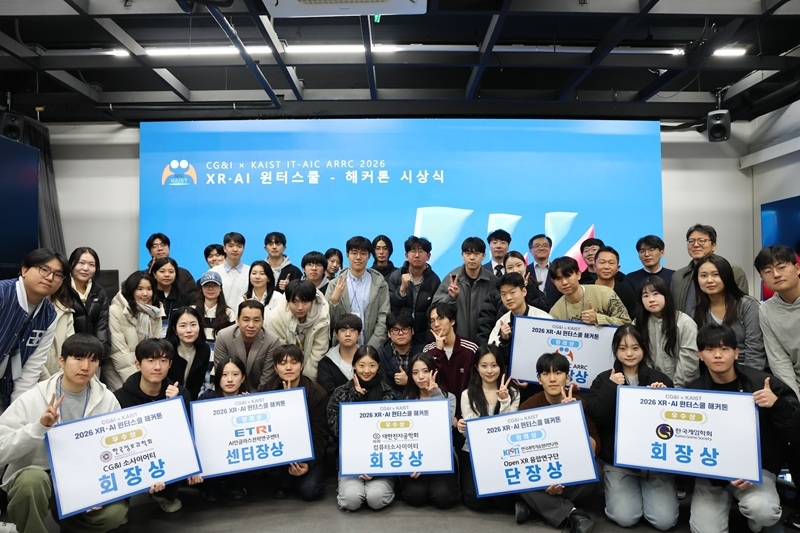
KAIST has launched an effort to develop technologies that use AI glasses and extended reality (XR) devices to enhance communication and learning. University students turned their ideas into working prototypes — including a system that converts sign language into real-time subtitles and another that passes an expert's hands-on knowledge to beginners.
The KAIST Augmented Reality Research Center held the "CG&I × KAIST 2026 XR·AI Winter School & Hackathon" over two days starting Saturday at the Metaverse Graduate School's industry-academia collaboration office, the university announced Monday.
The event drew 32 university students selected from 55 submitted proposals, competing in two-person teams. Eight teams worked with lightweight augmented reality (AR) glasses, while the remaining eight used immersive XR headsets to develop and demonstrate their technologies.
The lightweight AR glasses were used to overlay information linked to people or objects in real-world settings. The immersive XR headsets recreated learning and work environments in virtual space, allowing users to experience them directly. The two device categories served as platforms for exploring how AI technology can be applied across a range of everyday situations.
The event focused not on replacing human effort with AI, but on using AI to strengthen users' ability to communicate and learn — testing how and when AI intervention is most genuinely helpful in real-life contexts.
A total of 12 students across six teams received awards: three excellence prizes and three encouragement prizes.
The Korea Institute of Electronics Engineers Computer Society President's Award (excellence) went to a team of Yoo Jin from Chung-Ang University and Kwon Na-hyeon from Gachon University. They developed an AI assistant that translates an expert's equipment instructions into step-by-step guidance for beginners, linking vague expressions such as "this one" or "that one" to actual buttons and components.
The Korea Computer Graphics and Interactive Techniques Society President's Award (excellence) went to the team of Jang Seung-ho and Ki Min-jun of KAIST for their project "MAZU." The system recognizes Korean Sign Language and American Sign Language and displays Korean and English subtitles respectively, helping deaf and hearing people communicate with each other.
The Korea Game Society President's Award (excellence) went to the team of Yoo Si-hyeon from Konkuk University and Ahn Seong-jin of KAIST for "Spatial Review," a technology that analyzes the audio and board writing from mathematics lectures and lets students review three-dimensional shapes in virtual reality.
The encouragement prizes went to three KAIST teams: "Baton" (Park Eun-ji and Kim Ye-jun), which links a designer's verbal explanations to blueprints and relays them to assemblers; "FormBridge" (Kim Chan-i and Lee Ju-young), which lets users compare AI-generated design alternatives in XR space; and a guitar-lesson tool (Jeong Hyeon-seo and Choi Chi-won) that records an instructor's demonstration measure by measure to aid practice. The three teams received awards associated with the Electronics and Telecommunications Research Institute (ETRI), the Korea Institute of Science and Technology Information (KISTI), and the KAIST Augmented Reality Research Center, respectively.
Other prototypes demonstrated included an AI assistant that surfaces information only at critical moments during a conversation, and a tool that logs a gallery docent's explanations linked to the locations of artworks. The winning entries remain at the prototype and demonstration stage, however, and their real-world performance and learning effectiveness require further verification. Questions around privacy — stemming from the recording of video and audio — also remain unresolved.
Woo Woontack, director of the KAIST Augmented Reality Research Center, said AI glasses should help users learn and make judgments on their own, "so that even after taking the glasses off, what they have learned and experienced remains their own capability."
KAIST plans to offer outstanding undergraduates research internships of up to two months in January and February next year, and to hold regular spring and fall hackathons starting next year to support follow-up research and real-world testing.
Meanwhile, the KAIST Augmented Reality Research Center is conducting research on "Symbiotic AIR4BTS" — a framework for recording and organizing information gathered in the real world, applying it to new situations, and enabling users to perform at their best even without AI assistance.
woo@heraldcorp.com