Assessment-to-market ratio held at 69% for fifth straight year
Some southern Gyeonggi complexes may face broader comprehensive real estate tax base
With the government deciding to freeze the publicly announced housing price assessment ratio used to calculate property holding taxes next year, attention is turning to whether homeowners in lower-to-mid-tier Seoul neighborhoods and southern Gyeonggi Province — where prices surged this year — will face a heavier tax burden.
In Seoul's Gangnam area, where ultra-high-end properties are concentrated, there is even talk of assessed values falling due to proposed tax reforms. But warnings are emerging that increases could be substantial in non-Gangnam Seoul and in southern Gyeonggi Province, which has been buoyed by the semiconductor industry belt.
According to officials, the Ministry of Land, Infrastructure and Transport decided at a meeting of the Central Real Estate Price Disclosure Committee on Friday to maintain next year's assessment-to-market ratio at this year's level.
The decision reflects concern that raising the ratio on top of already rising Seoul apartment prices could doubly increase the holding tax burden, given that the tax reform plan announced in August is already aimed at expanding the tax load on high-priced homes and non-resident single-home owners.
As a result, the assessment ratio for publicly announced apartment prices will be frozen for the fifth consecutive year. Values as of Jan. 1 next year will be calculated by applying the same 69.0% ratio to market prices as this year.
Based on the Korea Real Estate Board's weekly apartment price index, Seoul apartment sale prices had risen a cumulative 8.91% through the third week of November this year, already approaching last year's full-year gain of 8.98%.
The geographic distribution driving that overall increase, however, looks very different from last year — and the pattern suggests that next year's changes in assessed values will vary considerably by district.
Last year, the three Gangnam districts posted exceptionally high annual gains — Songpa-gu at 22.52%, Seocho-gu at 15.26% and Gangnam-gu at 14.67% — while the Han River belt districts also contributed strongly, with Seongdong-gu up 18.75%, Mapo-gu 14.22%, Gangdong-gu 13.46%, Yangcheon-gu 13.33%, Yongsan-gu 13.26% and Gwangjin-gu 12.07%.
As a result, Seongdong-gu led the nation this year in the rate of increase in assessed values compared with the previous year, rising 28.98%, followed by Gangnam-gu at 25.83% and Songpa-gu at 25.46%.
This year's cumulative gains through the third week of November tell a different story: the top performers in Seoul have been Seongbuk-gu at 17.76%, Seodaemun-gu at 15.03%, Guro-gu at 13.80%, Gangseo-gu at 13.73%, Dongdaemun-gu at 13.53%, Gwanak-gu at 13.30% and Nowon-gu at 13.24%.
These are mid-tier or lower districts where annual gains last year were mostly in the 5% range, and where this year's assessed value increases were largely single-digit — well below those seen in Gangnam or the Han River belt.
Even if assessed values rise in line with higher prices, the actual tax burden may not increase noticeably in these areas, since the base prices were lower to begin with.
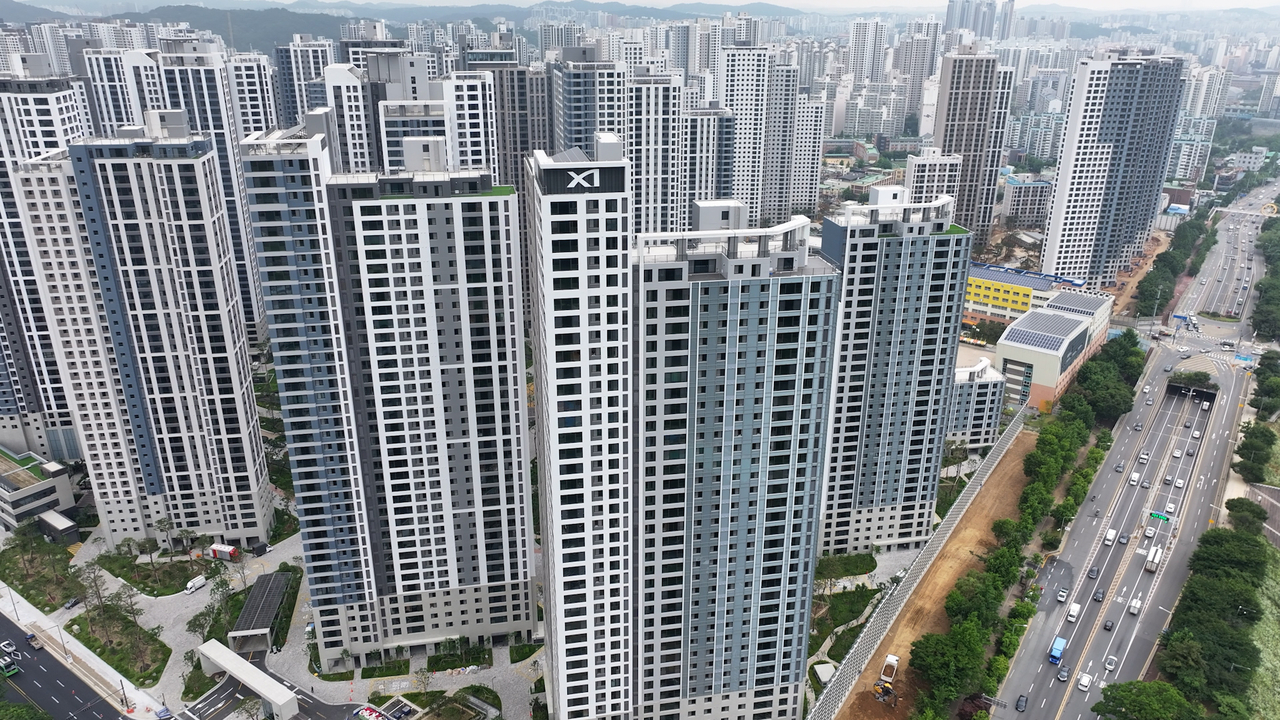
Southern Gyeonggi Province, however, presents a different picture, driven by the semiconductor industry boom. Through the third week of this month, eight of the top 10 districts nationally for cumulative apartment price gains this year were in Gyeonggi Province: Dongtan-gu in Hwaseong at 23.01%, Yeongtong-gu in Suwon at 19.29%, Gwangmyeong at 19.08% and Dongan-gu in Anyang at 18.86%, among others. In Hwaseong's Dongtan-gu, the flagship Dongtan Station Lotte Castle complex saw its 84-square-meter unit set a new high of 2.23 billion won ($1.67 million) in a 33rd-floor transaction in June. In Gwangmyeong, an 84-square-meter unit at Cheolsan Xi The Heritage in Cheolsan-dong sold for 2.01 billion won on Nov. 2, and listings are now appearing at 2.1 billion won, reflecting how sharply prices have climbed.
Park Won-gap, a senior real estate specialist at KB Kookmin Bank, said that applying the 69% assessment ratio straightforwardly, a market price above 2 billion won would translate to an assessed value of around 1.4 billion won — roughly the level of the basic deduction threshold for the comprehensive real estate tax under the proposed reform. "Areas along Seoul's Han River belt and parts of southern Gyeonggi Province that fall into this price range could see more homeowners become subject to the comprehensive real estate tax," Park said.
Meanwhile, in the three Gangnam districts where high-end properties are concentrated, prices have continued to slide — particularly at expensive reconstruction complexes — amid concerns over the tax reform plan, leaving cumulative annual price changes little different from last year. Through the third week of this month, Gangnam-gu's annual sale price change stood at minus 2.57% and Seocho-gu's at minus 0.80%, both weaker than a year earlier, while Songpa-gu's 3.38% gain was a sharp pullback from last year's pace.
Based on the actual transaction price index for apartments — a lagging indicator of housing prices — the average actual transaction price in Seoul rose 10.3% through September compared with the end of last year. The northeastern zone, dominated by mid-to-lower-tier districts, climbed 13.9%, while the southeastern zone, which includes the three Gangnam districts, was limited to a 2.9% gain.
With some large price corrections appearing in ultra-high-end Gangnam reconstruction complexes, close attention will be paid to how much assessed values shift for individual complexes next year.
hss@heraldcorp.com