Alumni association: 'When, who and how were all those responses reflected?'
Defense Ministry: 'Opinions will be incorporated as we fill in the details going forward'
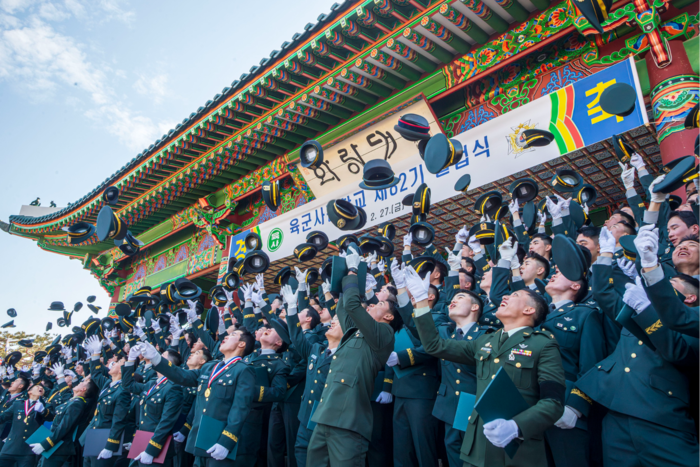
The ruling party and government have finalized a revised plan to establish a unified Korea National Military Academy, but the Defense Ministry is facing criticism that its earlier pledge — to gather opinions from service chiefs, cadets and experts before completing the plan — has been rendered meaningless.
According to the Defense Ministry, the plan for the new unified academy was recently revised from a "fully integrated four-year" model to a "network-type" arrangement that would make use of each service branch's existing campus. Critics say the ministry rushed to reach an agreement with the National Assembly without allowing enough time to meaningfully incorporate the feedback it had promised to collect.
The Defense Ministry conducted a survey of first- through fourth-year cadets at the Army, Navy and Air Force academies for five days through Tuesday. Yet the revised plan was announced the following morning through a ruling party-government consultative meeting, while the survey results were still being compiled and analyzed. Defense Minister Kang Shin-cheol had met with the heads of the alumni associations of all three academies on Nov. 9 and said the academies' names would not disappear — but reports had already emerged that morning that a plan to relocate only the Korea Military Academy to a provincial site was all but decided, and that the individual academy names would be abolished.
The Defense Ministry said it had "established a framework — the best possible plan to broaden policy acceptance and raise the overall quality of the proposal by comprehensively gathering input from the many stakeholders involved," adding that "opinions will be reflected as we fill in the specifics going forward."
The ministry cannot escape criticism, however, that the consultations — including the alumni association meeting and the cadet survey — were carried out as a formality after the broad outlines of the plan had already been set. The ministry said "the cadets who participated in the survey will not be subject to this education system," but it has not conducted any separate consultation with prospective cadets who would actually fall under the new integrated curriculum.
Opposition from the alumni associations has intensified since the revised plan was announced. The associations have argued that the policy amounts to "killing the Korea Military Academy" and that Minister Kang broke the promises he made at the Nov. 9 meeting.
"We demanded that each service academy's commandant retain full authority over the school's name, facilities, location, admissions, curriculum, graduation and commissioning — and the minister confirmed that such authority naturally belongs to each service chief," the alumni associations said in a statement. "Yet the revised plan transfers that authority to a school under the direct control of the Defense Ministry. Guaranteeing something in a meeting and then taking it away the moment you walk out the door is a betrayal of trust and a deception of the armed forces' senior veterans and alumni."
The associations also called the consultation process a "fiction," saying the views of cadets and academy officials — the very people the policy directly affects — were excluded, and that the open-ended cadet survey was conducted in a rushed, haphazard manner.
"When, by whom and how were all those responses analyzed, and where in the revised plan were they reflected?" the associations said. "Release the consultation results as they are. In particular, tell us when and how the cadets' open-ended survey responses were analyzed and incorporated."
"Everything has already been decided — from the location of the academy to the implementation timeline — so what exactly is there left to consult on?" the associations added. "An advisory committee that cannot even address whether integration should happen at all is nothing more than a prop for policy promotion. Please establish a public deliberation process that allows citizens to participate."
youknow@heraldcorp.com