All Seoul-proposed underground sections included in ministry's master plan
Gyeongbu line corridor: 34.7 km; Gyeongwon line corridor: 32.9 km
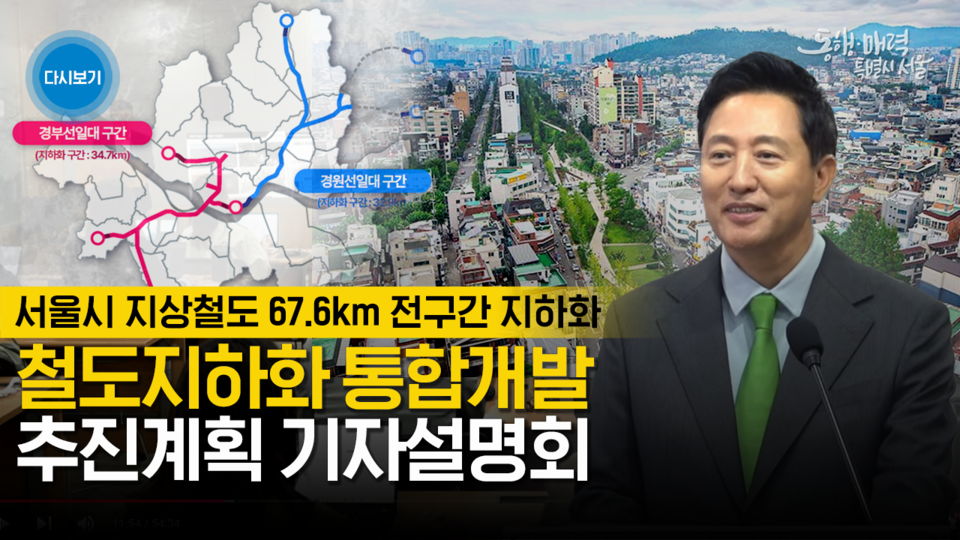
The Seoul Metropolitan Government welcomed the inclusion of a total 67.6-kilometer stretch along the Gyeongbu and Gyeongwon line corridors in the government's master plan for integrated railway undergrounding development, saying it would work closely with the central government to advance the project as quickly as possible.
According to the city Friday, the master plan announced by the Ministry of Land, Infrastructure and Transport incorporates both sections Seoul proposed in October 2024 as new projects: the 34.7-kilometer Gyeongbu line corridor from Seoul Station to Geumcheon-gu Station, and the 32.9-kilometer Gyeongwon line corridor from Seobinggo Station to Dobongsan Station. Together, the two stretches span 67.6 kilometers and cover 39 stations. Seoul said the inclusion lays the foundation for the railway undergrounding project to enter full-scale implementation. "I warmly welcome, together with 10 million Seoul citizens, the inclusion of every section of the railway undergrounding project proposed by Seoul in the master plan," Seoul Mayor Oh Se-hoon said. "We will form one team with the government, prepare follow-up procedures without gaps, and break ground as soon as possible to return to citizens the areas that have been severed by railway tracks for more than half a century."
The integrated railway undergrounding master plan is the first statutory plan established under the Special Act on Railway Undergrounding and Integrated Development of Railway Sites. It sets the direction and scope of railway undergrounding projects.
The sections proposed by Seoul are divided, based on Seobinggo Station, into the Gyeongbu line corridor — covering parts of the Gyeongbu, Gyeongin, Gyeongui and Gyeongwon lines — and the Gyeongwon line corridor, which encompasses the Gyeongwon, Jungang and Gyeongchun lines. Railway undergrounding was one of the signature campaign pledges of Oh's second elected term. At a briefing on the Seoul railway undergrounding integrated development plan held in October 2024, Oh called it "a meaningful day to announce a historic project" and said railway undergrounding was "a task that must be pursued for the city's long-term development." Oh also said the city would "underground the railways and create a second Yeonntral Park above — stretching about 68 kilometers from the southwestern to the northeastern parts of Seoul, covering 1.22 million square meters."
Above-ground railway sections within Seoul currently run about 71.6 kilometers across six lines, passing through 15 autonomous districts. These elevated tracks have fragmented the city's living spaces for more than half a century, causing persistent noise and vibration for residents. The severed neighborhoods have constrained development in surrounding areas and deepened disparities between districts.
The city plans to reconnect divided communities through railway undergrounding and transform the space above the tracks into a mixed-use green, cultural, business and commercial zone for residents. The rail corridor will be developed into a park-like green space modeled on a second Yeonntral Park, while areas around stations will be built up as new mixed-use hubs to revitalize their surrounding neighborhoods.
The city estimates the total project cost at about 25.6 trillion won ($19.2 billion), with projected development profits from the upper-level space reaching about 31 trillion won. The Gyeongbu line segment from Seoul Station to Geumcheon-gu Station is estimated to cost about 15 trillion won over roughly 17 years, while the Gyeongwon line segment from Seobinggo Station to Dobongsan Station is projected to cost about 10.6 trillion won over about 19 years. The ratio of development profit to project cost is estimated at 121 percent. Based on this feasibility analysis, the city said it will work with the central government to refine the project plan and secure a stable financing framework.
The city plans to work closely with the central government until the master plan is finalized, while preparing in advance the steps needed for follow-up procedures — including a preliminary feasibility review — to accelerate the project's progress.
The Onsu Station-to-Incheon Station section proposed by Incheon, selected as a new project, and the Seoksu Station-to-Myeonghak Station section in Anyang, Gyeonggi Province, conditionally selected, will both require coordination with the Gyeongbu line. Seoul said it plans to form a consultative body with the relevant local governments to ensure preliminary feasibility reviews can proceed simultaneously. The city also said it will continue discussions with the Ministry of Land, Infrastructure and Transport on regulatory issues needed to advance the project, including development density standards for the space above the rail sites and questions of property rights over that space after completion.
At a public hearing Thursday hosted by the Ministry of Land, Infrastructure and Transport to establish the integrated railway undergrounding master plan, a consortium led by the Korea Research Institute for Human Settlements presented findings showing that 9 of the 16 projects proposed by local governments had been classified as new projects. Three existing pilot projects will continue, while the remaining four will undergo further review. Projects newly selected include the undergrounding of the Gyeongin line from Onsu Station to Incheon Station (22.8 km), proposed by Incheon and Bucheon in Gyeonggi Province; the Gyeongbu line from Gupo Station to Gaya Depot (8.9 km) in Busan; and the Gwangju line at Gwangju Station (2.1 km) in the Gwangju integrated special city. Daejeon Station (0.4 km) and Seojeongli Station in Pyeongtaek (0.3 km) will be developed as deck-style elevated structures over existing rail facilities.
The undergrounding of the Gyeongbu line from Seoksu Station to Myeonghak Station (7.5 km) in Anyang, Gyeonggi Province, and the Gyeongui-Jungang line at Unjeong Station (2.5 km) in Paju were included as new projects on the condition that their plans be supplemented, given anticipated fiscal burdens on the local governments involved.
cook@heraldcorp.com