Mobis cockpit module, WIA Kappa engine prices up over 16%
Steel and paint procurement at Hyundai Motor's domestic plants up 27%
China's auto exports surge 52% even as profit margins fall to 1%
Tax subcommittee takes up EV domestic-production tax credit
Key raw material prices used in vehicle manufacturing have risen by as much as 40 percent, pushing up both parts costs and finished-vehicle prices. With cost pressures mounting and Chinese automakers flooding the market with low-priced vehicles, South Korea's domestic auto industry now faces a double burden, industry observers warn.
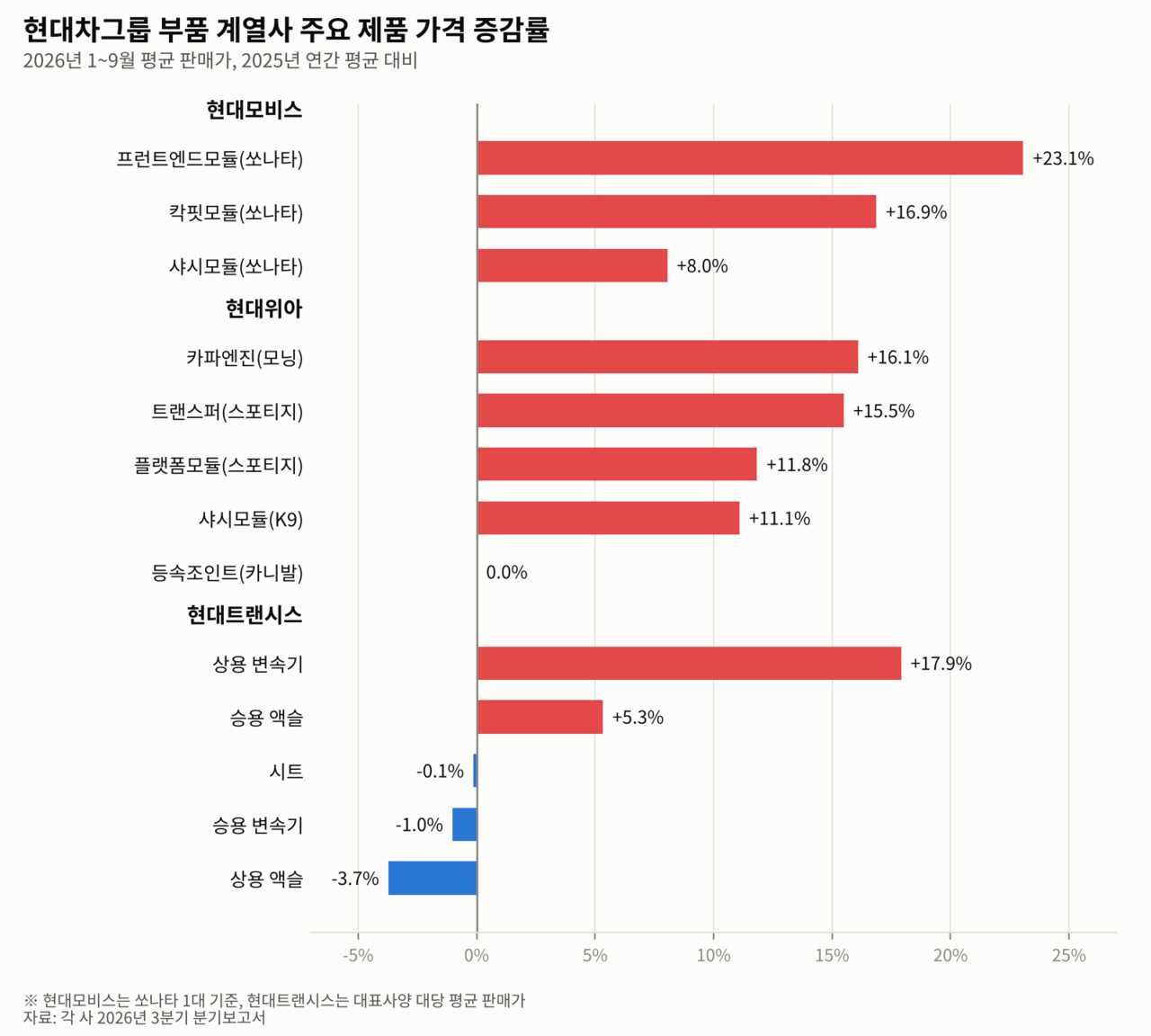
Third-quarter reports filed by major automakers show that the price of a cockpit module produced by Hyundai Mobis stood at 3.13 million won ($2,350) per Sonata unit, up 16.9 percent from last year's average. Over the same period, the front-end module price rose 23.1 percent and the chassis module 8.0 percent. Hyundai Mobis cited exchange rate effects, differences in material specifications by product, and parts price increases as reasons for the changes.
Hyundai Wia and Hyundai Transys tell a similar story. The price of Hyundai Wia's Kappa engine for the Morning rose 16.1 percent to 1.56 million won, while the transfer case for the Sportage climbed 15.5 percent. The average selling price of Hyundai Transys's commercial-vehicle transmission also jumped 17.9 percent to 1.59 million won. Both companies said raw material price fluctuations had affected their product prices.
Copper prices up 40%, yet automakers face backlash over vehicle price hikes
Raw material costs that Hyundai Motor and Kia purchase directly have also risen sharply. According to the companies' quarterly reports, the average copper price from January through September this year was $13,434 per ton, up 40.6 percent from $9,556 in the same period last year. Aluminum rose 29.7 percent to $3,328 per ton, and plastics climbed 21.9 percent to $1,090.
Steel sheet procurement costs have also grown. Hyundai Motor's domestic plants spent 4.22 trillion won on steel sheet and paint purchases, up 27.2 percent from the same period a year earlier — even as domestic output fell 9.8 percent to about 1.25 million units over the same period.
Despite rising costs, passing them on through vehicle prices has proven difficult. The new Avante drew criticism after the entry-level trim was discontinued, pushing the starting price to 23.98 million won — 3.36 million won more than the 2026 model's 20.62 million won.
Hyundai Motor's average domestic passenger car selling price from January through September this year was 57.41 million won, up just 2.2 percent from last year's average. Leisure vehicles averaged 57.55 million won, a 3.1 percent increase. Kia's average domestic passenger car price rose 2.5 percent to 38.74 million won, while its leisure vehicles fell 1.4 percent to 47 million won.
Hyundai Motor and Kia have been absorbing the burden through cost-reduction efforts, but the impact of rising raw material prices has continued into the fourth quarter. The cost burden from raw material price increases in the third quarter reached about 500 billion won for Hyundai Motor and 368 billion won for Kia.
Lee Seung-jo, Hyundai Motor's executive vice president and head of the finance and planning division, said during the third-quarter earnings conference call that "spot prices for key raw materials remain elevated, and prices for some materials such as copper continue to rise due to the global expansion of AI investment and geopolitical supply-demand issues." Lee added that "cost pressures related to raw materials are expected to continue through the fourth quarter, so we will keep up company-wide cost-improvement efforts."
China sacrifices profit to expand exports: 'Auto industry needs policy support'
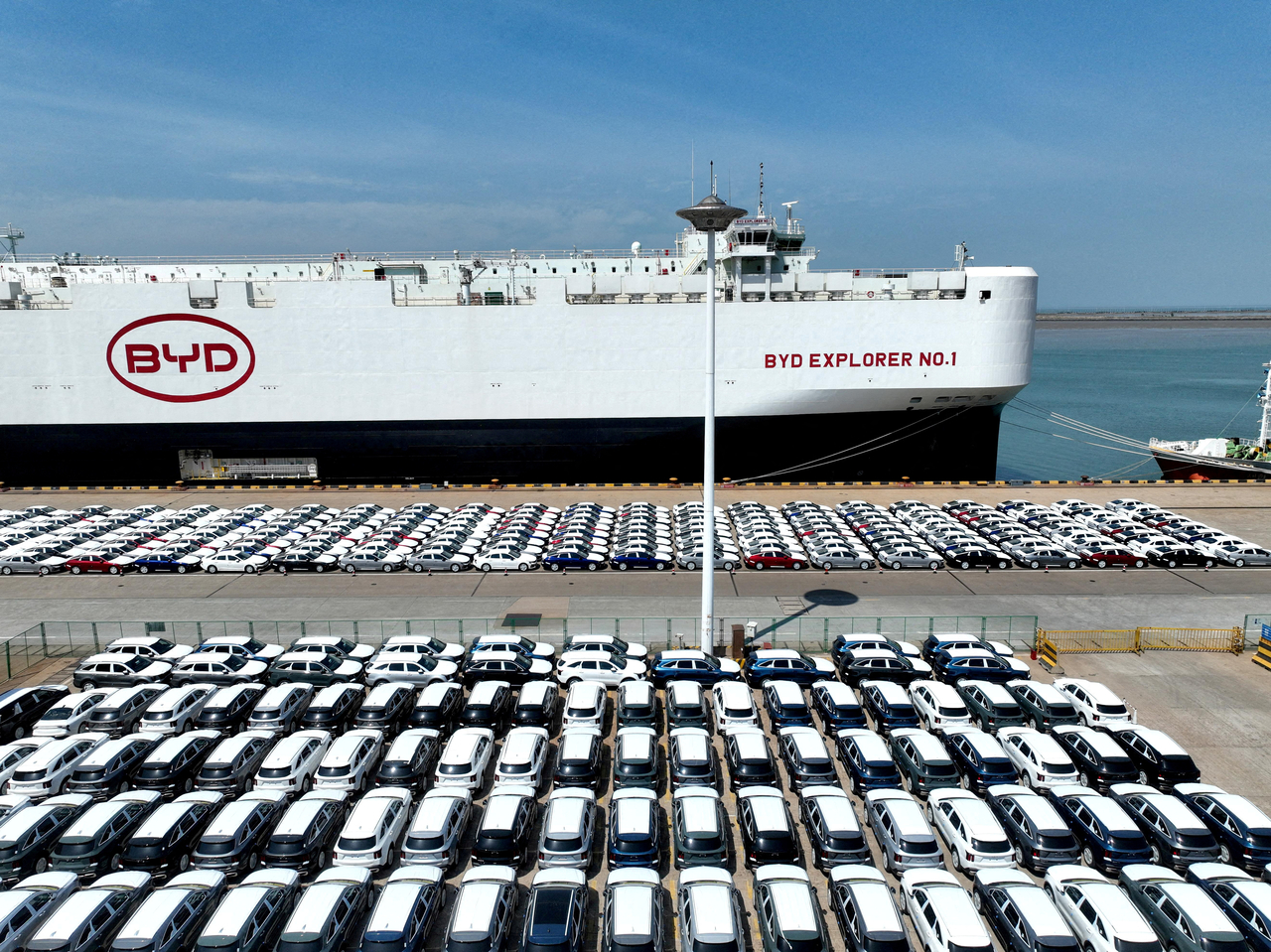
Chinese automakers are compounding the pressure on South Korea's domestic industry by ramping up export volumes even as their own costs rise. According to the China Passenger Car Association, Chinese auto exports reached about 8.63 million units in the first nine months of this year, up 52 percent from the same period last year — surpassing last year's full-year export total of about 8.32 million units in just nine months.
Profitability has deteriorated sharply. Over the same period, profits in China's auto industry fell 23 percent to 267.5 billion yuan ($40.1 billion), with the profit margin shrinking to 3.3 percent. In September alone, the margin dropped to 1.4 percent, the lowest in four years. With domestic demand weakening and raw material costs rising, Chinese automakers have been making up volume through overseas sales. According to the China Association of Automobile Manufacturers, domestic vehicle sales in China fell 22.4 percent year-on-year in the first nine months of this year.
Chinese vehicles are also gaining ground in the South Korean market at an accelerating pace. According to the Korea Automobile Mobility Industry Association, 112,417 Chinese-made passenger electric vehicles were newly registered in South Korea in the first nine months of this year — 2.2 times the figure from the same period last year. Their market share rose 8.4 percentage points to 43.5 percent, while the share of domestically made passenger electric vehicles fell below 50 percent to 48.7 percent.
Lee Ho-geun, a professor in the automotive engineering department at Daeduk University, said "the recent rise in automakers' costs is not limited to raw materials like steel or aluminum," adding that "cost burdens are growing across the full range of core components that go into a vehicle — automotive semiconductors, memory chips, electronic components and battery materials."
Lee added that "Chinese companies have secured cost competitiveness through vertical integration spanning batteries, materials, parts and finished vehicles, backed by their massive domestic market," and that "it will not be easy for domestic companies to compete on price in the short term."
The National Assembly is discussing whether to include electric vehicles in the domestic-production tax credit program. When the government introduced the credit as part of its tax reform package in August, it limited eligibility to six sectors: solar power, wind power, secondary batteries, semiconductors, core materials and AI robot components.
Whether to add electric vehicles is expected to be taken up in earnest during the tax law review by the tax subcommittee of the National Assembly's Finance and Economy Planning Committee this month. Deputy Prime Minister and Minister of Economy and Finance Lee Hyeong-il also weighed in after meeting Hyundai Motor Group Chairman Euisun Chung at the Hyundai Motor and Kia research center on Nov. 2, saying the government would "actively participate in and engage in in-depth discussions during the National Assembly's deliberation process on support for the electric vehicle production tax credit."
An industry official warned that "if policy support across the automotive industry — including the domestic-production tax credit — is not provided in a timely manner, the domestic auto industry ecosystem will wither away."

eyre@heraldcorp.com