
Interview with Yoon Jong-kyoo, adviser to KB Financial
'Held to three principles as chairman'
'Bull market shifting banks from lending model to investment model'
'Finance must not stoke excess demand for real estate'
'Bond auction system better than price ceiling on new apartments'
'Digital assets to develop alongside traditional finance'
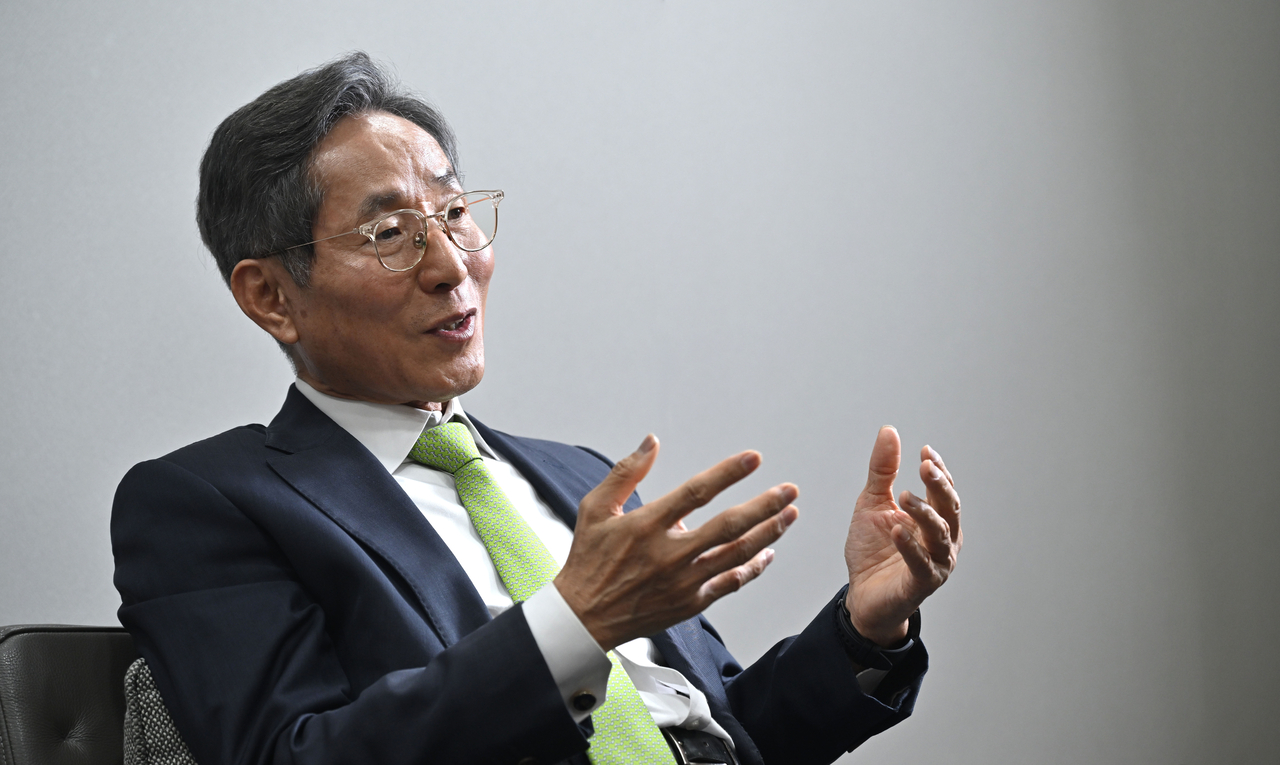
"It is wrong to hand out bonuses based on how hard a union fights or how a manager feels. There must be principles and standards."
Yoon Jong-kyoo, adviser to KB Financial, offered that assessment of the bonus disputes spreading across Korean industry, warning that agreements reached without clear principles could send shockwaves through the broader economy.
Yoon led KB Financial as chairman for roughly nine years from 2014, building it into the country's undisputed top financial group. Now also a distinguished professor at Sungkyunkwan University, he sat down for an interview May 28 near Gwanghwamun in Seoul, sharing his views as a senior figure in the business community on the bonus controversy and other pressing economic issues facing Korea.
Stock-based bonuses build a sense of ownership
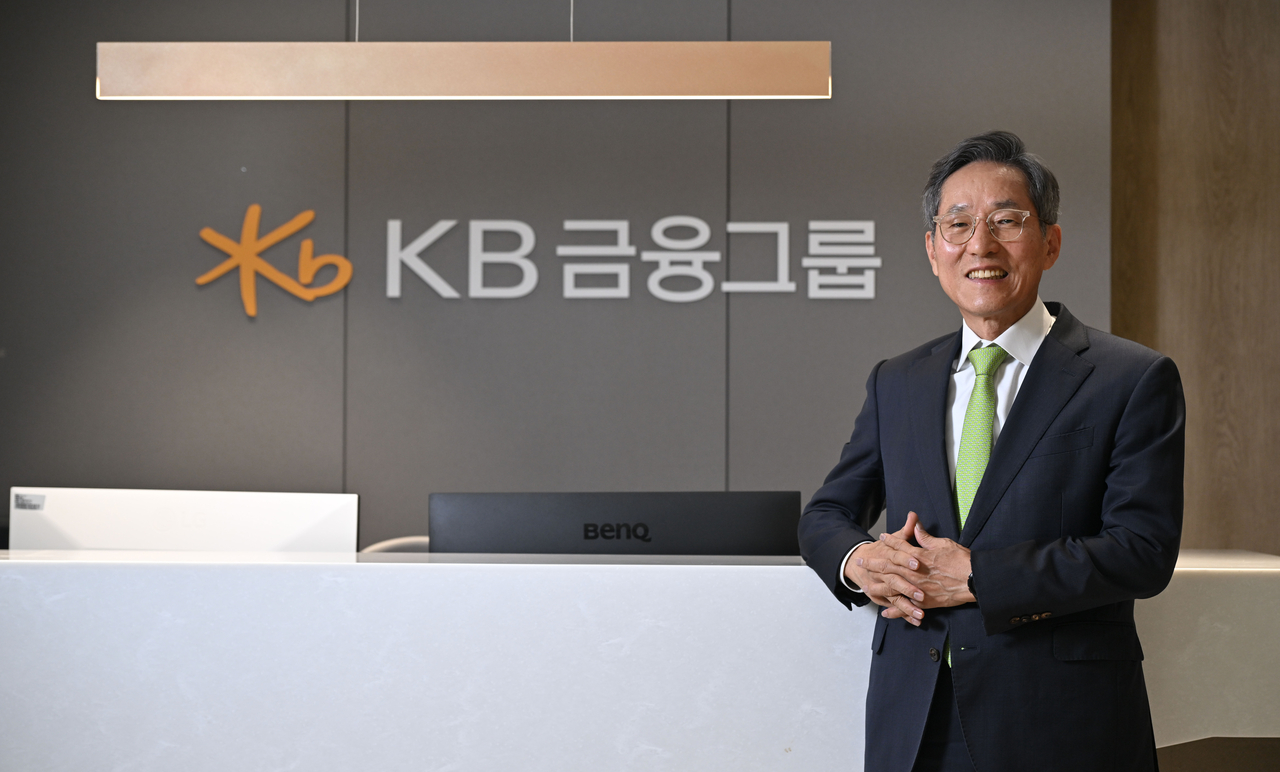
By far the most prominent issue on Yoon's mind was the bonus dispute roiling Korean industry. Conflicts between management and labor — and among different groups of workers — over bonuses worth hundreds of millions of won per person have grown from internal company matters into a society-wide problem.
"My worry is that the pattern of unions demanding more and management partially giving in will spread bonus conflicts to other industries," Yoon said. That concern appears well-founded: since the Samsung Electronics bonus dispute erupted, labor-management tensions over bonuses have spread across the corporate sector, including at Kakao.
He said that in a country like Korea, where labor market flexibility remains limited, such dynamics risk entrenching the interests of those already inside the system, potentially leading shareholders to question the long-term viability of companies.
Yoon traced the root of the current bonus disputes to an absence of principles and standards, recalling negotiations with the Kookmin Bank union during his time as KB Financial chairman. "The union went on strike demanding a larger special bonus," he said. "I thought we could pay more, but it was wrong for the amount to change each time based on how hard the union pushed or how the manager felt — without any principles or standards."
At the time, Yoon established three principles. First, any excess profit above a return on equity of 10 percent would be shared through negotiation. Second, special bonuses would be paid in stock, not cash. Third, payouts would be differentiated based on individual performance.
Paying bonuses in stock, he said, was particularly important for fostering a sense of ownership among employees. "When you give bonuses in stock, employees become shareholders," he said. "If the share price rises, it benefits them directly — that is where genuine ownership comes from."
'Stock market finally getting its due — but debt-fueled investing is dangerous'
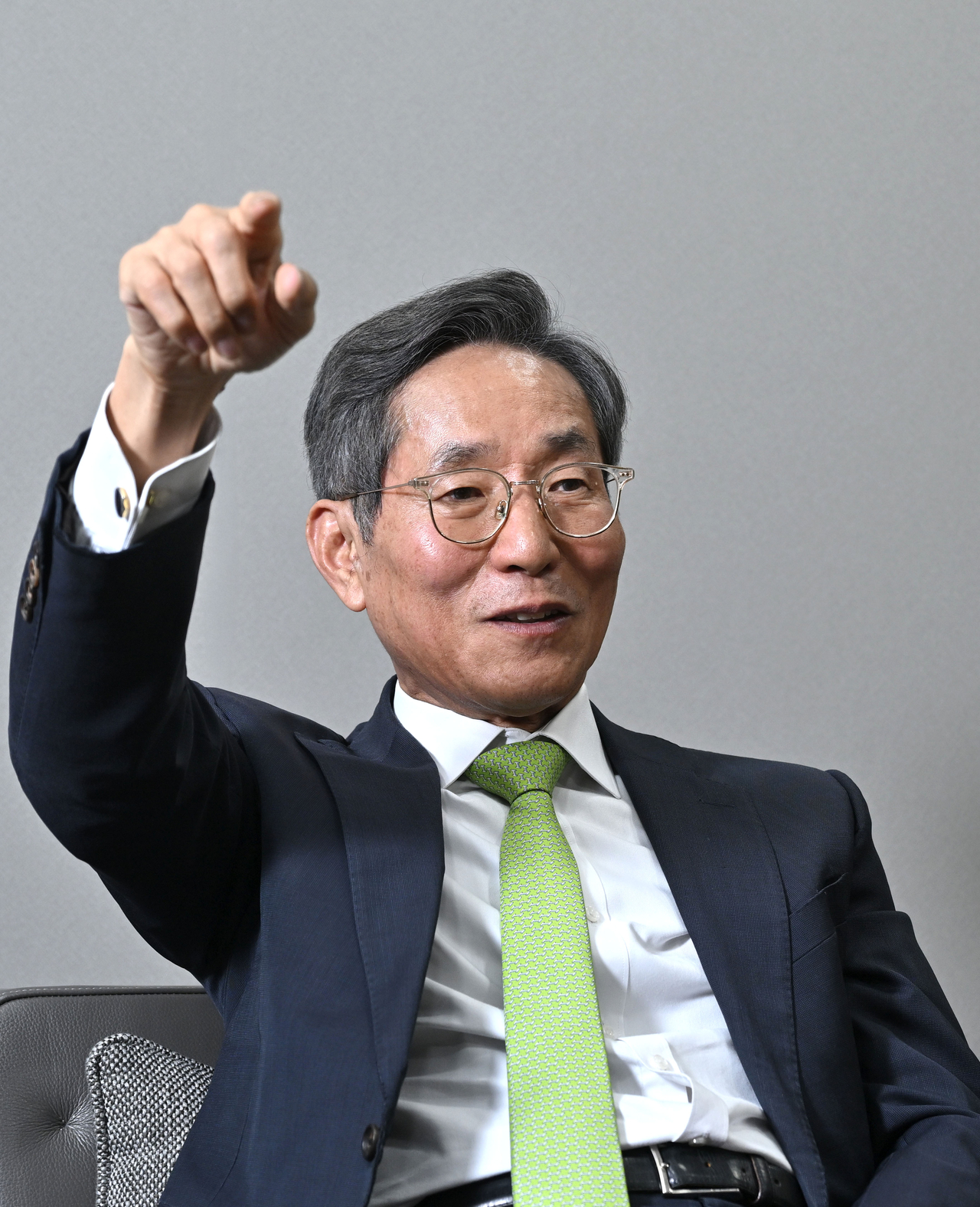
Yoon welcomed the recent stock market rally — with the Kospi approaching the 9,000 mark — but sounded a clear warning against excessive debt-fueled investing.
"Our stock market has been depressed for far too long," he said. "Look at bank stocks: KB Financial is called the leading bank, yet its price-to-book ratio is below 1. That is the reality of the Korean economy and the market's verdict on Korea." The price-to-book ratio measures a company's share price against its net asset value per share.
"I believed that, with some lag, the market would eventually give us a proper valuation," he added. "It is starting to do that now, and I see that positively."
He expressed concern, however, about the surge in debt-fueled investing accompanying the bull market. According to the Korea Financial Investment Association, the balance of margin loans — money borrowed from brokerages to invest — stood at 38.02 trillion won (about $24.9 billion) as of May 29, crossing the 38 trillion won threshold for the first time after rising by nearly 1 trillion won ($654 million) in a single day. The balance eased to around 37.7 trillion won ($24.7 billion) by June 4 but remains elevated.
"Temporarily borrowing to fill a gap in an otherwise sound investment strategy is fine, but relying heavily on debt in the expectation of much higher returns is dangerous," Yoon said. "The world does not move the way you expect — that is what worries me about debt-fueled investing."
He drew a line, however, at the risk of such borrowing becoming a systemic threat. "Loans from brokerages are collateralized, so if things go wrong they are immediately liquidated — the actual risk is not large," he said. "Bank credit lines, the so-called minus-account loans, carry some risk, but banks set limits based on borrowers' circumstances, so the scale is not large enough to create systemic risk, and risk management should be sound."
Yoon also welcomed what he described as a "money move" — a shift of capital away from real estate and into the stock market. "Close to three-quarters of personal assets were concentrated in real estate," he said. "Money flowing from real estate into productive investment and corporate finance is a very welcome development." He predicted that as household loans decline, bank funds will migrate toward corporate finance and overseas investment, and ultimately toward a model of direct customer investment — a shift, in short, from a deposit-and-lending model to an investment model.
He went on to say that Korea's stock market has seen strong activity on the secondary side but not yet on the primary side. "I hope the secondary market's vitality translates into a boom in the primary market — more new capital raising, which in turn drives more corporate investment, creating a virtuous cycle," he added.
Some of the gains from rising share prices are flowing back into real estate. A recent Bank of Korea report estimated that households without homes redirect about 70 percent of their stock capital gains into property. "The money move may have ebbs and flows depending on circumstances," Yoon said. "Ultimately, the problem is that real estate never leaves the minds of the Korean people."
'Finance sector must ask whether it fueled excess real estate demand'
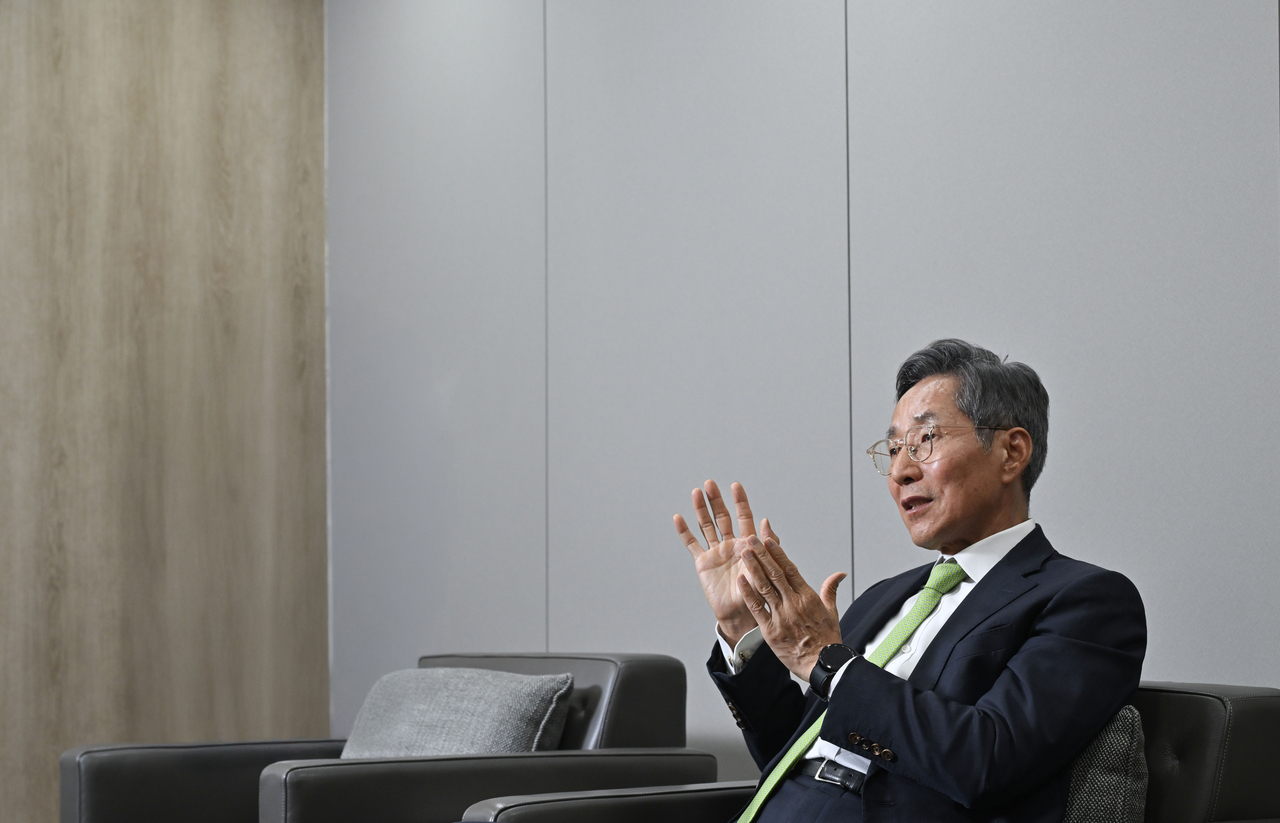
Yoon's voice grew more emphatic when the conversation turned to real estate. "The basic direction of housing policy going forward must be clearly established as something that will survive changes of government," he said. "I hope the ruling and opposition parties can reach a bipartisan consensus on the broad framework for real estate." He added that, given how many social aspirations converge on real estate, a pan-government approach — comprehensive and systematic — was needed, and that fundamental problems must be tackled boldly.
He also reflected critically on the financial sector's past behavior on household lending. "One of the main causes of the real estate problem is excess demand, and the financial sector needs to ask honestly whether it played its proper role," he said. Jeonse deposit loans, he noted, were originally designed to help people of modest means cover their deposits, but in practice they caused jeonse demand to surge, and as "gap investing" became possible, excess demand followed.
He added that loan-to-value ratio and debt-to-income ratio rules were not differentiated based on how many homes a borrower already owned. "People who were not genuine end-users should have been required to buy property with their own capital — it would have been better if banks had not poured fuel on the fire by facilitating that," he said.
He then outlined four priorities, saying the key was to make the best use of market mechanisms while applying policy tools wisely.
The first is expanding supply. "Gangnam real estate is like a luxury good — it is expensive because supply is scarce," Yoon said. "Regulations on reconstruction and redevelopment should be boldly eased where possible to increase supply." He also called for financial support targeted at genuine end-users. "For end-users, the loan-to-value ratio should be raised boldly to 80 percent, while speculative demand from multi-home buyers should be cut off — differentiation is essential," he said.
Yoon also argued that the price ceiling on new apartments was itself fueling excess demand, and proposed replacing it with a bond auction system. Under that system, buyers who purchase a new apartment below the surrounding market price would be required to buy additional bonds on top of the pre-sale price, allowing the government to recapture part of the price gap. "Capping costs through a price ceiling only encourages excessive apartment subscriptions, while removing all regulation simply lets construction companies pocket a windfall," he said. "If someone is willing to pay more to get in, the government can absorb that premium through bonds and use the proceeds for construction funds and public rental housing."
Finally, Yoon raised the need for tax reform. "The lenient taxation of rental income — through exemptions for one-home households and special long-term holding deductions — favors real estate income over wages and business income," he said. "In the AI era, we should be giving more advantages to creative talent, but the tax system is moving in exactly the opposite direction."
He went further, saying broader social change was essential to addressing economic problems including housing. "If I imagine going back to my 20s, deciding to get married requires first having a job, then having hope that you can find a home, and then having confidence about your children's education," he said. "In the end, those three things are the biggest constraints squeezing young people today."
On jobs, Yoon said service industries — tourism, healthcare, education, logistics and finance — would account for a far greater share of employment going forward, and that boosting their competitiveness was critical. On childcare and education costs, he said fully integrating kindergartens and childcare centers into a single free system would ease the burden on young parents. "If the state helps and takes responsibility, young parents will feel a sense of relief," he said.
He also called for an overhaul of the school system. "I question whether we need to keep the 6-3-3 structure," he said. "Our generation learned to read for the first time in elementary school, but today's children arrive already knowing hangul, English and math. We could probably shorten the 12-year system to 10 years — something like 5-3-2."
Universities, he said, must also change. "In the AI era, does a degree earned through rote memorization still mean anything? Universities need to change too," he said. "The government talks about creating 10 universities on par with Seoul National University — but we should go further and consider specializing every national and public university campus so that, together, they function as one Seoul National University."
'Digital assets will develop alongside traditional finance'
On digital assets — now a defining new paradigm for the financial sector — Yoon argued for coexistence with the existing financial system. "Rather than digital assets creating an entirely new financial architecture, I expect them to influence the existing system in ways that expand customer choice and convenience, developing in a mutually complementary way," he said.
He identified the tokenization of real-world assets, known as RWA, as the most important role for digital assets. RWA refers to the process of converting tangible and intangible assets — real estate, bonds, gold, artwork and the like — into digital tokens using blockchain technology.
"RWA breaks large physical assets into small pieces that can be traded in small amounts — security token offerings and fractional investment are the same idea," he said. "It creates liquidity in assets that were previously locked up. That is the greatest contribution digital assets can make."
On the recent convergence between the financial sector and the digital asset industry, he said digital asset companies would continue pushing to expand into financial services while traditional financial firms would keep working to incorporate or replace elements of digital asset technology. He cited the use of blockchain networks for international remittances and efforts to upgrade the existing SWIFT global financial messaging network as prime examples. "Digital asset companies want to do banking, and financial firms want to do digital assets — you could also see it as a turf war, with each side trying to expand its territory," he said.
He acknowledged that digital assets face significant challenges. "The clash between a state's traditional power to tax and borderless blockchain technology is the biggest problem governments around the world are grappling with right now," he said. Governments, he added, are moving to resolve this by exploiting blockchain's inherent transparency, regulating real-world access points such as exchanges, and combining international tax cooperation to preserve the taxing authority and monetary control essential to running a state. In Korea, the requirement that digital asset exchange accounts be linked one-to-one with bank accounts under verified real names is a prime example.
On the won-denominated stablecoin issuance currently being legislated, he advocated a phased approach. A won stablecoin is a digital asset pegged one-to-one to the value of the Korean won, and is generally considered more stable than ordinary digital assets.
"If stablecoin issuance goes wrong, the losses are borne by society as a whole — profits are privatized but losses are socialized," he said. "It may be worth starting by allowing one license to a consortium of traditional financial firms and one to digital asset or platform operators, then expanding further if needed down the road."
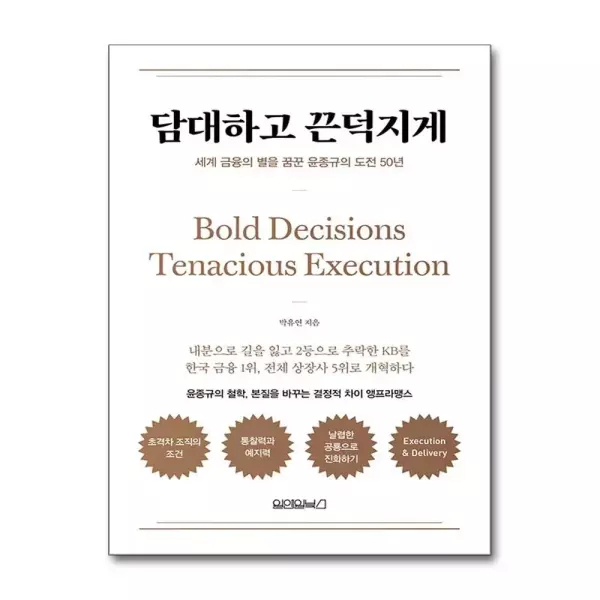
Meanwhile, Yoon recently published a book titled "Bold and Tenacious," in which he recounts the management philosophy behind his turnaround of KB Financial — taking the group from the center of an internal leadership crisis in 2014 to the top of the domestic rankings nine years later. The book reflects his commitment to long-term trust over short-term results.
kimstar@heraldcorp.com
killpass@heraldcorp.com




