Surprise Q3 growth and above-target inflation build case for hike
IMF backs further tightening to contain price pressures
Weak private consumption, vulnerable borrowers pose risks
Next year's growth forecast seen rising sharply from 2.9%
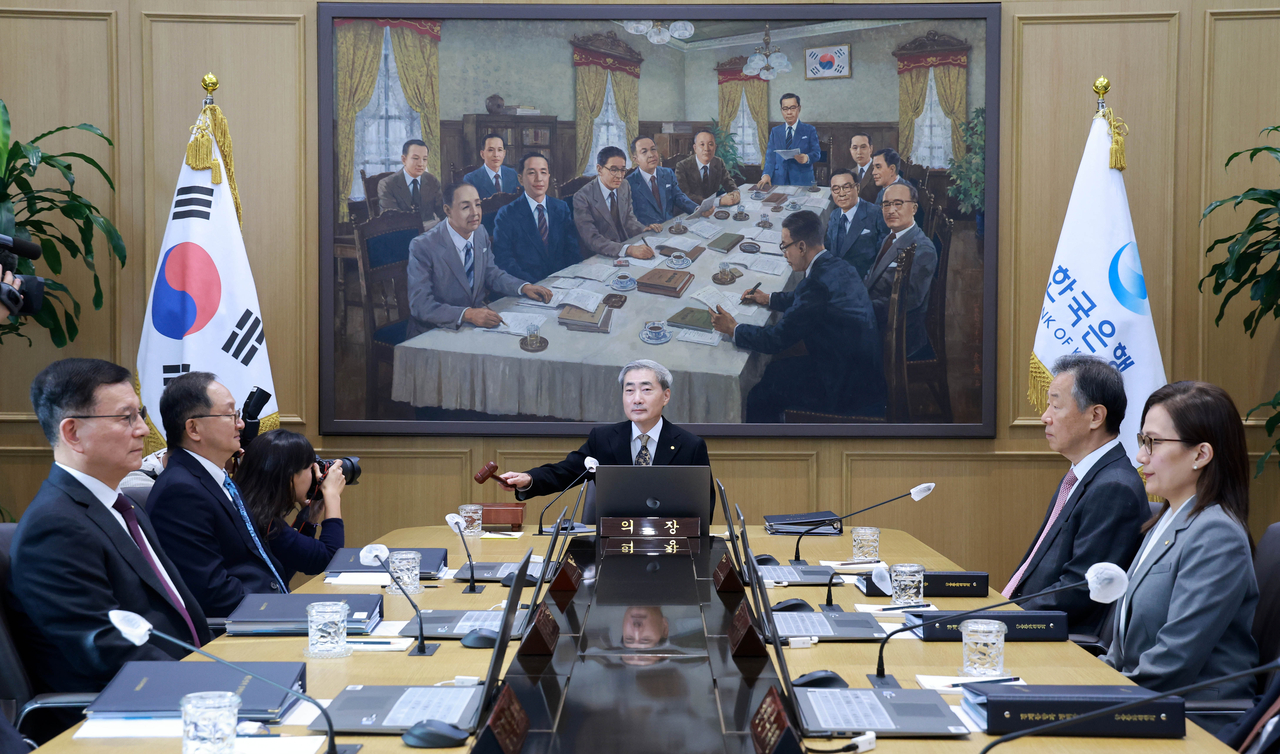
The Bank of Korea will hold its final Monetary Policy Board meeting of the year on Thursday, with markets widely expecting the central bank to raise its benchmark interest rate by 25 basis points. Analysts also anticipate a sharp upward revision to next year's growth forecast in the updated economic outlook the bank will release the same day.
High inflation, strong growth point to bigger forecast upgrade
Citibank Korea said in a recent report that the Bank of Korea would raise its benchmark interest rate to 3.25 percent at Thursday's meeting and follow up with another hike in February. Bloomberg Economics similarly projected the central bank would lift rates to 3.25 percent this month before pushing further to 3.5 percent sometime in the first quarter of next year. The benchmark rate stood at 3.00 percent when the board held it steady last month.
The case for a hike rests on inflation and growth data. Consumer prices rose 2.8 percent in October, exceeding the 2 percent target by 0.8 percentage point. Core inflation, which strips out volatile items, also held at 2.8 percent. Third-quarter real GDP expanded 1 percent quarter-on-quarter, more than three times the Bank of Korea's own forecast of 0.3 percent. Governor Shin Hyun-song said at last month's press briefing that the board would decide on further tightening after reviewing third-quarter GDP and October inflation data — both indicators have since come in on the side of a hike.
Other data reinforce the picture of robust momentum. The current account surplus for January through September reached $340.66 billion, 2.8 times the full-year figure recorded last year, and South Korea became the fourth country in the world to join the "1 trillion dollar exports" club.
The IMF has also backed further tightening. In its 2026 Article IV consultation findings on South Korea, the fund raised its growth forecasts for this year and next to 3.9 percent and 3.3 percent respectively, and said "additional monetary tightening is appropriate to prevent the entrenchment of inflationary pressures."
The board will also release updated economic projections at Thursday's meeting. In August, the Bank of Korea set its growth forecasts at 3.3 percent for this year and 2.9 percent for next year. Markets expect both figures to be revised upward.
The upgrade to next year's forecast is expected to be particularly large, driven by a chain-weighting effect from surging semiconductor prices. The Bank of Korea calculates real GDP using the previous year's prices as weights. Because semiconductor prices have jumped sharply this year, semiconductors now carry a greater weight in next year's growth calculation, amplifying the upside impact of the sector's strong performance.
The Korea Development Institute (KDI) raised its own forecast for next year's growth by 1.7 percentage points — from 2.2 percent to 3.9 percent — for the same reason. According to KDI, the share of computer, electronics and optical equipment manufacturing, including semiconductors, in nominal GDP surged from the 7 to 9 percent range to 20.7 percent in the first half of this year.
Concerns over vulnerable borrowers persist; some board members urge caution
Concerns about the side effects of a rate hike remain significant, however. Higher borrowing costs could weigh heavily on financially vulnerable borrowers, and if income gains concentrated in the semiconductor sector fail to translate into broader private consumption, the drawbacks of tightening could outweigh the benefits.
Private consumption actually contracted in the third quarter for the first time in three years and nine months, even as the overall economy posted stronger-than-expected growth. There are persistent concerns that income gains — including semiconductor-sector bonuses — are flowing into real estate and other assets rather than consumption. Turbulence in equity markets has further dampened consumer sentiment.
Cautious voices have also been heard within the Monetary Policy Board itself. Minutes from last month's meeting show all seven board members voted to hold rates steady, but two of the six members excluding the governor expressed reservations about further tightening. One member said the board had reached "a point where it must seek an appropriate balance between the need for additional monetary tightening and consideration for sectors left behind by the economic boom." Another said that while "the real economy is showing unprecedented growth, the benefits are concentrated in certain sectors," adding that delinquency rates among vulnerable borrowers "remain at a very high level."
Given those concerns, analysts say that even if the board raises rates on Thursday, multiple dissenting votes in favor of a hold are possible.
Attention is also focused on the dot plot to be released at the meeting, which shows where each of the seven board members — including the governor — expects rates to stand six months out. Each member submits three dots, for a total of 21.
In the August dot plot, 10 of the 21 dots, or 47.6 percent, were placed at 3.25 percent, above the then-current rate of 3 percent. Six dots, or 28.6 percent, were at 3.5 percent, and five, or 23.8 percent, were at 3 percent. The high was 3.5 percent and the low was 3 percent, with a median of 3.25 percent and a mean of 3.26 percent. Some in the market expect the median to rise to 3.5 percent in the new dot plot.
kimstar@heraldcorp.com