Ministry of Interior and Safety unveils 2027 ordinary local allocation tax reform plan; disaster safety investment and clean water access demands extended
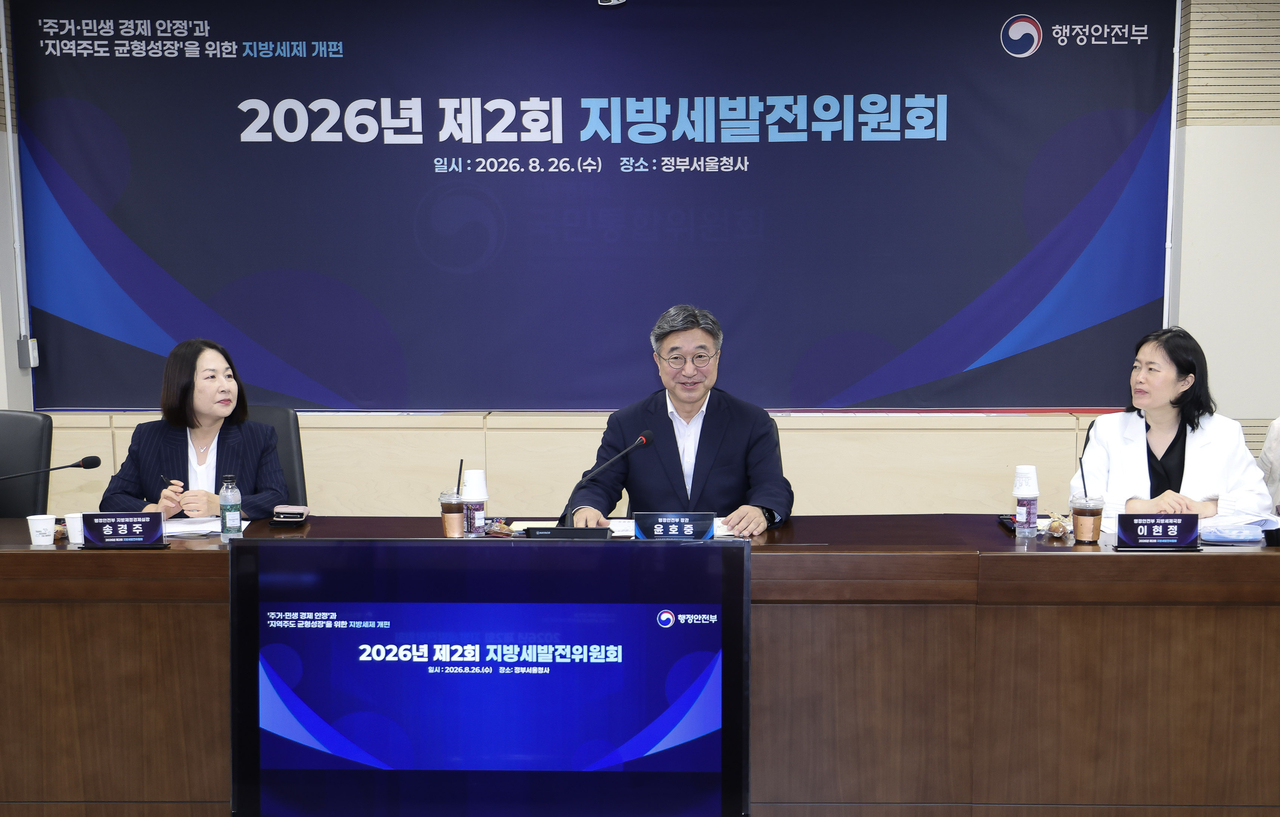
South Korea's central government will fully reflect the labor costs of local tax delinquency management units in the ordinary local allocation tax formula and tighten penalties on unspent or carried-over local budgets, as part of a broader push to strengthen local fiscal health.
The Ministry of Interior and Safety announced the "2027 Ordinary Local Allocation Tax Improvement Plan" on Friday, following approval by the Local Allocation Tax Committee.
The ordinary local allocation tax is designed to ensure that residents across the country receive a standard level of administrative services, compensating local governments that cannot cover their expenditures through local tax revenue alone. It also addresses the concentration of tax bases and corrects fiscal imbalances between regions.
Under the new plan, the calculation framework for supporting the functions of metropolitan local governments will be restructured.
Integrated special cities established in 2026 will be assigned a new local government category for calculating basic demand under the ordinary local allocation tax formula, with unit costs computed separately. However, because the budget figures used as the basis for the 2027 allocation — those from the preceding year — were drawn up before integration, the ministry plans to calculate amounts for each pre-merger local government individually and combine them for disbursement to the integrated special city.
For special autonomous cities, the basic demand calculation method will be upgraded to a level comparable to that used for metropolitan cities, so that the single-tier administrative structure — which has no basic-level local government beneath it — and the functions of the administrative-centered complex city are more fully reflected in the formula.
To promote fiscal sustainability through sound financial management, the plan creates a new demand category covering 100 percent of the labor costs of local tax delinquency management unit investigators hired by local governments, supporting the stable operation of units that contribute to tax equity and productive job creation.
The penalty rate applied to unspent or carried-over budget amounts will be raised by 20 percentage points from the current level, encouraging local governments to execute their budgets fully within the fiscal year. The plan also adjusts the formula to impose penalties when personnel expenditure settlements exceed the standard personnel cost plus the autonomous range, reflecting the reintroduction of the autonomous range within the standard personnel cost benchmark in 2027.
To bolster public safety and quality of life, the sunset provisions for two demand categories will be extended by three years beyond their scheduled expiration this year. The two categories are one encouraging ongoing disaster safety investment by local governments, and another ensuring traffic safety for vulnerable groups such as children, the elderly and people with disabilities in designated protection zones.
Alongside this, the calculation for the "village water supply" demand category — which supports clean water access for residents in areas where connection to the general water supply network is difficult — will be expanded to include the number of people served by small-scale water supply facilities jointly installed and managed by village residents.
A proposed amendment to the enforcement regulations of the Local Allocation Tax Act reflecting the plan announced Friday will be put out for public comment by mid-December. Once promulgated, the amendment will be applied to the 2027 ordinary local allocation tax calculation and take effect nationwide.
"Based on this reform plan, I hope the local allocation tax — funded by the precious taxes paid by the public — will be calculated in a more rational and transparent manner, and that each local government will be able to invest efficiently where it is truly needed," Minister of Interior and Safety Yun Ho-jung said. "The ministry will continue to operate the local allocation tax so that it serves as a solid foundation for improving people's livelihoods and driving a major shift toward locally led growth."
thlee@heraldcorp.com