Songdo research capacity, Namdong industrial base and Ganghwa-Ongjin marine resources to be integrated
Seaweed food, cosmetics and pharmaceutical materials targeted for high-value commercialization
Partnerships with FAO, GGGI and other international bodies; tidal flat blue carbon research to begin in earnest
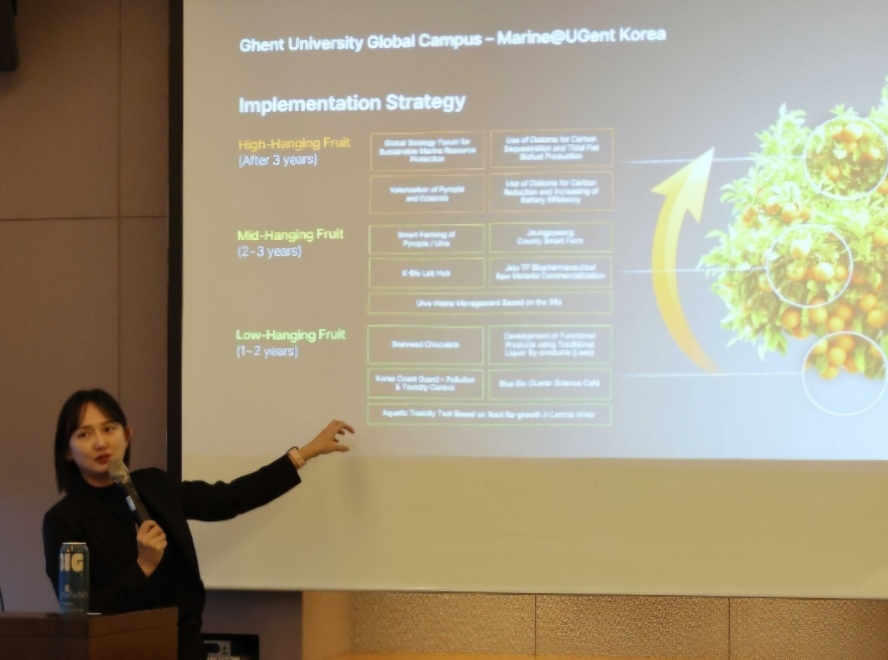
A global research and development project aimed at transforming Incheon's tidal flats and marine biological resources into a future growth industry is getting underway.
The initiative seeks to build a new industrial ecosystem through marine biotech material development and product commercialization while preserving the ecological value of the marine environment.
Marine@UGent Korea (MUK), the marine convergence research hub of Belgium's Ghent University, held a Media & Partners Day on Thursday to announce its strategy for developing a global blue economy centered on Incheon and its business direction for 2027.
The core of the plan is to integrate Incheon's marine resources, research and development capabilities, and manufacturing base into a single chain connecting marine biotech from research through demonstration to commercialization.
To that end, MUK will build an open collaborative framework linking Songdo's research and development infrastructure, the manufacturing and commercialization capacity of the Namdong National Industrial Complex, and the tidal flat and coastal marine resources of Ganghwa and Ongjin.
A "marine biotech and environment living lab" — in which universities, research institutions, companies, local governments and residents participate from the earliest stages of research to identify on-site challenges and carry projects through to technology validation and product development — will serve as the centerpiece.
Particularly notable is the push to commercialize high-value products derived from marine biological resources.
MUK plans to expand its research and development scope across a range of fields, including seaweed beer "BIG," marine organism-derived food and beverages, functional cosmetics, pharmaceutical material candidates and eco-friendly textiles.
Sustaining the marine biotech industry will also require resource-circulation technology. MUK's strategy is to maximize the added value of marine resources through biorefinery techniques — extracting useful compounds from seaweed and other organisms and repurposing the remaining byproducts as new materials such as biochar and activated carbon. The organization also plans to develop specialized products using Incheon's local marine resources, including dried laver produced on Jangbongdo Island.
MUK plans to conduct joint research with local companies and expand industry participation by connecting that work through performance and safety verification, prototype production and commercialization.
The organization will also look beyond domestic commercialization, partnering with international bodies to address global environmental and climate challenges. MUK plans to work with the Food and Agriculture Organization of the United Nations (FAO), the Global Green Growth Institute (GGGI) and the East Asian-Australasian Flyway Partnership (EAAFP) to extend marine biotech into food security, carbon reduction and biodiversity conservation.
With the FAO, MUK will explore the development of food and nutritional resources using seaweed and microalgae, along with low-carbon production technologies. With the GGGI, it will identify projects for restoring tidal flat and coastal ecosystems and pursuing nature-based carbon reduction.
Collaboration with the EAAFP will focus on conserving migratory bird habitats including tidal flats, conducting biodiversity investigations and carrying out long-term environmental monitoring.
MUK also plans to pursue seaweed and microalgae-based carbon reduction and marine biotech commercialization projects in Indonesia, Chile and Ecuador in partnership with international cooperation agencies.
Research to scientifically verify the ecological value of Incheon's tidal flats and connect those findings to international environmental standards will also begin in earnest. MUK plans to analyze the carbon fixation processes of microalgae — including diatoms — inhabiting the West Sea tidal flats, as well as the mechanisms governing carbon movement, re-emission, burial and long-term storage, with the goal of developing a reliable blue carbon measurement, reporting and verification (MRV) system.
MUK will also advance ecotoxicity and environmental impact assessment technologies using aquatic organisms and microalgae, and link that work to domestic KS and international ISO standardization activities.
The organization is also pursuing greater participation in Horizon Europe, the EU's multinational research and development program.
MUK plans to connect universities, research institutions and companies in Belgium and across Europe, as well as in the United States, Canada, the Asia-Pacific region and Latin America, to organize international joint research consortia in marine biotech, sustainable aquaculture, eco-friendly new materials and carbon reduction.
A primary long-term goal is for MUK to serve as the lead coordinating body for international research projects, subject to eligibility requirements and selection outcomes for competitive programs.
MUK opened in Songdo, Incheon, in 2024, established with support from the Ministry of Trade, Industry and Resources, Incheon city and the Incheon Free Economic Zone Authority, and drawing on the research capabilities of Ghent University in Belgium.
MUK has designated 2027 as the year to apply its research results in the field and lay the groundwork for commercialization, with a concentrated push on domestic industry-academia-research joint studies, corporate co-development, international organization-linked projects, tidal flat blue carbon research and international standardization activities.
"The blue economy is not simply about industrial growth through the use of marine resources — it is about returning sustainable value to local communities while preserving tidal flats and biodiversity," said Park Ji-hye, director of Marine@UGent Korea. "We will connect scientific discoveries made in the laboratory to field demonstration, product development, international standards and policy, and create global results from Incheon."
gilbert@heraldcorp.com