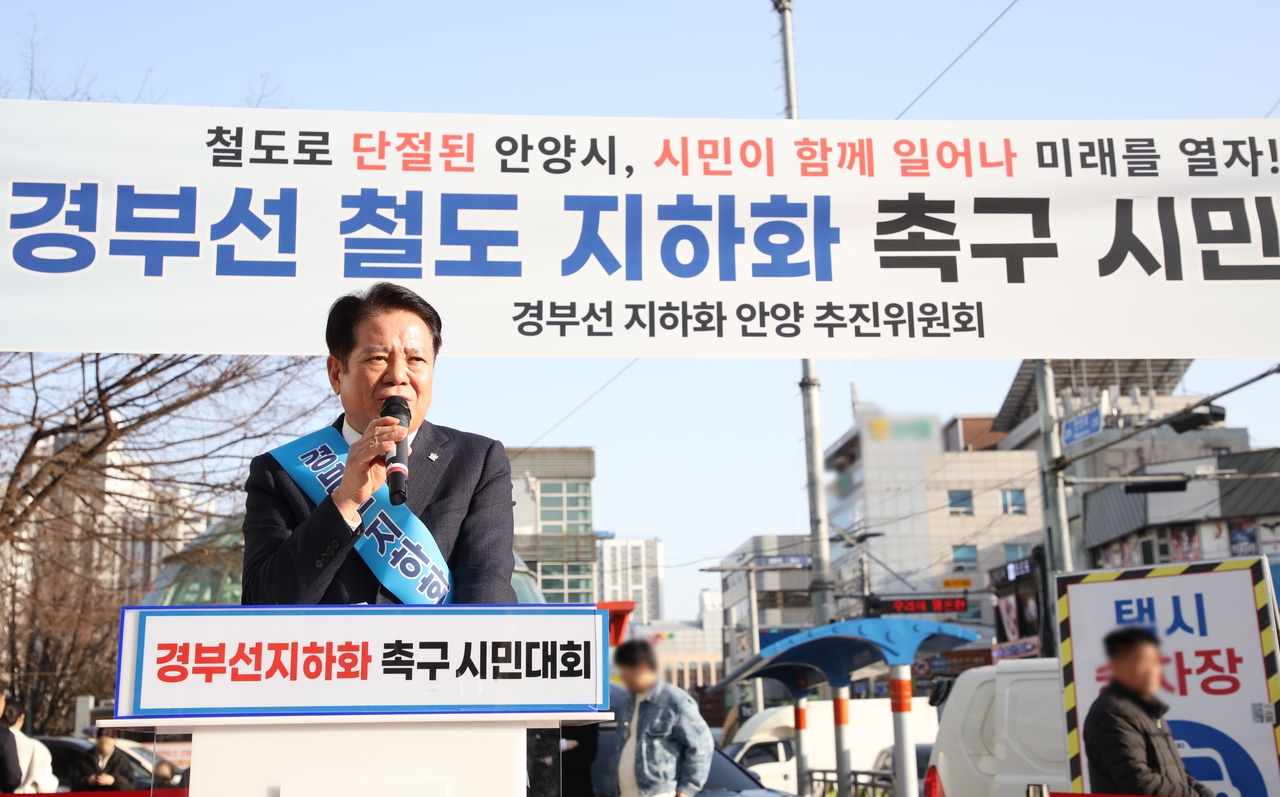
Anyang Mayor Choi Dae-ho posted a message on his social media Thursday announcing that the underground routing of the Gyeongbu Line railway through Anyang had been confirmed, writing: "Gyeongbu Line underground routing confirmed — a new chapter in Anyang's history begins."
"The underground routing of the Gyeongbu Line, a long-held dream for Anyang, has finally been confirmed," Choi said. "A 7.5-kilometer stretch of track — from Seoksu Station through Anyang Station to Myeonghak Station — will go underground. Since we first proposed this in 2010, the first local government in the country to do so, and after the special act passed on Jan. 9, 2024, that dream has at last come to fruition."
"It is particularly meaningful that Anyang's integrated development approach — securing project viability by developing areas adjacent to the railway site together — has been reflected in the plan," Choi added. "We will now move step by step to put in place specific financing and development plans."
Choi went on to say the city would reconnect neighborhoods divided by the railway and create new public spaces above the tracks, including green areas, sports facilities and a mixed-use cultural complex for youth. "This is just the beginning. Together with our residents, we will redraw the map of Anyang," he added.
The city said Thursday that its Gyeongbu Line underground rail and surface development project had been included as a new conditional project in the Ministry of Land, Infrastructure and Transport's comprehensive plan for integrated underground rail development.
The ministry held a public hearing on the comprehensive plan that day at the Korea Research Institute for Human Settlements auditorium in Sejong, under the theme "New Growth Through Railway Site Utilization," to gather input from local governments, the public, academics and industry.
The hearing covered the plan's key contents, project-by-project review findings and the direction for future implementation.
Anyang's inclusion in the plan came with conditions, including coordination with neighboring local governments on sections near administrative boundaries and advance consultation on cultural heritage management zones.
The city said it would work closely with the ministry and relevant agencies to fulfill those conditions and complete the follow-up procedures, including supplementing the project plan.
The project calls for placing approximately 7.5 kilometers of track underground from Seoksu Station to Myeonghak Station and developing the surface above with wide green corridors and residential, commercial, office and cultural facilities.
The city said the project would reconnect urban areas severed by the railway and promote balanced development between Manan-gu and Dongan-gu.
Anyang first proposed the underground routing in 2010, during its fifth elected administration, making it the first local government in the country to do so. Over the following 16 years, the city commissioned a preliminary design study in 2012, held a final briefing in 2014, submitted a feasibility report to the ministry in 2016, and coordinated with six other local governments in the Seoul and Gyeonggi Province area in a joint push for the project.
A legal foundation was established when the Special Act on Railway Underground Routing and Integrated Development of Railway Sites was enacted in January 2024, but the city was left off the ministry's list of pilot project sites in February last year.
In response, the city resubmitted a revised proposal strengthening the project's feasibility and economic case, pressing for inclusion in the comprehensive plan.
fob140@heraldcorp.com